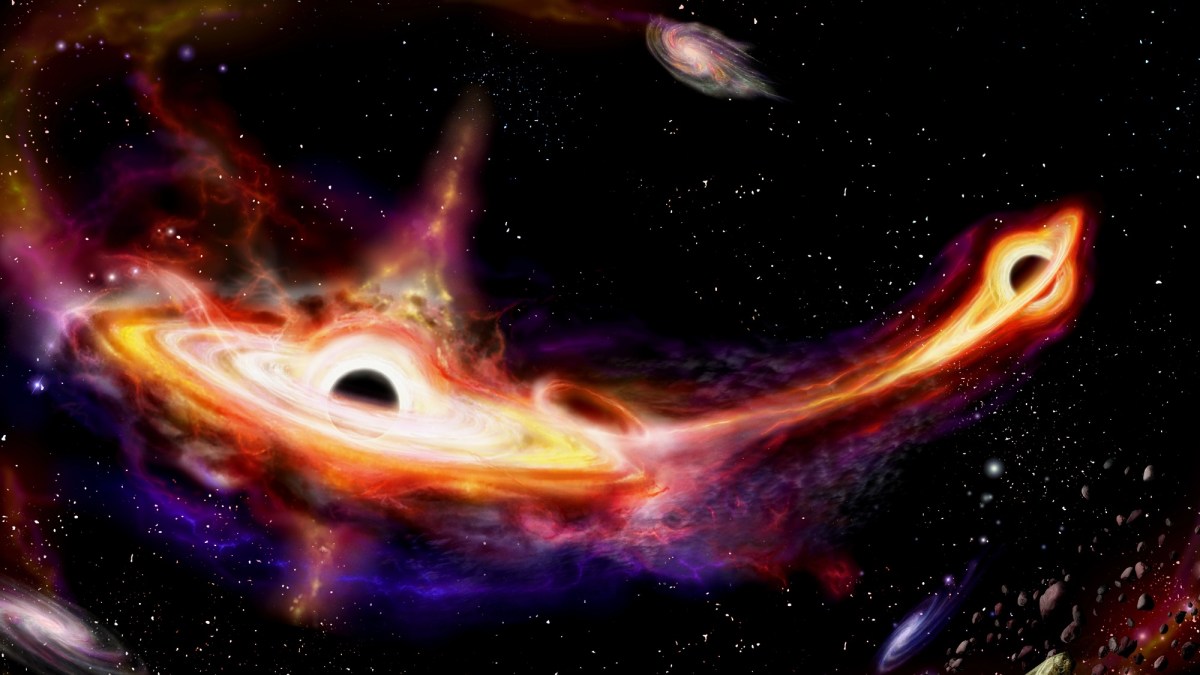
Artistic depiction of two supermassive black holes orbiting in the center of a distant galaxy
At the center of galaxy Markarian 501, located in the constellation Hercules, two supermassive black holes have been discovered that are rapidly approaching each other. The distance between them is negligible by cosmic standards, and their merger could occur within the next hundred years. For the first time in the history of astronomy, scientists are observing a pair of such giants at the final stage before collision, and this event could answer the fundamental question of how the most massive objects in the Universe come into existence.
What Are Supermassive Black Holes
In almost every large galaxy, including our Milky Way, a supermassive black hole lurks at the center. The mass of such objects ranges from millions to billions of solar masses. But here’s the paradox: to accumulate that much matter through conventional means — absorbing surrounding gas — the entire age of the Universe wouldn’t be enough. The math simply doesn’t add up.
The most likely explanation is that supermassive black holes grow when two smaller black holes crash into each other during galaxy collisions. Galaxy collisions in the Universe are a common occurrence, and it’s logical to assume that the black holes at their centers eventually meet as well. But until now, this was merely a hypothesis: no one had been able to reliably detect a close pair of supermassive black holes at the stage of convergence. That changed thanks to a team from the Max Planck Institute for Radio Astronomy in Bonn.
What Is a Galaxy Jet
Galaxy Markarian 501 is an elliptical galaxy located more than 440 million light-years from Earth. It belongs to blazars — a special type of active galaxy whose black hole ejects a powerful jet (a stream of charged particles accelerated to nearly the speed of light) directly toward Earth. That is why the jet of Markarian 501 is clearly visible and has been studied for a long time.
An international team led by Silke Britzen analyzed radio observations of this galaxy accumulated over 23 years at various frequencies. And in this data, the researchers saw something unexpected: the galaxy’s core contains not one jet, but two. The second jet is oriented differently from the first, which made it harder to detect. But over several weeks of observations, the scientists tracked how it moves in an arc counterclockwise around the first one.
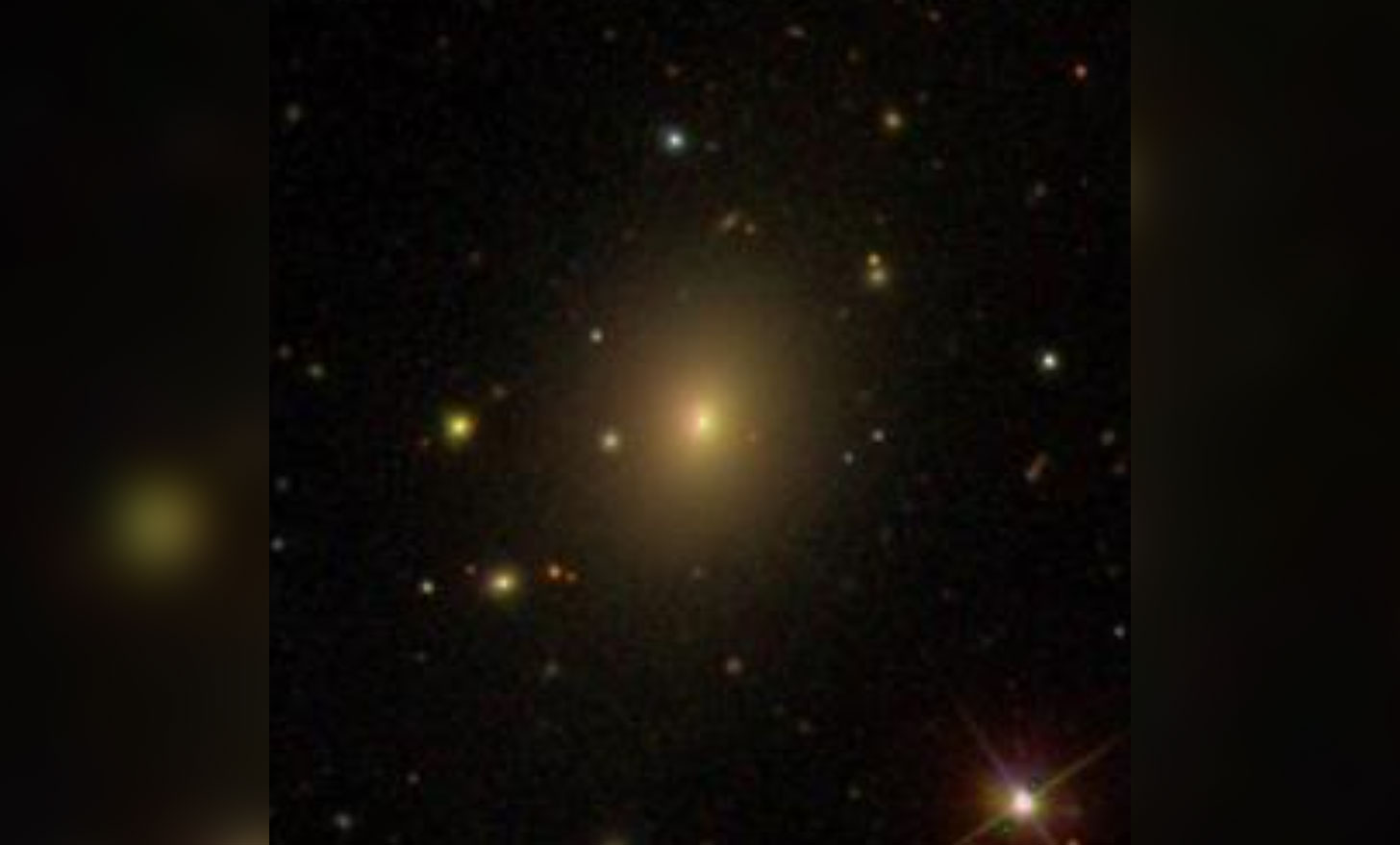
Galaxy Markarian 501. Image source: wikipedia.org
Two jets mean two “engines.” And in this case, the engines are two separate supermassive black holes. The results were published in the journal Monthly Notices of the Royal Astronomical Society.
Einstein Ring in Astronomy
One of the most convincing pieces of evidence came from an observation in June 2022. At a certain moment, the radiation from the second jet was distorted to such an extent that it took on an almost ring-shaped form. This phenomenon is known as an Einstein ring — an effect predicted by the general theory of relativity.
How does it work? Imagine that between you and a distant lantern there is a massive glass sphere. Its gravity bends the lantern’s light so that instead of a point, you see a ring. According to the researchers, this is exactly what happened in galaxy Markarian 501: the first black hole acted as a “lens” and bent the light from the jet of the second black hole located behind it. This is only possible when the two objects are nearly perfectly aligned with the observer on Earth.
This observation became an important argument in favor of the idea that we are indeed dealing with two black holes, rather than some other explanation for the dual jet structure.
When Will the Black Hole Collision Occur
Analysis of repeating brightness cycles allowed scientists to estimate the orbital period of the pair — approximately 121 days. The distance between the black holes ranges from 250 to 540 astronomical units (one AU is the distance from Earth to the Sun). For cosmic objects with masses ranging from 100 million to a billion solar masses, this is incredibly close.
So close that the merger could occur within the next century. However, seeing the actual final moment is unlikely, because at a distance of over 440 million light-years, even the most powerful telescopes, including the Event Horizon Telescope (the one that took the first photo of a black hole), cannot resolve the two objects separately. And as they draw closer together, it will become even harder.
But science has another tool. When the black holes enter the final stage and begin converging more intensely, they will emit ultra-low-frequency gravitational waves. These can be detected using pulsar timing arrays — networks of pulsars whose signals reach Earth with nanosecond precision. The slightest distortion of these signals could indicate the passage of a gravitational wave.
In 2023, the European Pulsar Timing Array and other collaborations already detected a background “hum” of gravitational waves, presumably created by mergers of supermassive black holes throughout the Universe. Markarian 501 is now the leading candidate for linking a specific gravitational wave signal to a specific pair.
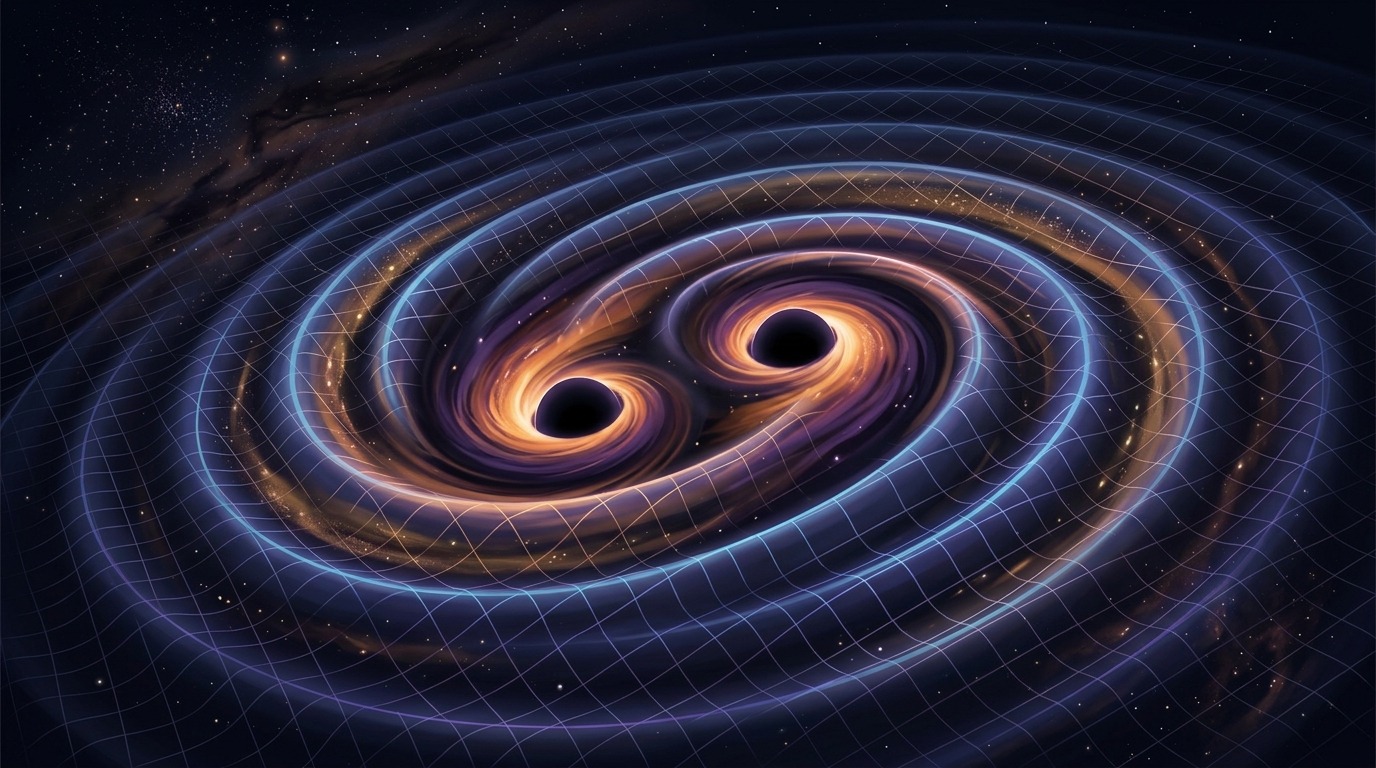
Diagram of two black holes approaching each other and generating gravitational waves
Why Pairs of Supermassive Black Holes Are Hard to Find
It might seem strange: if galaxy collisions are commonplace, why haven’t we found close pairs of black holes until now? This is where the so-called final parsec problem comes into play. A parsec is approximately 3.26 light-years.
The essence of the problem is as follows. When two galaxies collide, their black holes gradually converge, losing energy through interactions with surrounding stars and gas. But when the distance between them shrinks to a few parsecs, the stars and gas around them run out — there is nothing left to eject or absorb, meaning nothing to slow the orbit. In theoretical models, the black holes “get stuck” at this distance and orbit each other for longer than the Universe has existed.
If the pair in galaxy Markarian 501 is indeed at a distance of less than 0.003 parsecs from each other, it means the black holes somehow overcame this barrier. Their very existence on such a tight orbit indicates that nature has found a mechanism that models cannot yet fully reproduce. Among the proposed solutions are interactions with dark matter, accretion disks, and the influence of a third black hole, but science has not yet provided a definitive answer.
Collision of the Milky Way and Andromeda Galaxies
Since we’re talking about galaxy collisions, it’s logical to recall the closest example to us: in 4–5 billion years, the Milky Way will collide with the Andromeda galaxy. Both galaxies contain supermassive black holes at their centers. According to current understanding, after the collision they too will begin to converge and may ultimately merge.
But there’s no need to panic, because even during a galaxy collision, the distances between individual stars are so vast that direct stellar collisions are virtually impossible. The Solar System will most likely simply end up on a new orbit within the merged galaxy. The black holes at the centers, however, will indeed find each other. The discovery in Markarian 501 shows what the final act of such a process might look like: two giants on a tight orbit, emitting jets and generating gravitational waves.
What is happening in galaxy Markarian 501 right now is possibly a preview of the distant future of our own galaxy.
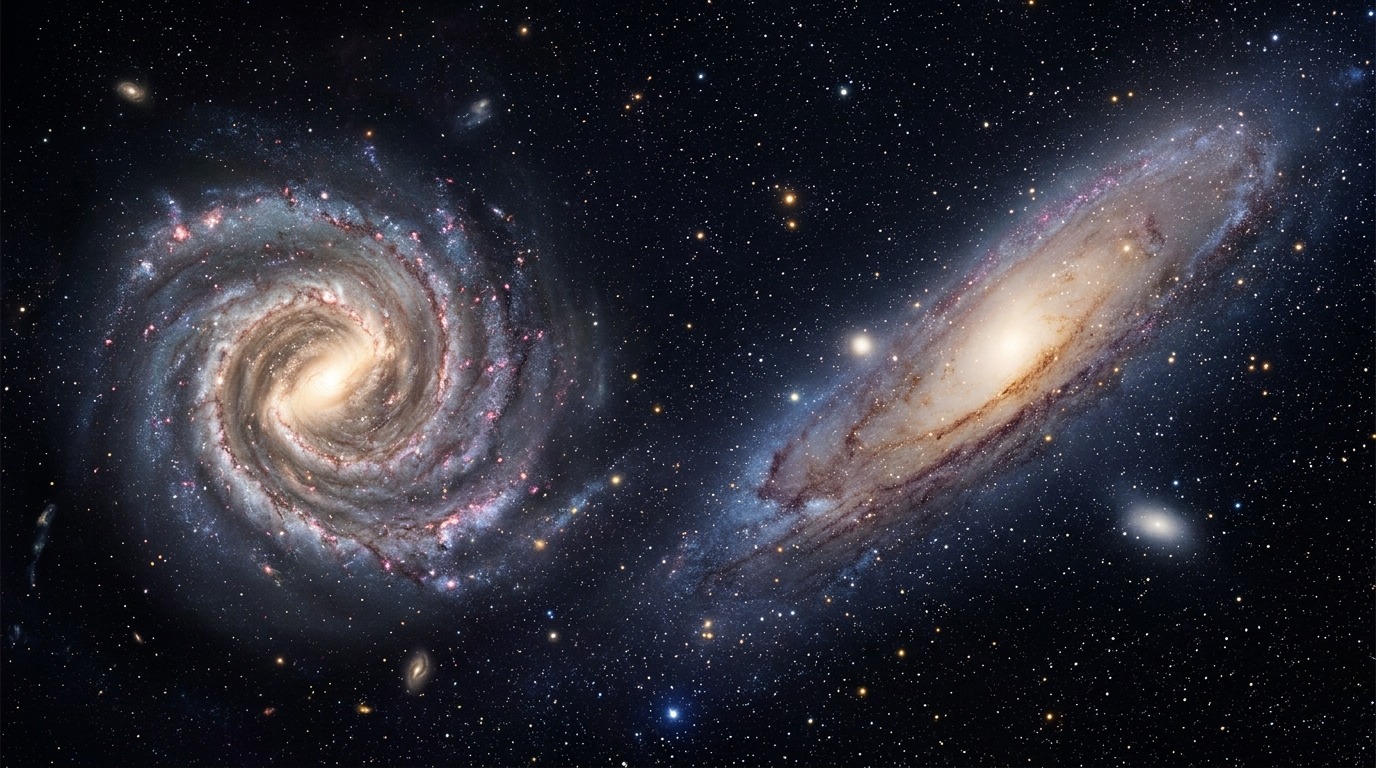
In billions of years, the Milky Way and Andromeda will collide — their black holes may also face a merger
How Scientists Changed Their View of the Universe
The result obtained by the team of scientists is important for several reasons at once:
- This is the first direct observation of a dual jet system in a galaxy’s core, and accordingly the first strong evidence of a close pair of supermassive black holes on the verge of merging.