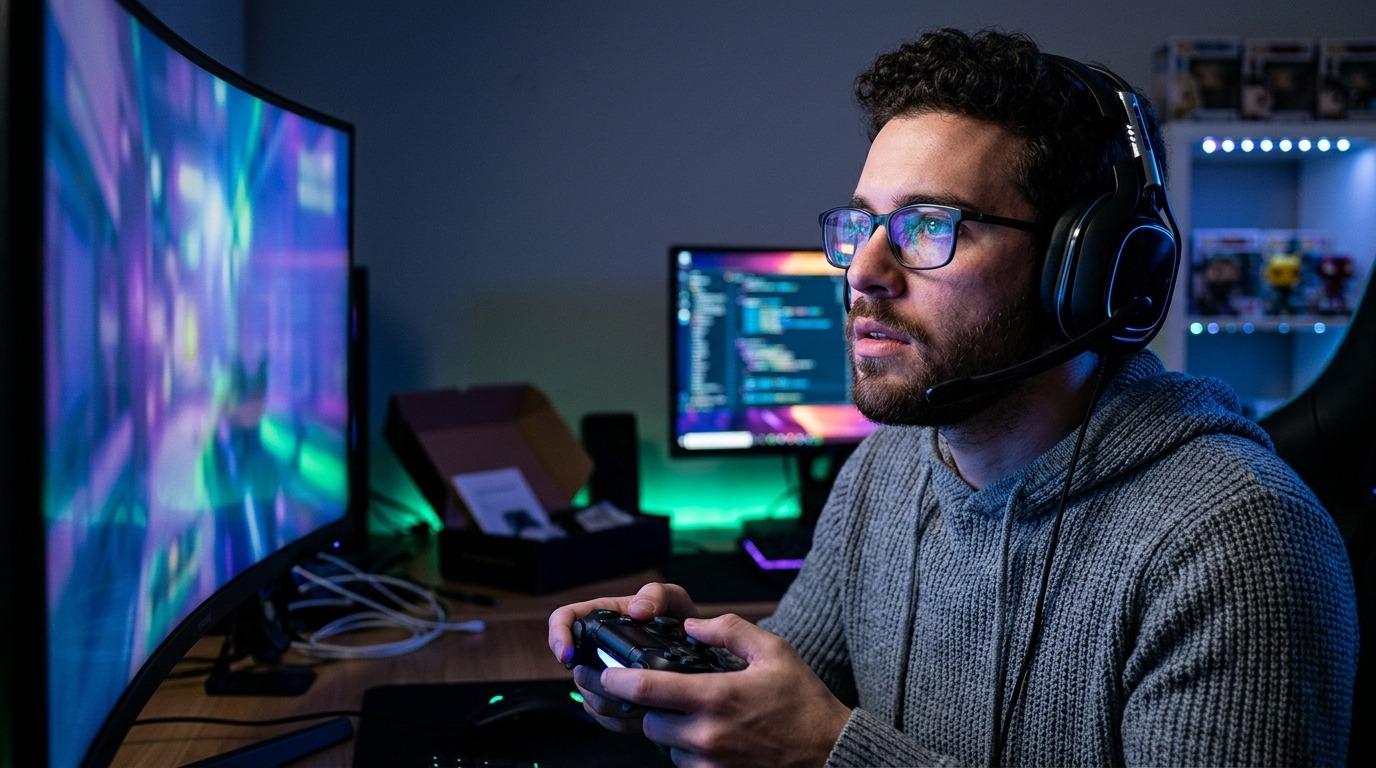
Time flies especially fast when we play computer games
The human brain is not equipped with a precise stopwatch — instead, it constructs its own subjective sense of time. When we are engaged or enjoying ourselves, the brain releases dopamine and directs all resources toward processing new information, pushing time tracking to the background. This is exactly why hours at a great party fly by like minutes, while boring waiting in a queue drags on endlessly.
Why time drags during waiting
To measure the passage of time, our brain relies on cognitive processes that directly depend on attention and memory. We don’t have a perfect internal mechanism that counts seconds. Our perception of time is more of an estimate of how much information we are currently processing and how focused we are on it.
When we are bored or engaged in monotonous work, the brain isn’t loaded with interesting information. Because of this, it constantly starts “checking the clock” — verifying how many minutes have passed. This continuous tracking makes us overly aware of time, creating the agonizing sensation that it is barely crawling.
The brain measures time not by seconds, but by the amount of information processed and emotions experienced.
But everything changes when we immerse ourselves in an interesting task. Our brain is physically incapable of processing all the information around us equally effectively, so it activates selective attention. The mind focuses on a specific activity, and such a parameter as “the passage of time” is simply deemed unimportant and sent to background processing. As a result, we discover that several hours have already passed, even though by our internal sense it felt like no more than fifteen minutes.
Why happy people don’t notice time
The secret to time acceleration lies in our biochemistry. When we experience positive emotions — joy, anticipation, delight from socializing with pleasant people — a powerful surge of dopamine occurs in the brain. This substance not only brings pleasure but literally distorts our perception of reality.
Under the influence of dopamine, the brain is so busy enjoying the moment that it loses the ability to accurately measure the chronology of events. The stronger your emotions, the more intense this effect: truly great and happy moments always race by at tremendous speed.
Albert Einstein once very precisely and humorously described this phenomenon while explaining his theory of relativity:
Sit next to a beautiful girl for a minute, and it will seem like a second. Sit on a hot stove for a second, and it will seem like a minute. That’s relativity!
Why time passes unnoticed in a state of flow
When an activity particularly stimulates us by presenting new challenges and impressions, the brain begins processing enormous amounts of data simultaneously. This triggers the so-called state of flow — a period of intense yet very enjoyable concentration.
Research shows that people in a state of flow unanimously report distorted time perception. Most often, this effect is triggered by the following things:
- Interesting work or creative tasks that require full commitment and skill;
- New, unexpected events and hobbies that activate our curiosity;
- Interaction with screens: video games, movies, or social media.
In the case of gadgets, the effect is especially strong. Captivating and entertaining content is designed to hold attention continuously. The brain loves such situations because they constantly provide it with new material to process. As a result, we become so distracted from the passage of time that we can spend half the night in front of a monitor without noticing it.

Enjoyable pastimes switch off attention to the real world, making hours fly by unnoticed
Why time seems to fly faster as we age
Although there are always 24 hours in a day, our perception of that span changes as we grow older. In childhood, every day brought something new: a first bicycle ride, new game rules, unfamiliar places. The brain actively encoded these unique memories, and because of their abundance, childhood seems so long to us.
As we age, more routine enters our lives. We commute to work along the same route, perform familiar tasks, and socialize with the same circle of people. The decrease in new experiences leads the brain to form fewer vivid, distinctive memories.
Memory plays a paradoxical role: the more emotionally rich an event is, the faster it flies by in the moment, but the longer and more significant it seems when we look back. Without new experiences, the brain “merges” similar days into one brief instant, creating the unsettling sensation that years are flying by at the speed of light.