Surprisingly, sometimes the speed of light becomes lower
They say the speed of light is the Universe’s “ceiling” — nothing can accelerate beyond it. But if you dig a little deeper, it turns out that some things can indeed break through this barrier, albeit with one important caveat. They aren’t “things” in the usual sense. Let’s figure out what’s behind this paradox and why physicists see no contradiction in it.
What Is the Speed of Light
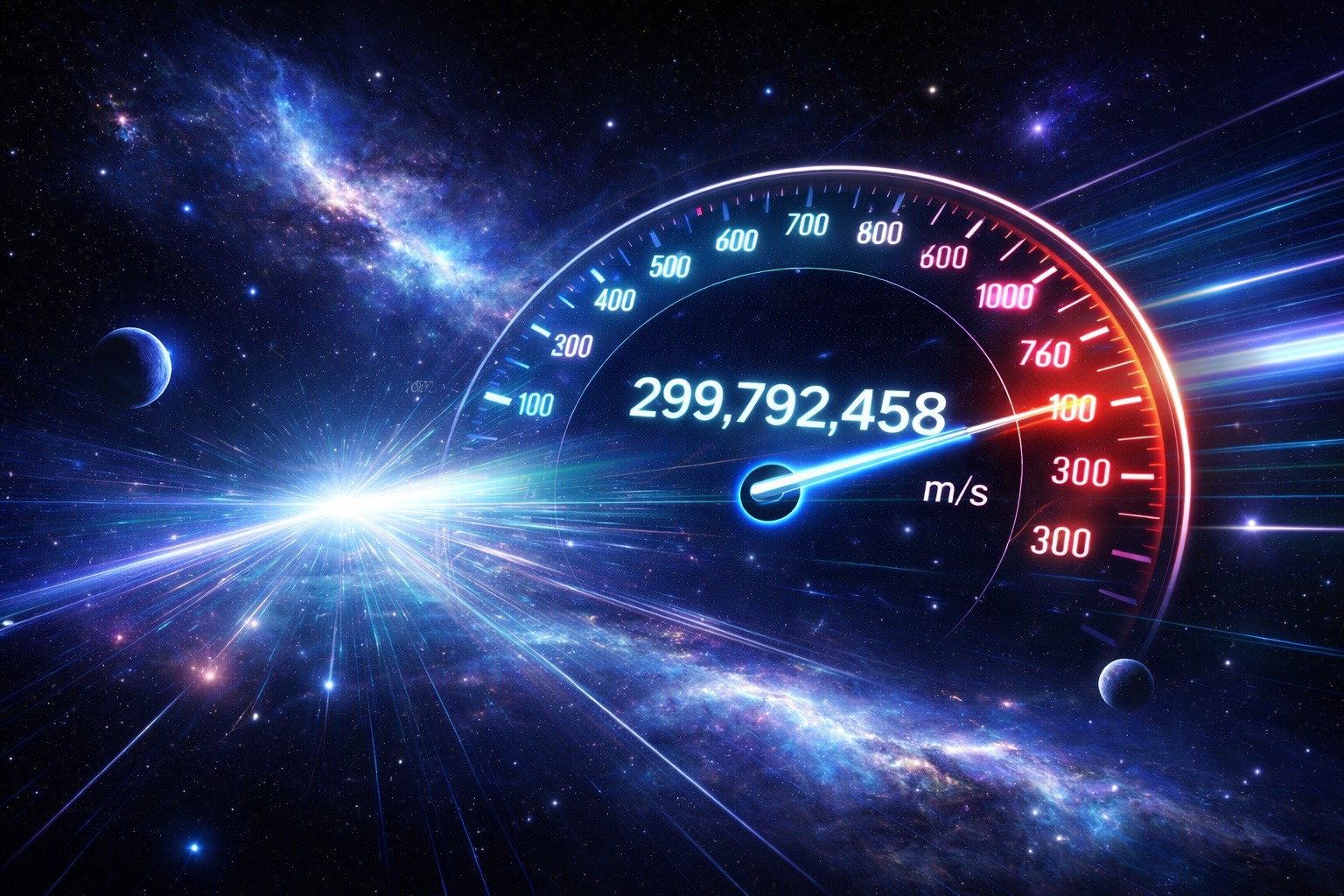
Let’s start with specific numbers. The speed of light in a vacuum is exactly 299,792,458 meters per second. For convenience, it’s usually rounded to 300,000 km/s. In kilometers per hour, that’s a staggering figure — about 1,079,252,849 km/h. To grasp the scale, consider that in one second, light could circle the Earth along the equator nearly 7.5 times.
Interestingly, the number 299,792,458 m/s is not the result of the latest measurement — it’s a definition. Since 1983, the meter itself has been tied to the speed of light: one meter is the distance light travels in a vacuum in 1/299,792,458 of a second. Therefore, the speed of light cannot become “more precise” — it is precise by definition.
This value is one of the fundamental constants of nature. It doesn’t depend on who measures it or how the light source is moving. This is precisely what Einstein’s special theory of relativity is built upon.
Why the Speed of Light Is Greater Than the Speed of Sound
To truly appreciate how fast light is, it helps to compare it with sound. The speed of sound in air under normal conditions is approximately 343 m/s, or about 1,235 km/h. This means light is roughly a million times faster than sound.
Each of us has observed this firsthand. During a thunderstorm, we first see the flash of lightning and only hear the thunder several seconds later — precisely because light reaches our eyes almost instantly, while sound needs time.
But the key difference isn’t even about speed. Sound is a vibration of a medium: air, water, metal. Without a medium, it cannot exist — in the vacuum of space, there is complete silence. Light, on the other hand, is an electromagnetic wave that needs no medium at all. It travels perfectly through absolute emptiness.
Speed of Light in Water and Other Media
When we say “the speed of light,” we almost always mean the speed in a vacuum. But in the real world, light almost always passes through some medium — air, water, glass. And in each of them, it slows down.
By how much depends on the refractive index of the medium. For water, it’s approximately 1.33. This means the speed of light in water is about 225,000 km/s — roughly a quarter less than in a vacuum. In air, the slowdown is minuscule — only about 90 km/s. But in diamond, light slows down by almost 2.5 times.
Why does this matter? Because in a medium where light is slowed, other particles can theoretically move faster than it. For example, an electron entering water at near-light speed outpaces light in that water. This produces a beautiful bluish glow — the Vavilov-Cherenkov effect. But even in this case, the electron does not exceed the speed of light in a vacuum.
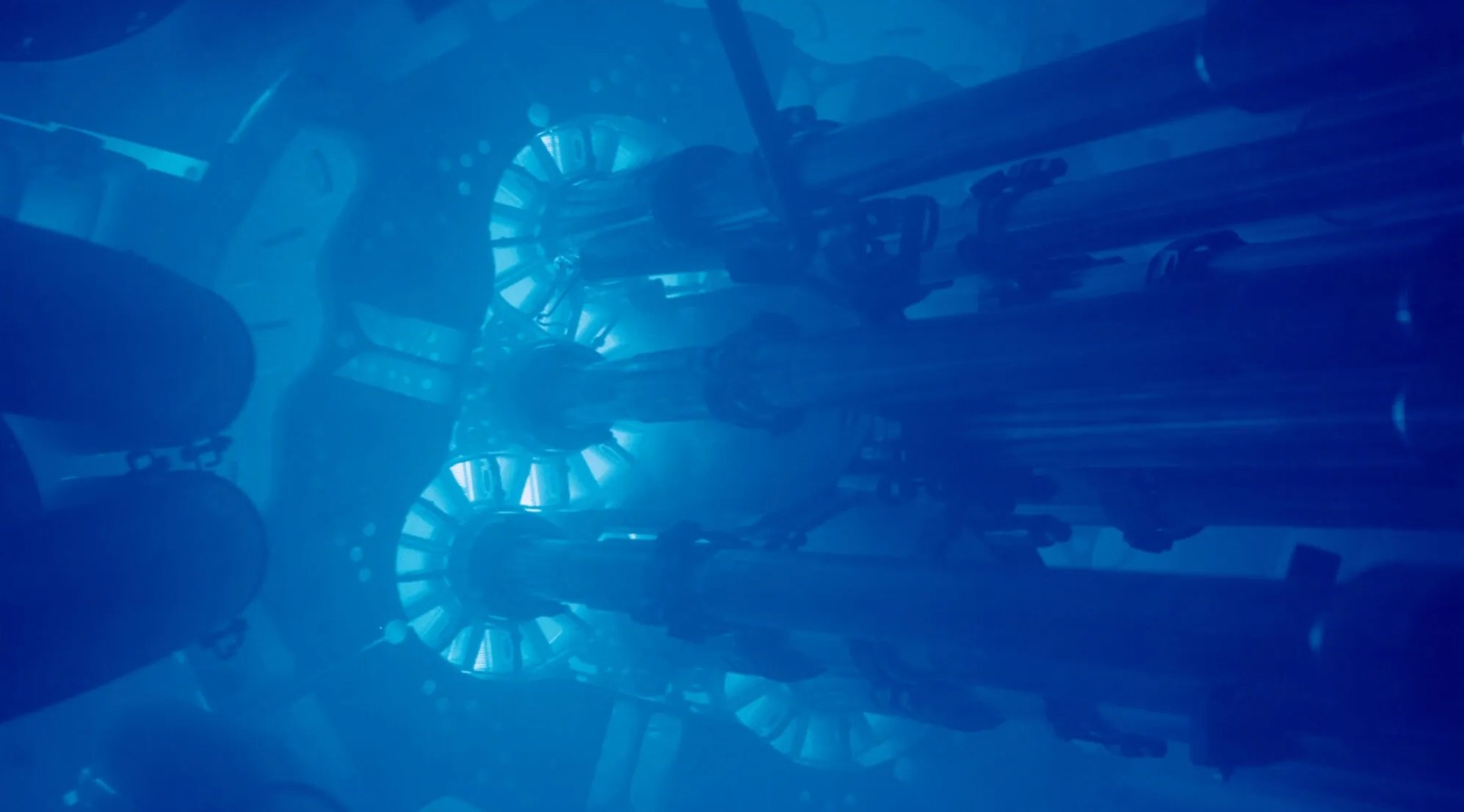
Vavilov-Cherenkov radiation. Image source: 24hitech.ru
Why Nothing With Mass Can Reach the Speed of Light
This is where things get really interesting. The special theory of relativity explains that accelerating an object with mass to the speed of light would require an infinite amount of energy. Literally infinite. Not “a whole lot,” but mathematically infinite!
Imagine you’re pushing a cart up a hill that keeps getting steeper. The closer you get to the top, the more effort each next meter requires. And the summit always stays just a bit ahead. That’s roughly how accelerating a massive body works: the closer to the speed of light, the more energy each additional meter per second consumes.
In practice, physicists have long learned to accelerate particles to 99.9999% of the speed of light in accelerators like the Large Hadron Collider. But the remaining fraction of a percent demands colossal amounts of energy, and reaching exactly 100% is impossible.
Massless particles — photons — behave in exactly the opposite way. They always travel at the speed of light and cannot move slower (in a vacuum). The speed of light is the only speed at which they exist.
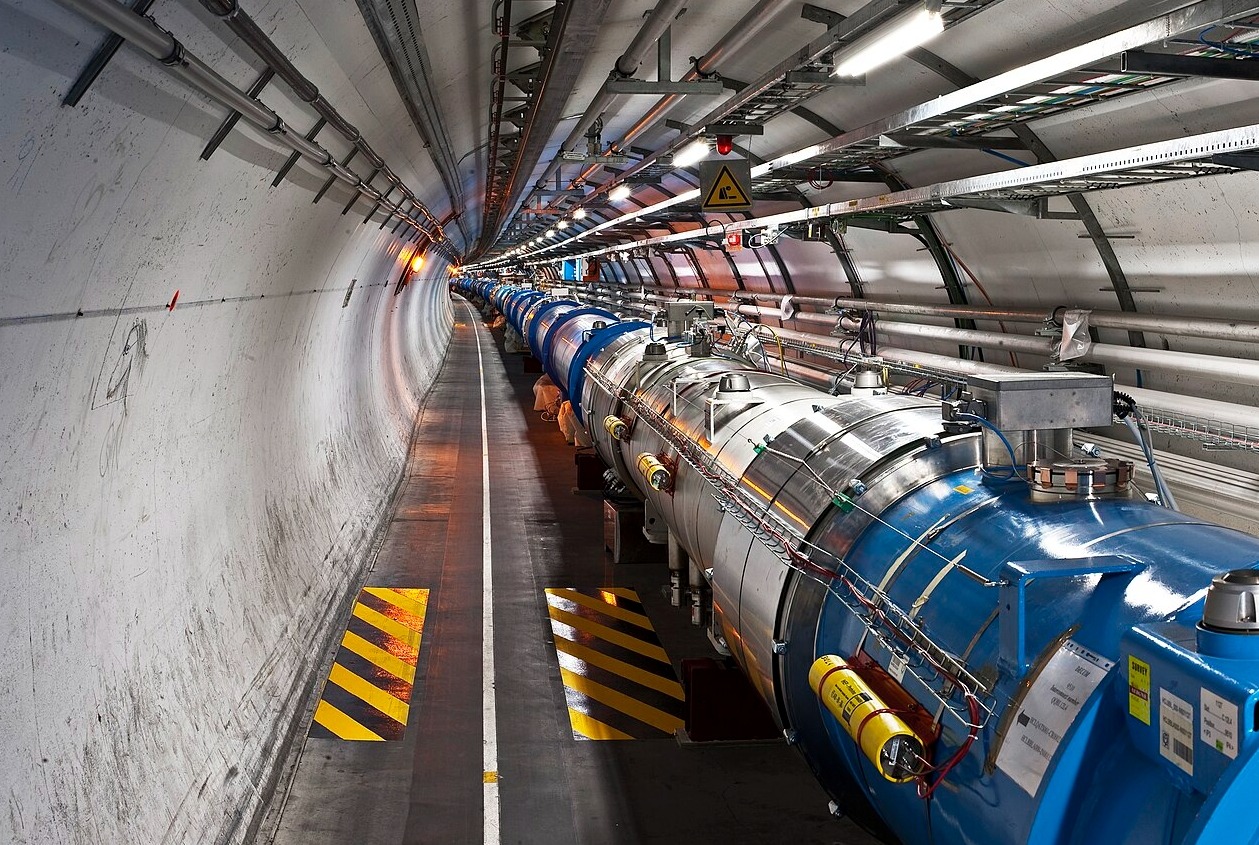
Part of the Large Hadron Collider. Image source: wikimedia.org
What Can Move Faster Than the Speed of Light
If no object with mass can accelerate to the speed of light, then what can exceed it? The answer: “non-things” — phenomena that carry neither matter nor information.
The simplest example is a shadow. Imagine you’re waving your hand in front of a powerful spotlight, and the shadow falls on a very distant wall. The edge of the shadow on the wall moves much faster than your hand. If the wall is far enough away, the shadow easily “moves” faster than light. But a shadow is not an object. It carries no mass and transmits no information. It’s simply the absence of light.
Another example is the expansion of the Universe. Two distant galaxies can fly apart from each other at speeds exceeding the speed of light. But the thing is, it’s not the galaxies themselves that are flying apart — it’s space itself stretching between them. The galaxies are simply “sitting” on the expanding fabric of the cosmos, like dots on an inflating balloon.
Neither a shadow nor the expansion of space transmits information faster than the speed of light. This means the fundamental prohibition is not violated.
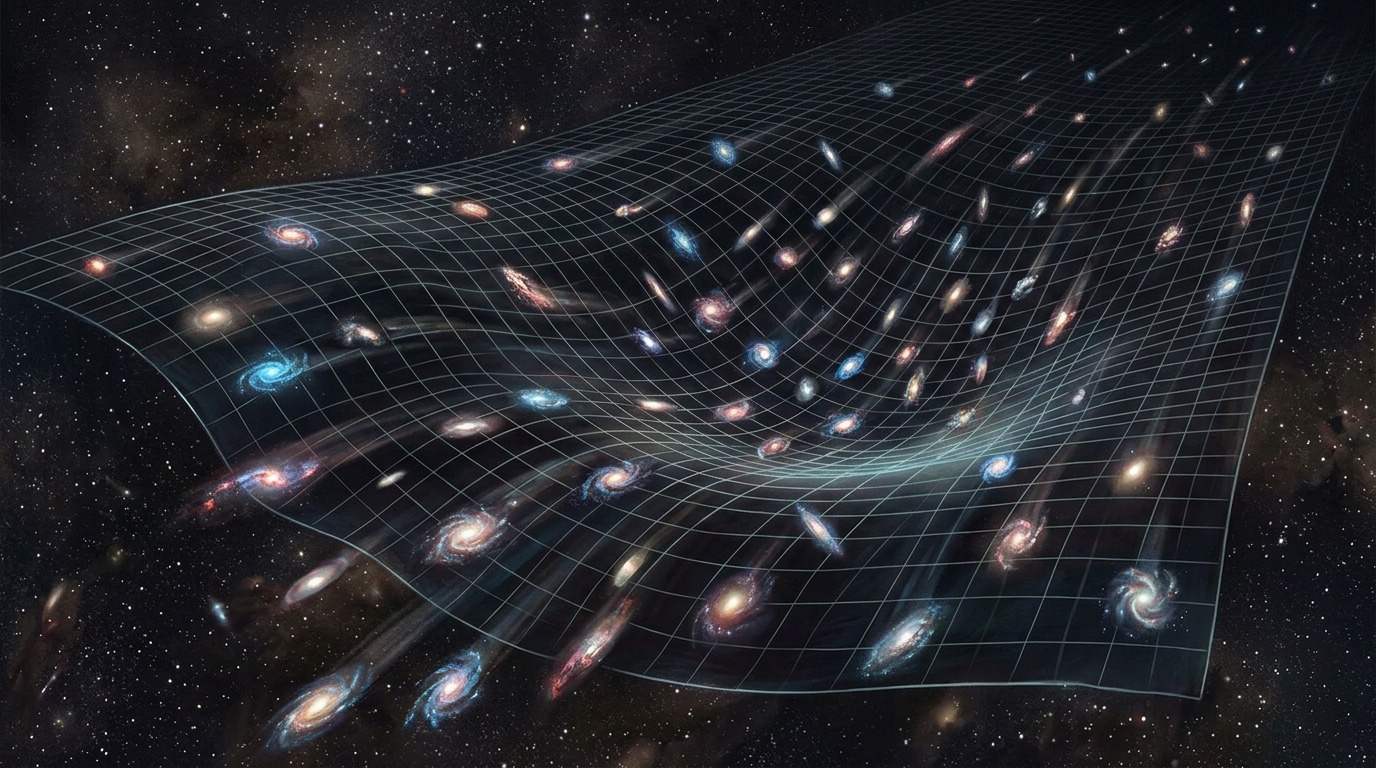
Expansion of the Universe: space stretches and galaxies move apart from each other
What Is a Tachyon in Physics
In physics, there is a hypothetical particle called a tachyon. If it exists, it always moves faster than light and cannot slow down to the speed of light — a mirror image of ordinary particles. But no tachyon has ever been detected experimentally. For now, it remains a purely theoretical construct.
There have also been sensational claims. In 2011, the OPERA experiment seemingly detected neutrinos traveling faster than light. But it later turned out that a faulty fiber optic cable connection was to blame. After the error was corrected, the neutrinos returned to the bounds of familiar physics laws.
The speed of light remains the ultimate limit for everything that has mass and carries information. Physicists call it not just the “speed of light” but the speed of causality — the maximum speed at which one event can influence another in the Universe. Shadows, expanding space, and quantum correlations formally circumvent this prohibition, but none of them allow you to send a message faster than a photon. And so far, not a single experiment in the history of physics has disproven this.