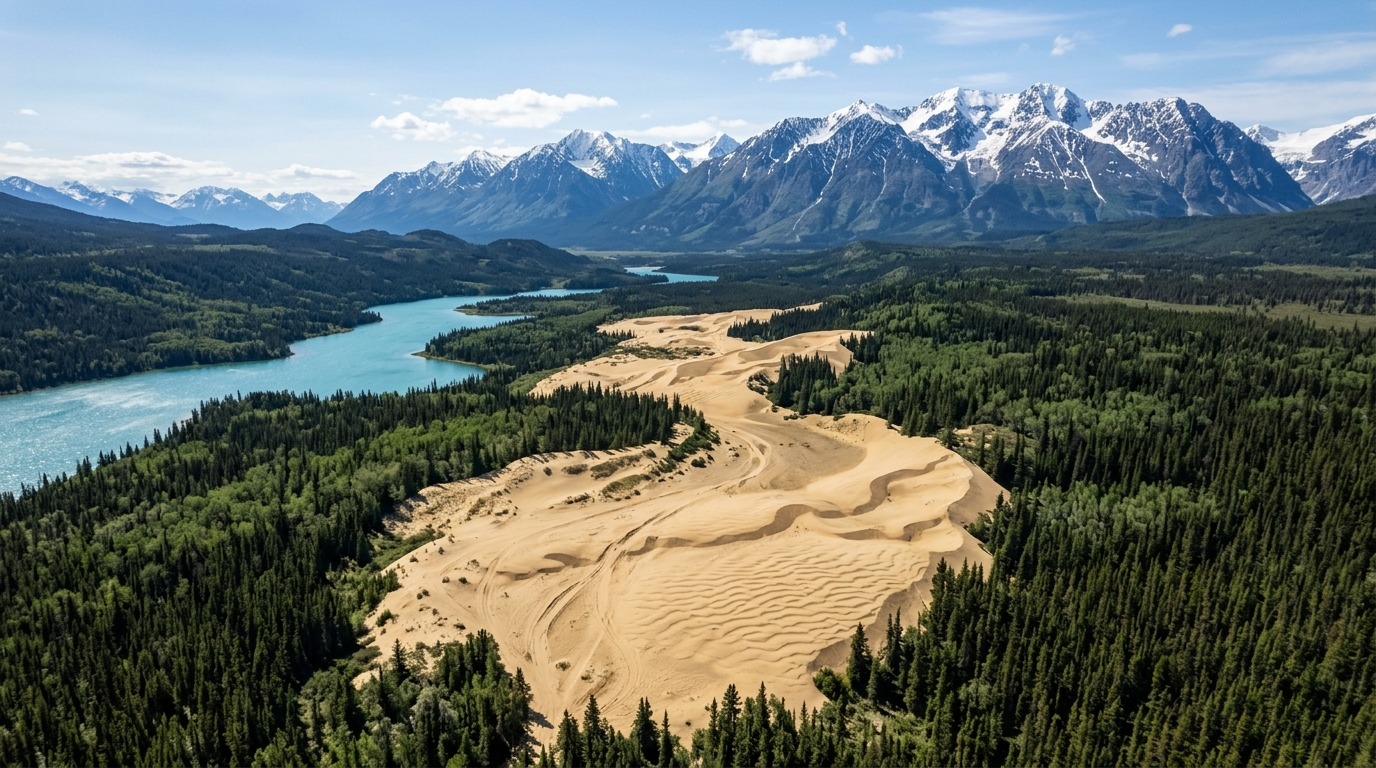
Carcross sand dunes against the backdrop of snow-capped mountains and coniferous forests of Yukon
When people think of deserts, most imagine the endless dunes of the Sahara or the scorching rocks of Death Valley. But the world’s smallest “desert” is located in northern Canada, surrounded by mountains, lakes, and coniferous forests, and in winter it’s covered with snow. Moreover, from a scientific standpoint, it’s not actually a desert at all. Let’s figure out how this is possible and where the sand dunes in Yukon came from.
Where Is the World’s Smallest Desert Located
The Carcross Desert is located near the village of the same name in the Yukon Territory in northwestern Canada and consists of a system of sand dunes covering approximately 2.6 square kilometers. For comparison, that’s roughly 350 football fields — a tiny patch by the standards of any real desert.
The village of Carcross is located approximately 74 km southeast of Whitehorse — the capital of Yukon. For many, it comes as a genuine surprise to discover a desert-like landscape in northern Canada — where winter temperatures drop far below zero and bears roam the area.
Carcross is known not only for this natural anomaly — it features world-class mountain biking trails, and the “desert” itself is regularly called the “world’s smallest desert.” However, as we’ll see below, this title is not so straightforward.
Why Carcross Is Not Actually a Desert
To understand the catch, we need to recall what a desert is from a scientific perspective. According to IFL Science, most experts agree that a desert is a territory receiving no more than 250 mm of precipitation per year. Scientists typically consider regions with less than 250 mm of annual precipitation as arid and those with 250–500 mm as semi-arid.
Carcross technically is not a desert because it receives too much precipitation for that classification — it falls into the semi-arid category and is covered with snow in winter. Precipitation here is indeed less than in the surrounding areas — less than 50 cm (about 500 mm) per year — partly due to the rain shadow effect from the surrounding mountains. But this is still too much for a true desert.
Simply put, imagine an area that’s drier than its neighbors but still receives two to three times more moisture than needed for desert status. There’s sand, there are dunes, the wind dries your face — but there are no formal grounds to call the place a desert. That’s why Carcross is more accurately described as a northern sand dune system.
How the Carcross Desert Was Formed
The history of these dunes goes back to the last ice age. Approximately 11,000 to 24,000 years ago, the territory of present-day Yukon was covered with a thick layer of ice. When the glaciers began to retreat, enormous lakes formed in the deep valleys. Over time, the lakes shrank, leaving behind sandy beaches between the mountains. Wind picked up this sand and shaped it into dunes.
This process continues to this day — wind carries sand from the shores of nearby Bennett Lake into the dune zone, replenishing them. It turns out that the Carcross “desert” is not a frozen relic but a living geological system that is constantly being renewed.
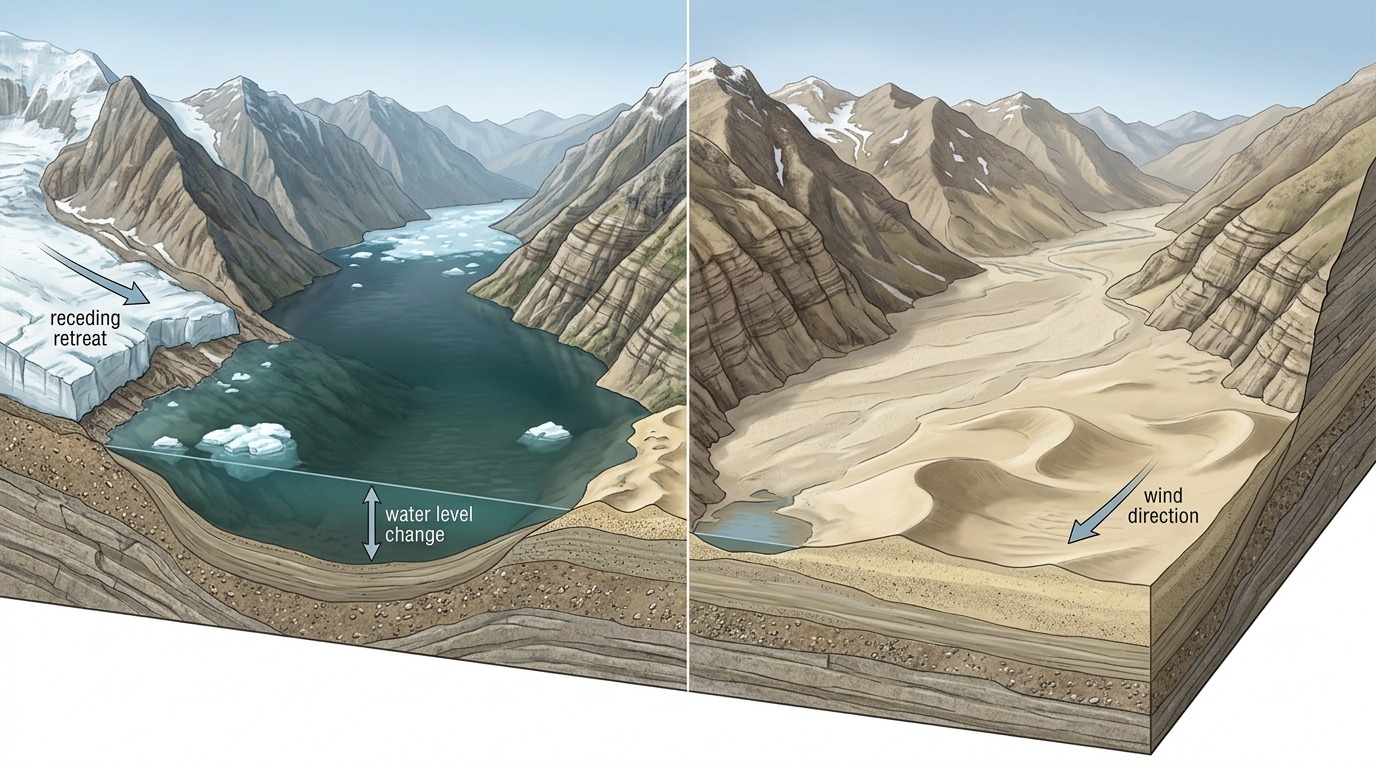
Diagram of dune formation: a glacial lake retreats, exposing sandy deposits
Rare Plants and Animals of the Canadian Desert
Despite harsh winds and poor soil, the Carcross dunes turned out to be home to remarkable inhabitants. An extremely rare sand sedge grows here, which under normal circumstances can only be found on the shores of Lake Baikal in Siberia, as well as Yukon lupine.
The sand sedge is known in only four other locations in North America; it primarily inhabits Asia. How did a Siberian plant end up in the Canadian north? Most likely, these are traces of ancient biogeographic connections between Asia and North America through Beringia — the land bridge that existed during glacial periods.
Five new species of butterflies have also been discovered in the dunes, and possibly not all species have been identified yet. At the same time, most plants that have taken root in Carcross would not survive in a real desert — yet another confirmation that this place only looks like a desert without actually being one.
Interestingly, vegetation currently holds most of the dune system in place, but a major event like a forest fire could easily destroy this “green armor” and return the dunes to an active state.
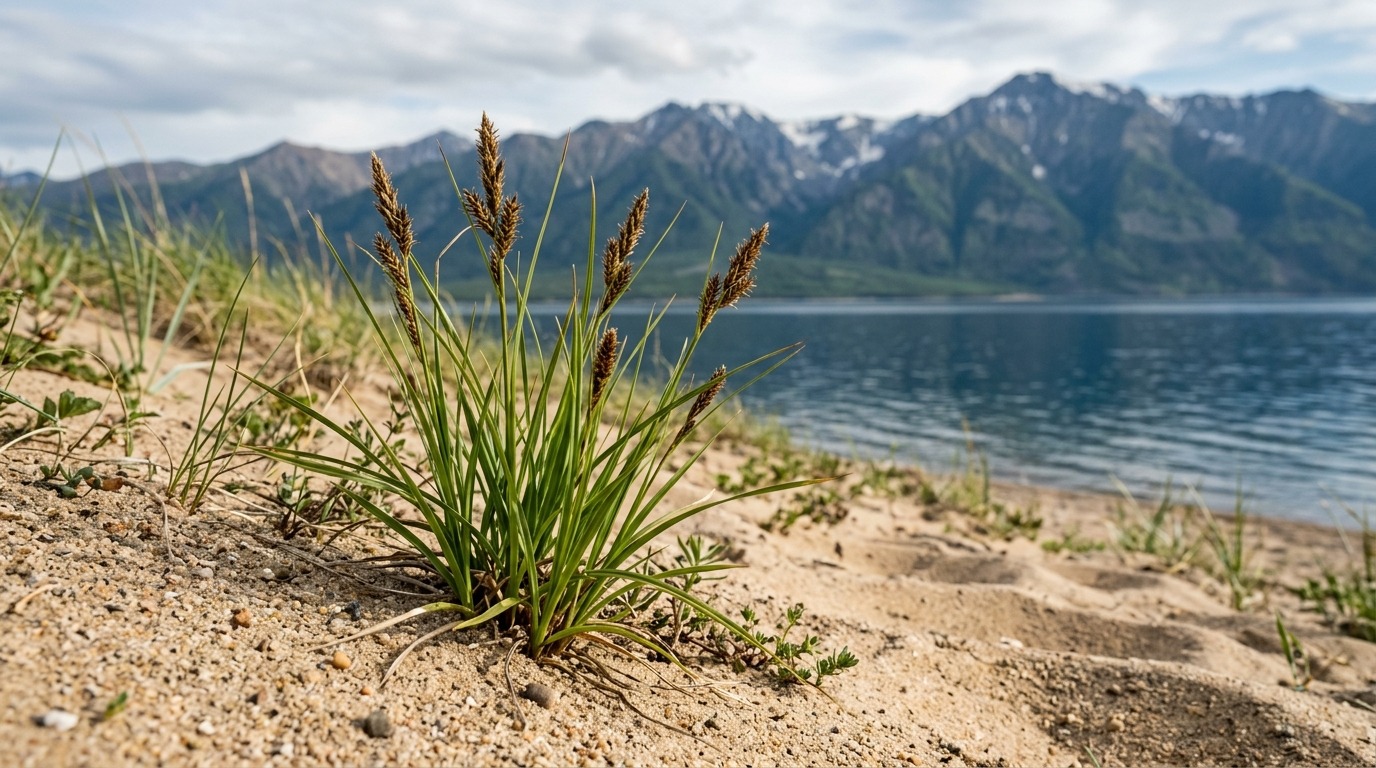
Rare sand sedge in Carcross
Is There an Even Smaller Desert in the World
Carcross is far from the only contender for the title of the world’s smallest desert. The Canadian dunes have a competitor in South Africa: the Red Desert in KwaZulu-Natal province claims a diameter of just 200 meters.
The Red Desert is located approximately 10 kilometers from the town of Port Edward, with a total area of just 11 hectares. That’s 23 times smaller than Carcross. This tiny patch of bright red sand is surrounded by lush tropical greenery and is literally a stone’s throw from the ocean, but like Carcross, it receives too much precipitation to be considered a true desert.
The origin of the Red Desert is far more prosaic than the Canadian one. According to one theory, a Zulu tribe kept large herds of cattle here that destroyed the vegetation cover, and the remaining bare ground was subjected to wind erosion. Meanwhile, artifacts dating back up to 300,000 years have been discovered on the reserve’s territory, belonging to the Early, Middle, and Late Stone Age.
So which “desert” is the smallest? The answer depends on what you consider a desert. If we strictly follow the scientific definition, neither Carcross nor the Red Desert are true deserts — both receive too much moisture. But if we’re talking about territories that look like deserts and are commonly called such, then the title probably goes to South Africa’s Red Desert with its 11 hectares.
What Happens in Canada’s Desert
Carcross has long been a popular tourist destination. Local residents ride sandboards across the dunes, tours are conducted here, people play beach volleyball, go hiking, and even skydive.
In summer, residents of Whitehorse come here to sandboard, and in winter — for skiing and snowboarding. The scene looks surreal: sand dunes covered in snow against a backdrop of snow-capped mountain peaks.
The dunes have park reserve status but lack formal protection. The ecosystem here is fragile, so visitors are asked to avoid the edges and crests of the dunes where rare plants grow. The area around Carcross has been inhabited for at least 4,500 years — artifacts of the indigenous Tlingit and Tagish peoples have been found here.
The Carcross Desert is a perfect example of how geography challenges our stereotypes. We’re used to thinking of deserts as heat, cacti, and endless sand. But nature knows how to create landscapes that don’t fit any classification: sand dunes in the Canadian north, covered in snow half the year, with Siberian plants and undiscovered butterfly species. Sometimes the most amazing places on the planet are those that simply refuse to conform to definitions.