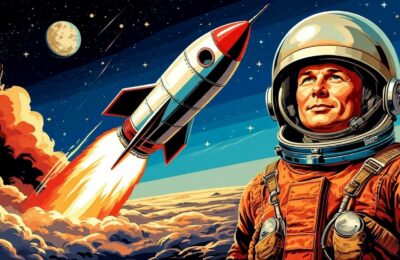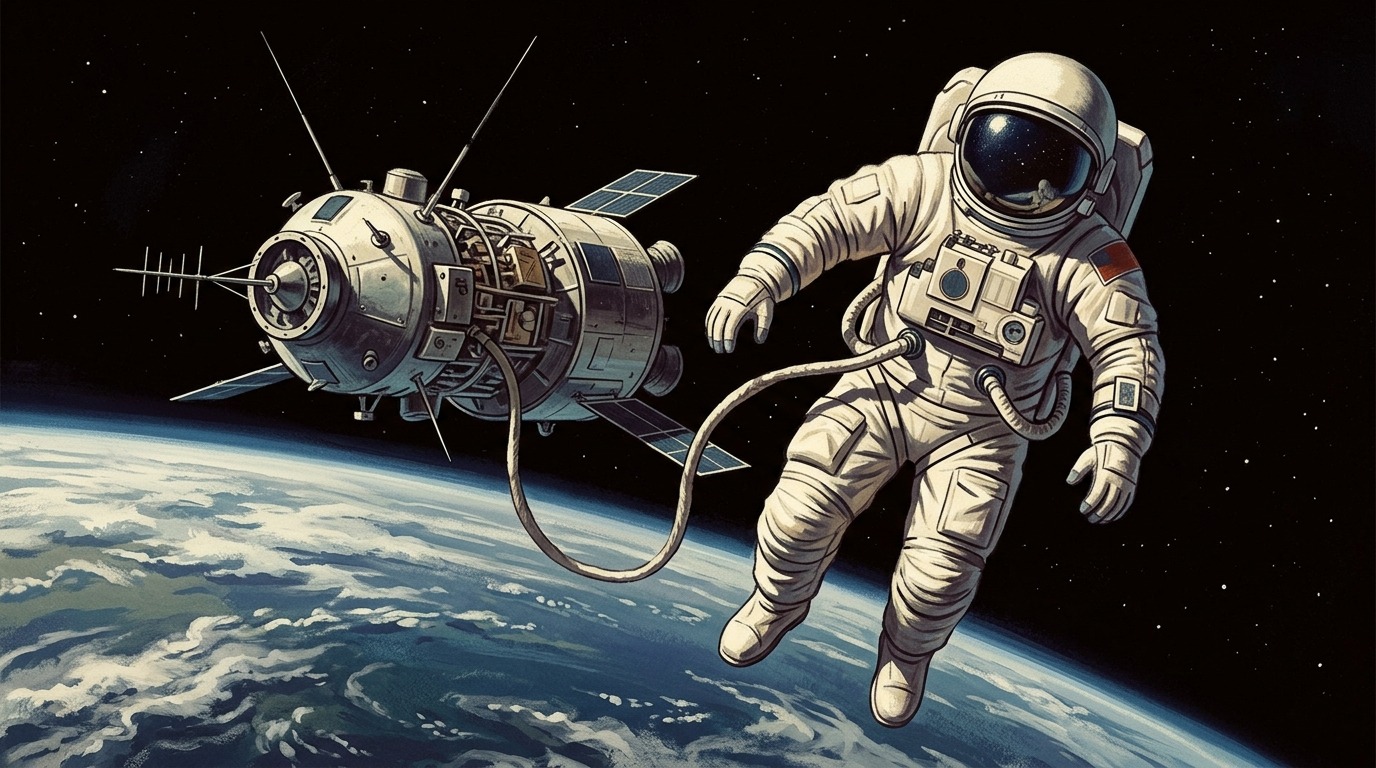
Alexei Leonov in open space — the first person to find himself alone in the vacuum
On March 18, 1965, cosmonaut Alexei Leonov became the first person to walk in open space — and nearly died trying to get back into the spacecraft. His spacesuit inflated so much that it wouldn’t fit through the airlock, and Leonov had to bleed off pressure, risking his life. But even when he was back inside Voskhod-2, the nightmare was only beginning. Ahead lay uncontrolled spinning, the threat of explosion, navigation system failure, a landing in the remote taiga, and a night surrounded by wolves at minus twenty-five degrees. This is one of the most remarkable feats ever accomplished by humans in space.
Leonov’s First Spacewalk
The Voskhod-2 mission, with a crew of two — Alexei Leonov and mission commander Pavel Belyayev — became one of the most important events of the space race. Leonov spent about 12 minutes outside the spacecraft, connected to it only by a five-meter tether. But in the vacuum, his spacesuit inflated so much that the cosmonaut couldn’t bend his arms and legs — and consequently couldn’t squeeze back into the inflatable airlock, which was just over a meter in diameter.
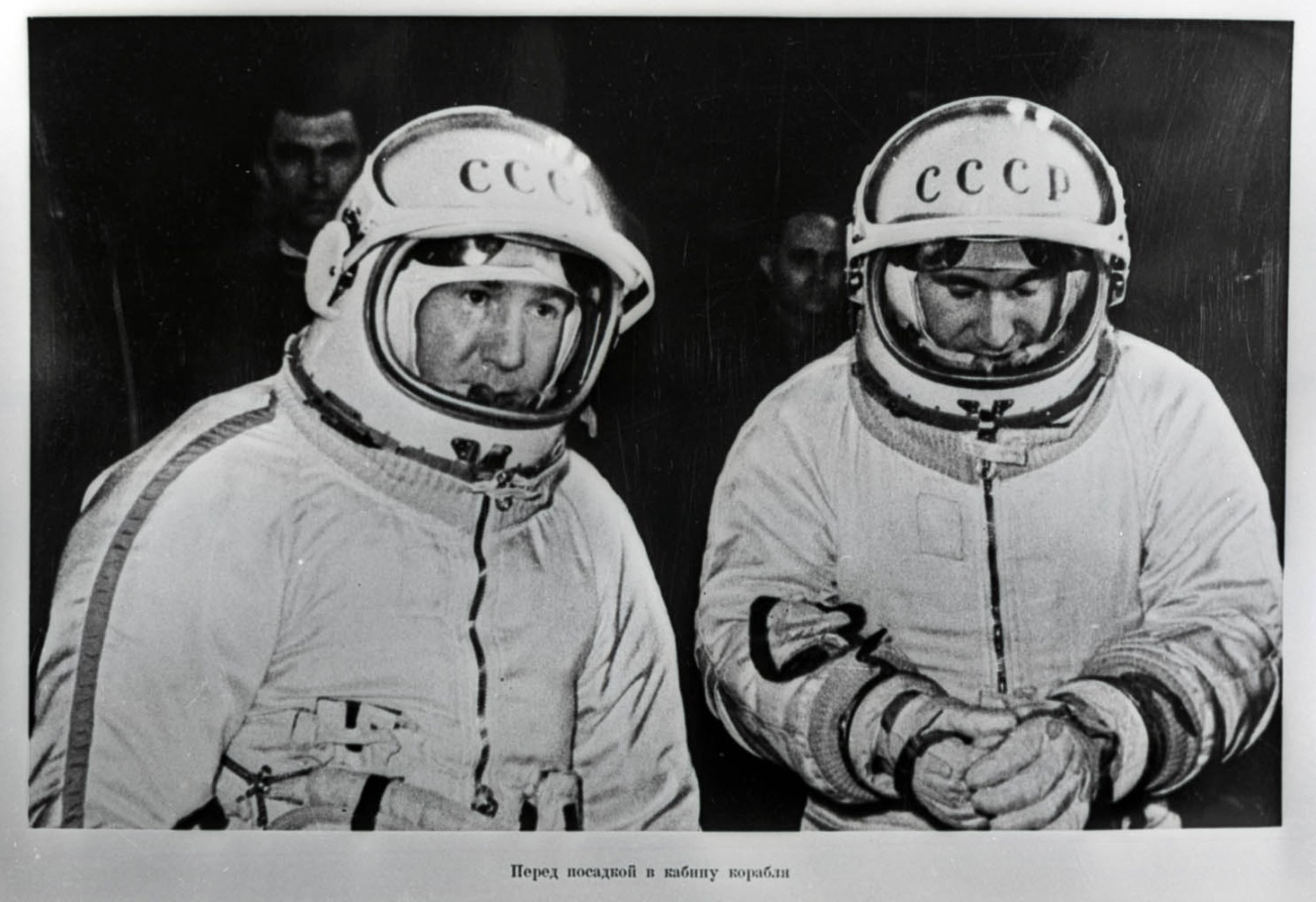
The crew of the Voskhod-2 spacecraft. Image source: calend.ru
Leonov made a desperate decision: he bled off some of the pressure from his spacesuit while still in open space. This risked decompression sickness (when gas bubbles form in the blood — known as “the bends”), but there was no other option. Overheated, drenched in sweat, upside down, he still managed to squeeze into the airlock. It seemed like the worst was over. It seemed…
Why the Voskhod-2 Spacecraft Began to Spin
When the spacewalk was completed, the inflatable airlock (a three-meter tube with barely enough room to maneuver) was no longer needed. Leonov and Belyayev triggered the pyrotechnic charges to jettison it from the spacecraft. According to Newton’s third law, the explosion created an impulse in the opposite direction, and Voskhod-2 began spinning uncontrollably.
But the spinning turned out to be just the beginning of a chain of problems. The cosmonauts noticed that the oxygen level inside the spacecraft was rising rapidly. The hot, humid air, oversaturated with oxygen, was turning the cabin into a powder keg — any spark would have meant an instant explosion.
Fortunately, the engines didn’t produce sparks. A spark would have caused an explosion, and we would have been vaporized, — Leonov recalled later.
The crew managed to reduce the oxygen pressure, but then the next malfunction was discovered: the spacecraft’s automatic orientation system had failed.
How Leonov and Belyayev Manually Landed the Spacecraft
Leonov discovered the navigation failure five minutes before the braking engine was supposed to begin firing for deorbiting. Automatic landing had become impossible. For the first time in the history of spaceflight, a crew would have to orient and land the spacecraft manually.
This was a precision task. If the angle of atmospheric entry was too shallow, the spacecraft would skip off the atmosphere like a stone off water. If too steep, the craft would be destroyed by overheating and g-forces. There was exactly enough fuel for one correction attempt. To use the optical orientation device, Belyayev had to lie horizontally across both seats, while Leonov held him in front of the viewfinder. After that, both had to return to their correct positions in a flash to avoid shifting the spacecraft’s center of gravity.
When they requested support, the question from Mission Control was: “Where did you land?” — it became obvious: the crew was on their own.
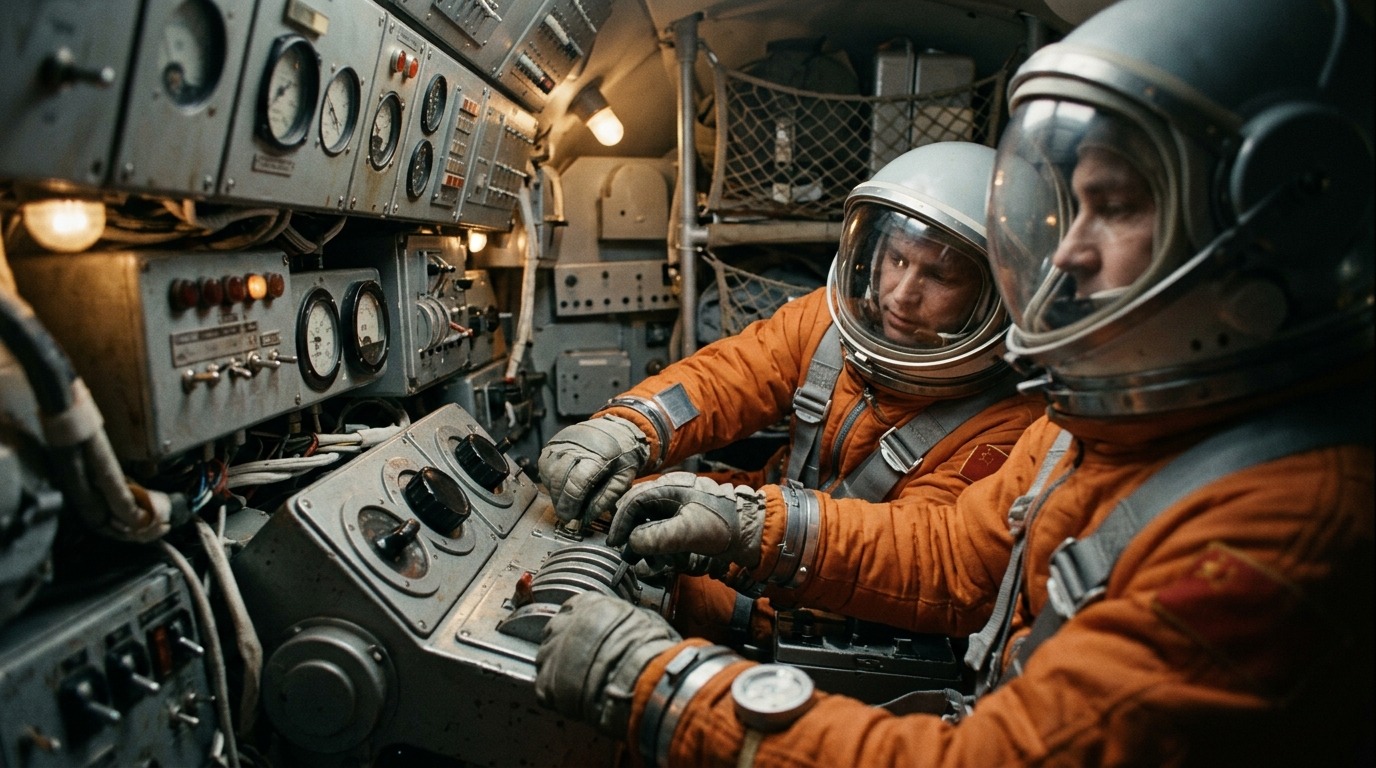
The cramped cabin of Voskhod-2, where the cosmonauts had to manually control the landing
The Landing of the Voskhod-2 Spacecraft
Belyayev fired the braking engine. The spacecraft began to slow down and descend. But something went wrong again. Leonov recalled:
It felt as if we were being pulled back, as if something was holding us.
The instruments showed 10G overload — enough to kill even a trained pilot. Blood vessels burst in both cosmonauts’ eyes.
The cause turned out to be that the orbital module, which was supposed to separate before atmospheric entry, remained connected to the landing module by a cable. The two modules spun around this cable like stones tied to a rope. Only at an altitude of about 100 kilometers did the cable finally burn through, the modules separated, and the spinning stopped.
Alexei Leonov’s Landing in the Taiga
All the accumulated errors and malfunctions shifted the landing point far from the planned area. Instead of the vicinity of Perm, the spacecraft landed in the remote Siberian taiga — almost 2,000 kilometers from the calculated landing point.
How soon do you think they’ll find us? — asked Belyayev.
In about three months, maybe, they’ll reach us by dog sled, — Leonov joked.
But the adventures didn’t end on the ground either. The spacecraft landed so close to a tree that the exit hatch was jammed. The cosmonauts had to rock it before Belyayev could push the cover out — it flew off into a snowdrift. Two men in sweat-soaked spacesuits found themselves in the middle of a winter forest at minus 25 degrees, surrounded by wolves and bears during mating season.
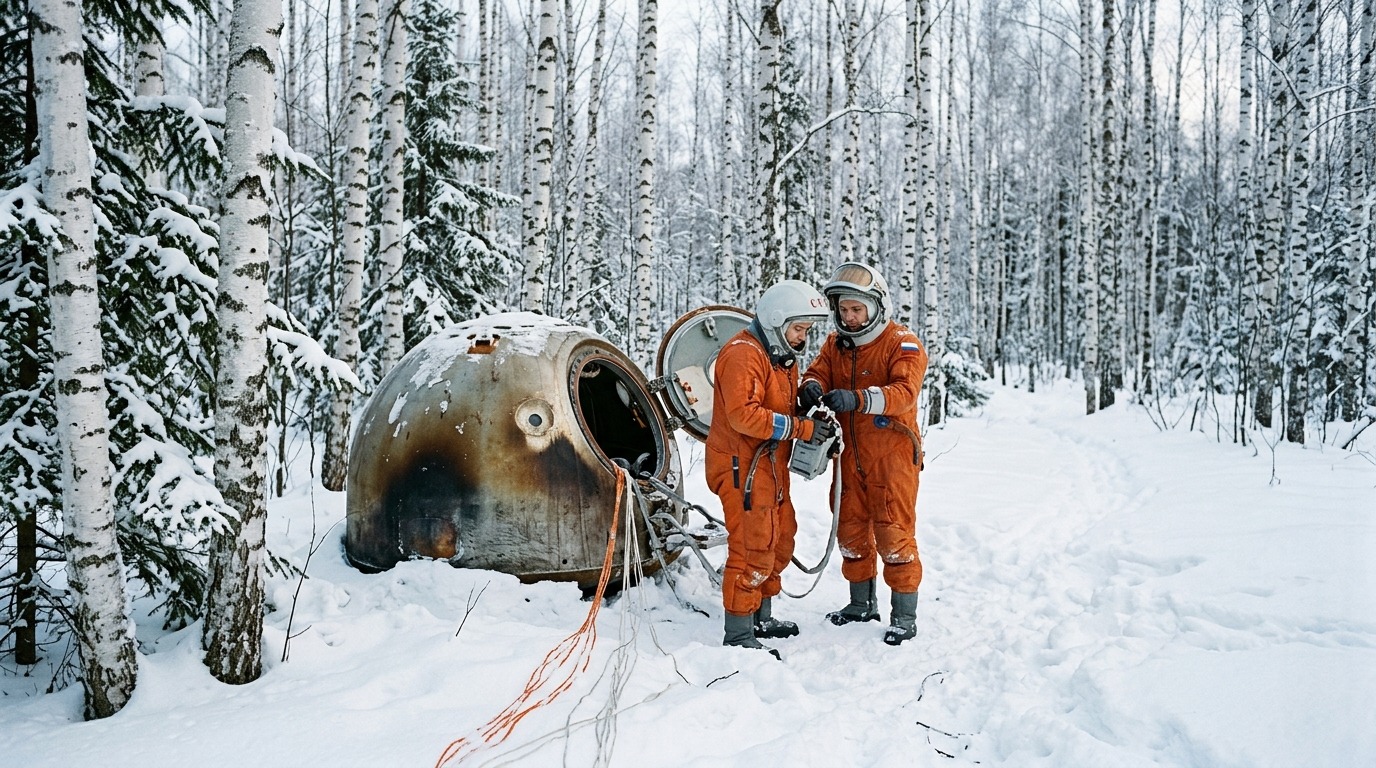
The cosmonauts found themselves in the snow-covered taiga — far from any settlement
How Leonov and Belyayev Were Rescued from the Taiga
Moscow never received the crew’s radio signal. But they were lucky — perhaps the only time during the entire mission: the signal was picked up by a passing cargo plane, which called in a rescue helicopter. However, it was a civilian aircraft, not a military one, and it couldn’t retrieve the cosmonauts. A rope ladder was dropped from the aircraft, but the spacesuits were too heavy and rigid to climb it.
More and more planes began circling above the forest. Pilots dropped everything they could: winter boots, an axe, warm clothing. But the sun was setting, and it became clear: the night would have to be spent in the taiga.
The cosmonauts had to strip completely naked in the freezing cold — so much sweat had accumulated inside their spacesuits that Leonov had it sloshing up to his knees inside his boots. Wet clothing meant frostbite. They wrung out their suits, tried to remove extra layers, and endured the night in the capsule with a gaping hole where the hatch had been.
Only the next morning did a team arrive from Moscow — on skis, with food, water, and materials to build a temporary shelter and fire. But the forest was so dense that a helicopter couldn’t land: they had to clear a landing area for another full day. In the end, Leonov and Belyayev skied 9 kilometers to the rescue helicopter and finally returned to the cosmodrome.
How the Soviet Space Program Changed
When it was all over, Leonov wrote his official report. It was laconic:
Given a specialized suit, a human can survive and work in open space. Thank you for your attention.
Behind that dry formulation lies one of the most incredible survival stories in the history of space exploration. The Voskhod-2 mission proved that spacewalking was possible — but it also showed how fragile early space technology was and how much depended on the crew’s composure. Each of the problems — the inflated spacesuit, uncontrolled spinning, navigation failure, 10G overload, landing thousands of kilometers from the target — could have been fatal. Leonov and Belyayev survived them all.