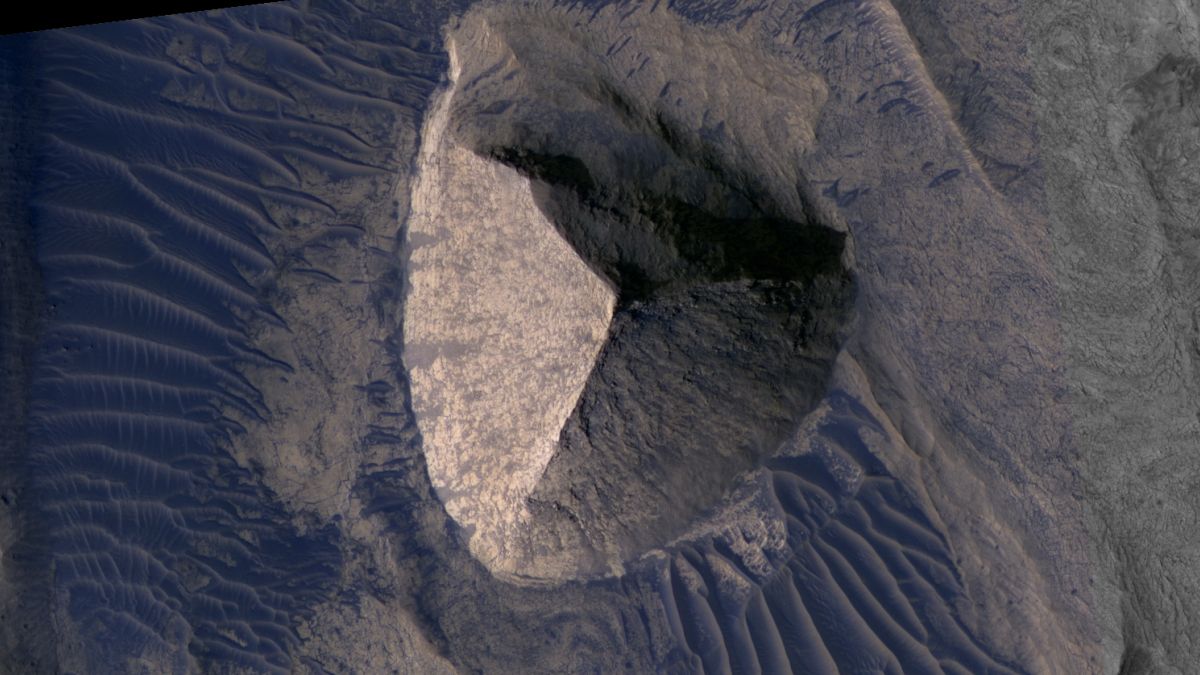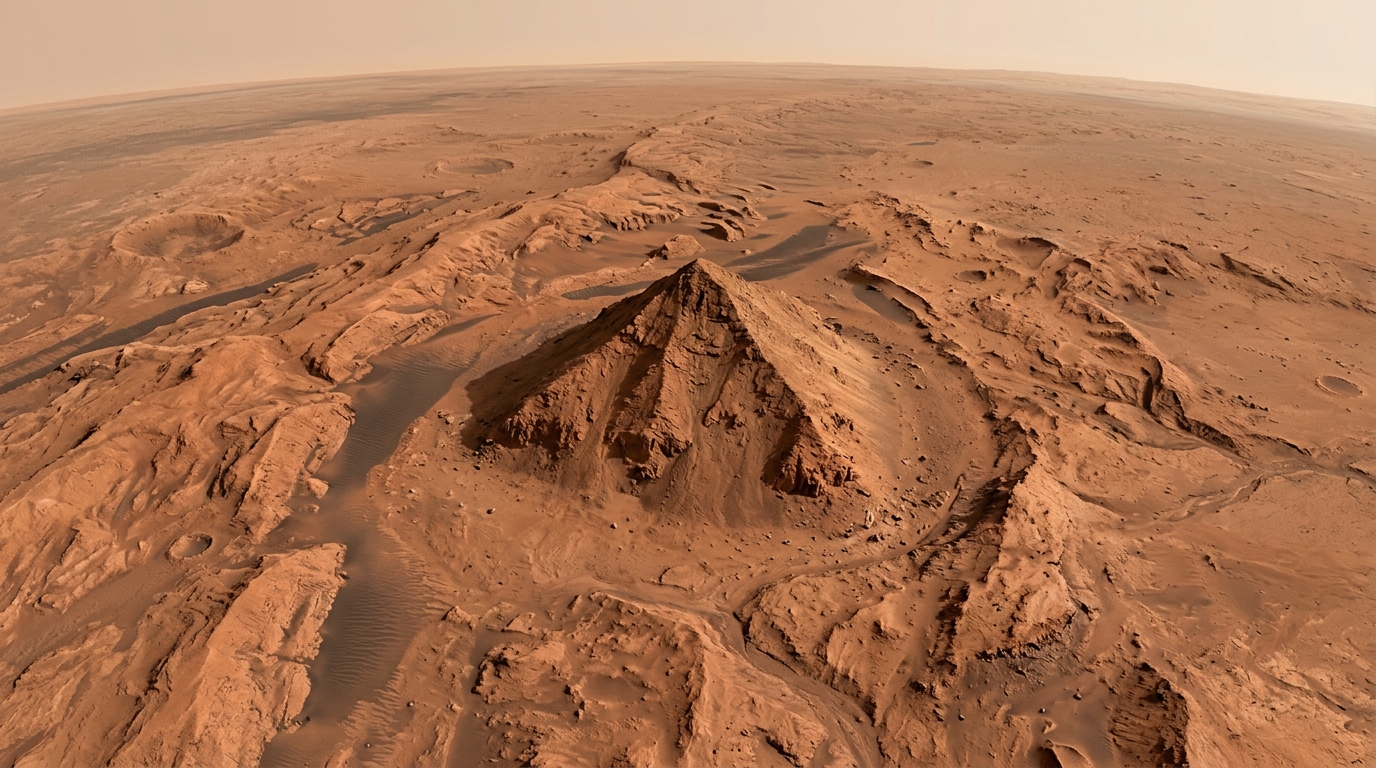
The three-sided rock structure on the surface of Mars bears an uncanny resemblance to an ancient Egyptian pyramid
A rock has been found in a canyon on Mars that looks like a three-sided pyramid — almost like an Egyptian one, only 145 meters tall. The images were taken by NASA orbital spacecraft, and they are real. But before building theories about alien builders, it’s worth understanding what the camera actually shows and what natural forces are capable of creating such shapes without a single mason.
What Pyramid Was Discovered on Mars
We’re talking about the so-called Candor Tetrahedron — a rock formation located in the western part of Candor Chasma. The structure is about 290 meters in diameter and approximately 145 meters in height. Its shape truly resembles a three-sided pyramid — and at first glance looks too geometric for a natural object.
The images showing this structure are real NASA data: orbital spacecraft first photographed the region in 2001. In 2002, independent researcher Wilmer Faust was the first to notice the unusual shape while studying Mars Global Surveyor image number E06-00269.
A new surge of interest in the pyramid occurred after filmmaker Brian Corey Dobbs, who had previously promoted the idea of artificial structures on Mars, published a post on the social network X. Cropped images quickly spread across tabloids and social media.
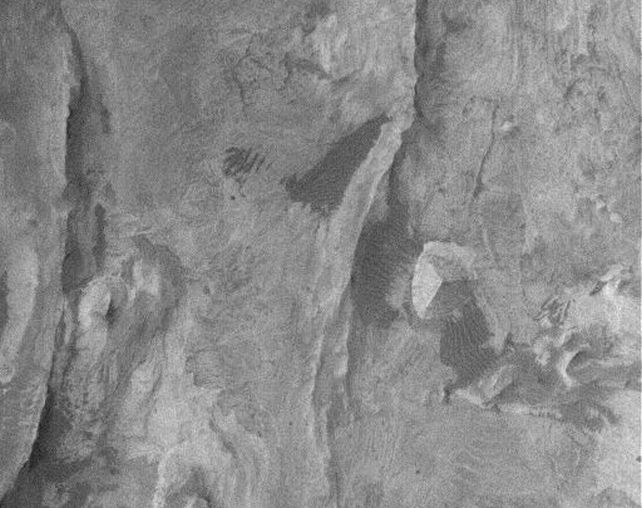
Image E06-00269 from Mars Global Surveyor. Image source: sciencealert.com
Candor Canyon: Where the Mars Pyramid Is Located
Candor is one of the largest canyons on Mars. It is part of the Valles Marineris system — the largest canyon in the Solar System, stretching over 4,000 km in length, up to 200 km in width, and up to 7 km in depth. For comparison: the Grand Canyon in Arizona is approximately 800 km long and 1.6 km deep. If Valles Marineris were transferred to Earth, they would stretch across the entire United States from coast to coast.
Candor Canyon was formed by water, landslides, wind, and possibly tectonic activity over billions of years. This is not a frozen, lifeless landscape — erosional processes are still at work here: wind continues to move dust and sand, forming wave-like ridges on the canyon floor.
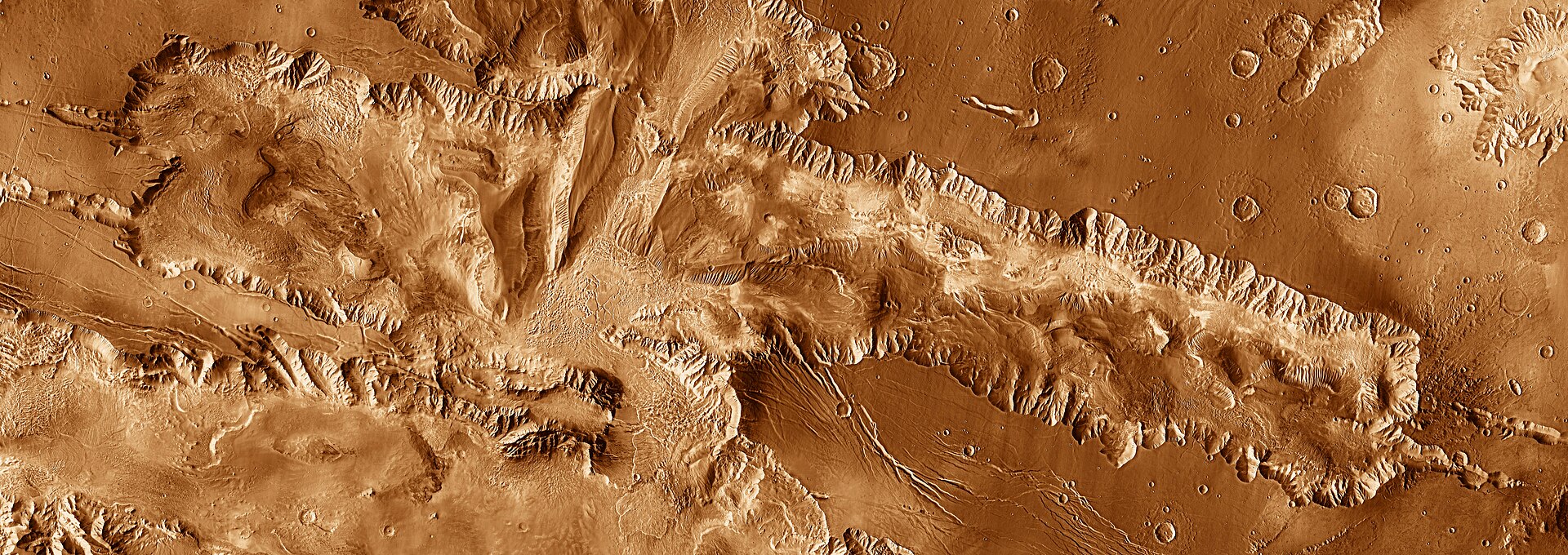
Candor Canyon on a mosaic of THEMIS infrared images, with fragments of Ophir, Melas, and Juventae canyons at the top, lower left corner, and far upper right corner respectively. Image source: en.wikipedia.org
Why Pyramid-Like Shapes Appear on Mars
The key to the mystery lies in the geological context. Candor Canyon is dotted with formations that scientists call “positive relief protrusions.” These are previously buried rock structures that are stronger than the surrounding rock: when erosion removed the soft ground around them, the hard protrusions remained standing.
Imagine a sandcastle into which you pressed several pebbles. If wind and rain gradually erode the sand, the pebbles will remain sticking out — this process works in roughly the same way, only on a scale of hundreds of meters and billions of years.
Such protrusions can reach a kilometer in diameter and tens of meters in height. The Candor Tetrahedron, with its 290 meters across and 145 meters in height, is somewhat larger than a typical “protrusion” but fits perfectly into this landscape of layered rocks carved by erosion into individual hills.
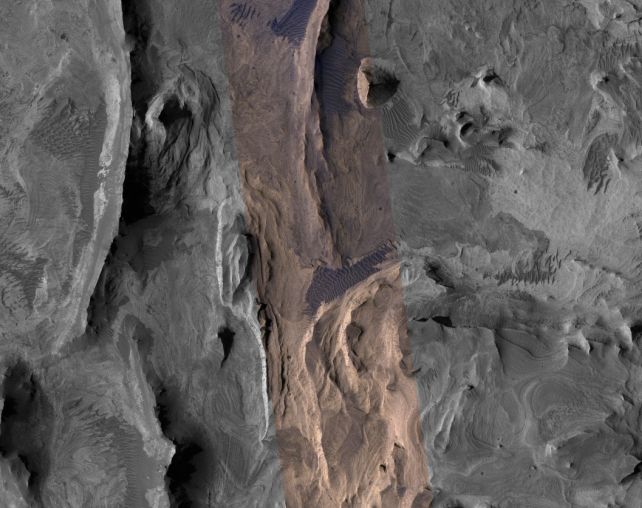
This image was captured by the HiRISE camera on the Mars Reconnaissance Orbiter, which shoots in color infrared along the central strip. Image source: sciencealert.com
Scientific studies using the HiRISE camera and digital terrain models confirm that at least three types of such protrusions exist in the Candor region, differing in size, shape, and likely origin. Their overall height is on the order of tens of meters, and they are formed primarily through erosion that cuts through layered deposits and carves individual sculptural forms from them.
But the Candor Tetrahedron is not unique: unusual structures are regularly found on Mars that initially seem mysterious but then receive perfectly earthly explanations.
Do Natural Pyramids Exist on Earth
Pyramidal shapes in nature are not Martian exotica. Cerro Tusa in Colombia is a natural pyramid 457 meters tall above the surrounding terrain, located in the Antioquia department. Its symmetrical shape is so impressive that Cerro Tusa is called the tallest natural pyramid in the world. And in Guizhou Province in China, you can see entire fields of pyramidal mountains formed by karst processes.
All of this is the result of water, wind, and tectonics at work. Nature doesn’t “build” pyramids on purpose: it’s simply that with a certain combination of rocks and erosion conditions, a conical or pyramidal shape turns out to be the most stable.
The Candor Tetrahedron on Mars operates on the same principle: harder rock resists erosion longer than the surrounding ground and gradually acquires its characteristic angular shape.
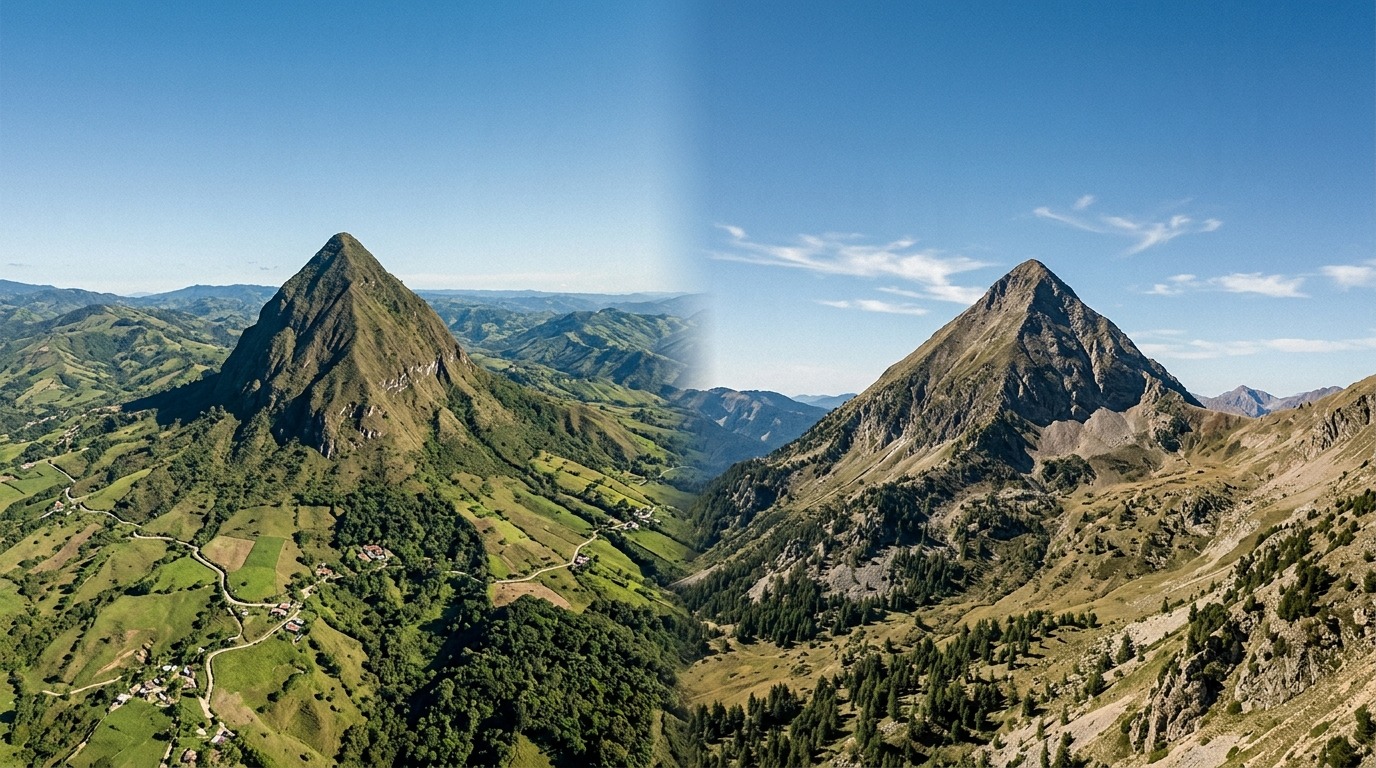
Cerro Tusa in Colombia — the tallest natural pyramid on Earth
Why the Mars Pyramid Seems Man-Made
The human brain is wired to involuntarily search for familiar patterns even where none exist. This effect is called pareidolia — it’s what makes us see faces in clouds, figures in wall stains, and, of course, man-made structures in Martian rocks. We are especially sensitive to images resembling people or faces, but geometric shapes also easily catch our attention.
If you look more closely at the images of the Martian pyramid, you can see that it is surrounded by aeolian waves — relief ridges created by Martian wind, indicating ongoing erosion. The faces of the mountain are uneven and unequal, and the three sides differ in size — something you wouldn’t expect from an actual construction.