Lunar dust may seem unremarkable, but each grain holds information billions of years old
The far side of the Moon remained one of the greatest mysteries of planetary science for decades. We had seen it in photographs, but never held its soil in our hands, meaning we could only guess at its composition. Now Chinese scientists have not only delivered samples from the invisible side of our satellite, but have also used artificial intelligence to decode the chemical composition of this soil, revealing yet another astonishing fact about the Moon!
Why the Far Side of the Moon Differs from the Near Side
If you look at the Moon through a telescope, the near side is covered with dark “seas” — vast plains of solidified lava. But the far side looks completely different: it is almost entirely covered with craters and light-colored highland rocks. This asymmetry between the two hemispheres has puzzled scientists for half a century.
The fact is that all lunar samples delivered to Earth by the Apollo missions were collected exclusively on the near side. It’s like judging an entire continent by only one of its halves. The chemical composition of the far side of the Moon was known only from orbital spectrometer data, and such measurements are far from ideal.
The Chinese Chang’e-6 mission, which in 2024 became the first in history to deliver approximately 1.94 kilograms of soil from the far side of the Moon to Earth, finally broke through this information vacuum. And the results turned out to be far more interesting than anyone expected.
How AI Helped Determine the Moon’s Chemical Composition
The Chang’e-6 samples were collected in the South Pole–Aitken basin, one of the largest and oldest impact craters in the Solar System. Its diameter is approximately 2,500 kilometers. For comparison, that’s roughly the distance from Moscow to Madrid.
But the main challenge was not the delivery, but the analysis. Lunar soil, or regolith, is a fine mixture of minerals, glasses, and rock fragments. Traditional chemical analysis methods produce good results, but processing them takes months. Chinese researchers took a different approach: they trained a machine learning model on spectroscopy data and analysis results from already known lunar and terrestrial minerals.
The algorithm made it possible to quickly and accurately determine the content of key oxides: silicon, aluminum, calcium, iron, magnesium, and titanium. It turned out that soil from the far side is significantly poorer in iron and titanium than samples from the visible lunar seas. However, the aluminum and calcium content is noticeably higher. Put simply, the far side of the Moon is composed of “lighter” rocks.
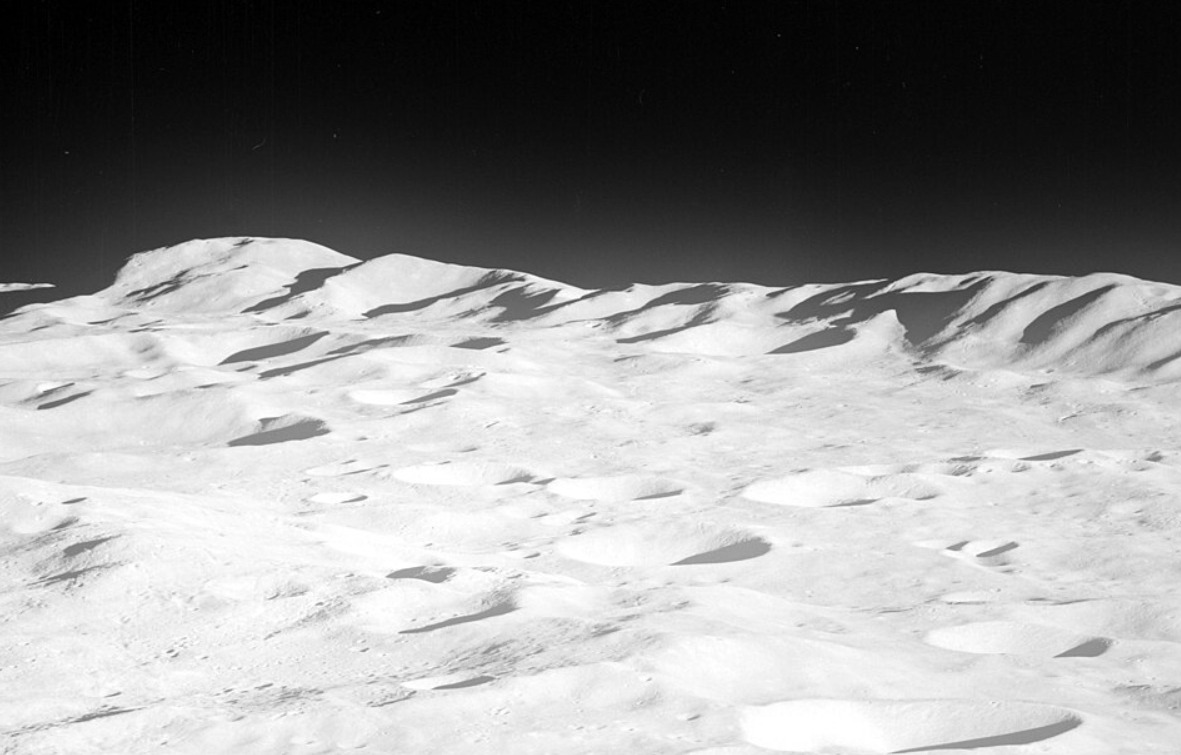
Mountain ridge on the northern edge of the South Pole–Aitken basin. Image source: wikipedia.org
What the Soil Analysis Revealed About the Moon’s History
The results obtained made it possible to reconstruct a picture of the geological history of the far side. And this is where things get truly fascinating.
According to the data, volcanic activity on the far side of the Moon ceased significantly earlier than on the near side. Lava flows there were less powerful, and the magma had a different composition. This explains why the far side is almost devoid of dark seas: the lava simply didn’t have time to fill all the craters.
But there’s a nuance. The analysis also revealed traces of several different epochs of volcanism, separated by hundreds of millions of years. This means the far side wasn’t dead right away — it faded gradually, in spurts. Each epoch left its own chemical imprint in the regolith, and it was precisely AI that made it possible to separate these layers of data.
Another unexpected conclusion: the crust on the far side of the Moon turned out to be thicker than previously thought. This supports the hypothesis that the lunar mantle is distributed asymmetrically, which explains the fundamental differences between the two hemispheres of our satellite.
How the Chang’e-6 Mission Changed Science
Before the Chang’e-6 mission, all models of the Moon’s formation were built on samples from one side. It’s as if geologists studied the Earth using samples only from Europe and tried to draw conclusions about Antarctica from them. Now that direct data from the opposite hemisphere has become available, several established theories require serious revision.
First, the “lunar magma ocean” model, according to which the entire surface of the Moon was once molten, needs refinement: it appears that cooling occurred unevenly, and the far side solidified faster. Second, the role of giant impact events, such as the formation of the South Pole–Aitken basin, turned out to be even more significant. The impact may have mixed layers of crust and mantle so deeply that it altered the entire course of geological history of that hemisphere.
Finally, the data analysis method itself opens new horizons. Artificial intelligence trained on lunar samples can be adapted for analyzing soil from Mars and asteroids. China, by the way, is already planning the Chang’e-7 mission to the Moon’s south pole, and Chang’e-8 is expected to test technologies for a future lunar base.