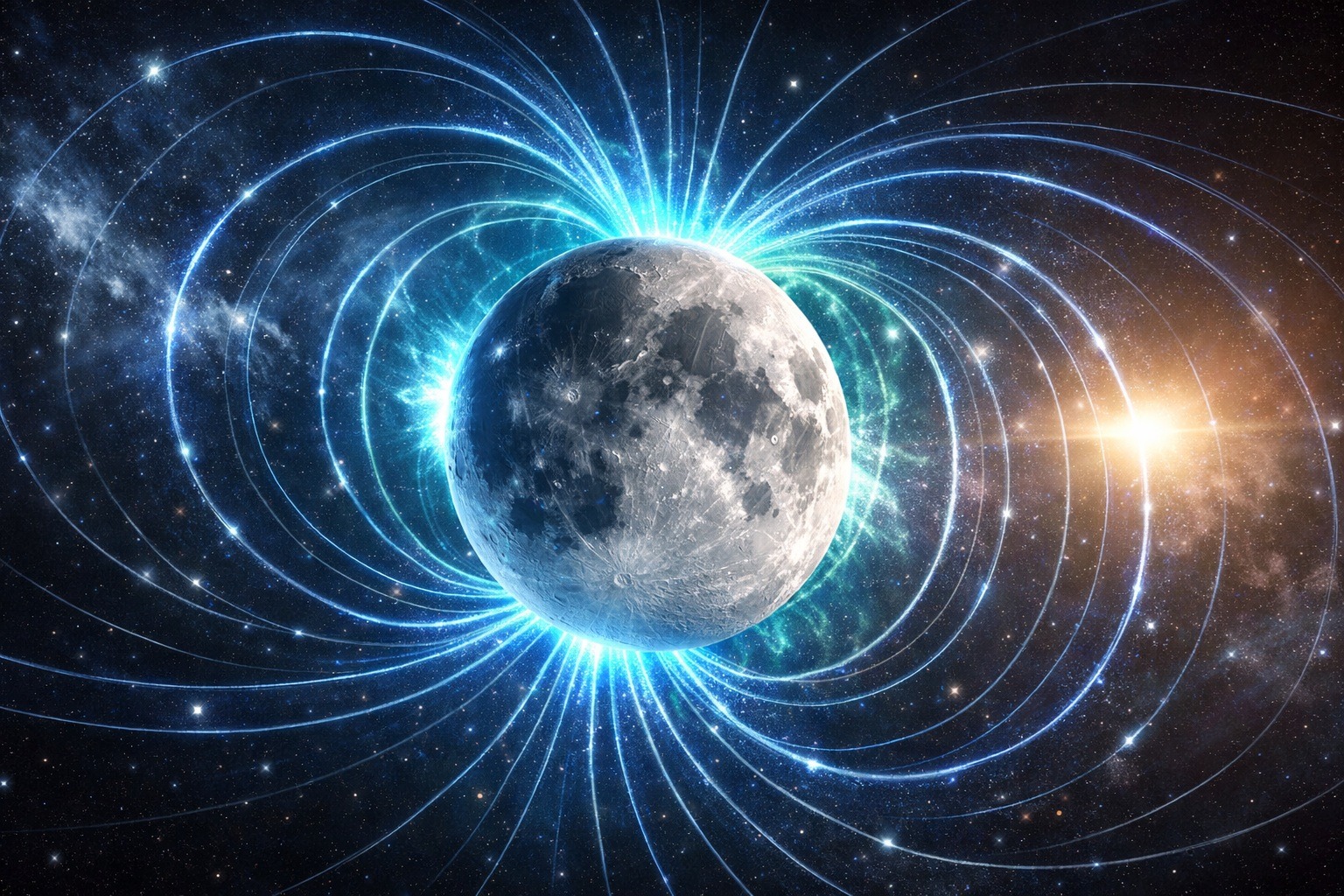
Lunar rocks collected by astronauts in the 20th century held the answer to a half-century-old mystery
When Apollo astronauts brought lunar rocks back to Earth, scientists discovered something strange in them — traces of magnetization. This meant that the Moon once had its own magnetic field, possibly even stronger than Earth’s. But how could a tiny celestial body without a liquid metallic core generate such magnetic protection? This mystery tormented researchers for over half a century, and only now has an international team of scientists found the answer.
Did the Moon Have a Magnetic Field?
On Earth, the magnetic field is created by the so-called geodynamo — flows of molten iron in the planet’s outer core. These flows generate electric currents, which in turn create the magnetic field. It is this field that protects us from solar wind and cosmic radiation.
When in the early 1970s samples of lunar soil ended up in laboratories, the minerals within them preserved a paleomagnetic record — a kind of “imprint” of an ancient magnetic field. It turned out that approximately 3.5–4 billion years ago, the Moon possessed a magnetic field comparable in strength to Earth’s. For comparison, the Moon’s mass is only about 1.2 percent of Earth’s mass, and its core occupies a disproportionately small fraction of the total volume. So where did the energy for the lunar dynamo come from?
This very paradox became one of the most persistent mysteries of planetary science. Classical models simply could not explain how such a small core could sustain convection long enough to create such a strong field.
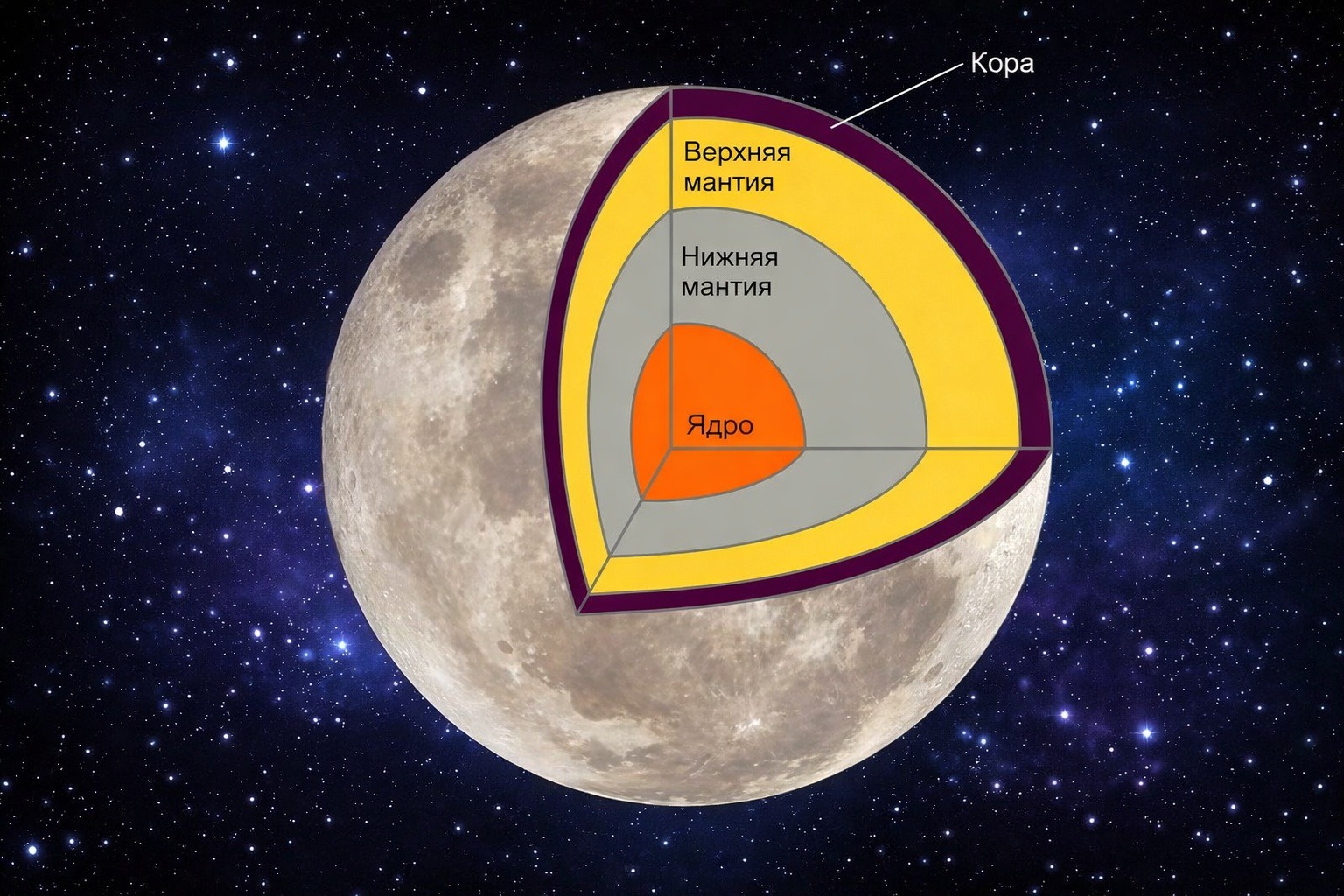
Internal structure of the Moon
What the Analysis of Lunar Rocks Revealed
An international team of researchers applied modern paleomagnetic analysis methods to the Apollo samples — methods that did not exist in the 1970s. The key task was to separate genuine lunar magnetization from artifacts, since over decades of storage on Earth, the rocks had been exposed to Earth’s magnetic field and even the magnetic fields of laboratory equipment.
The results were unexpected. The actual strength of the ancient lunar magnetic field had been significantly overestimated in earlier studies. Previous measurements showed a field strength of up to 100 microtesla — roughly twice the strength of Earth’s current field. The new data indicates much more modest values, which completely changes the picture.
The point is that with lower field intensity, there is no longer any need to seek exotic mechanisms for its generation. Ordinary thermal convection in the Moon’s relatively small liquid core is perfectly capable of doing the job. In simpler terms, the lunar dynamo operated on the same principles as Earth’s, only it was weaker and “switched off” roughly one billion years ago, when the core cooled and solidified.
Previous Measurements of the Moon’s Magnetic Field Were Inaccurate
It would seem that scientists were working with the very same rocks — so where did the error come from? It all comes down to technology and approaches. In the 1970s and 1980s, paleomagnetic analysis was significantly cruder. Researchers used larger samples, and demagnetization methods did not allow precise separation of primary magnetization from secondary magnetization.
Secondary magnetization is “noise” that accumulated in the rocks after their formation. There are numerous sources of this noise: meteorite impacts that heated the rock and remagnetized it, solar wind exposure after the disappearance of the lunar field, and even the simple storage of samples on Earth. Modern methods allow scientists to “peel away” these layers one by one, reaching the original signal.
Furthermore, a new generation of magnetometers works with samples less than one millimeter in size, allowing analysis of individual mineral grains. This is truly a revolutionary approach: instead of an averaged signal from an entire piece of rock, scientists obtain pinpoint data from specific crystals that preserved the primary record.
That said, no one disputes the very existence of the lunar dynamo — the field indeed existed. But its strength turned out to be one that can easily be explained by standard physics, without invoking hypotheses about giant collisions or tidal effects from an early close approach to Earth.
What the Discovery Means for Understanding Other Moons
This research is important far beyond just lunar science. Magnetic fields are one of the key factors determining the habitability of planets. Without a magnetic shield, solar wind gradually strips away the atmosphere, which is probably what happened to Mars. Understanding how dynamos work in small bodies helps assess which exoplanets and moons could have retained conditions suitable for life.
If extreme conditions are not needed to generate a magnetic field and ordinary convection in a relatively small core is sufficient, then the number of potentially “protected” bodies in the Solar System and beyond increases dramatically. This applies, for example, to Jupiter’s moon Ganymede — the only moon in the Solar System that possesses its own magnetic field right now.
The research results also affect plans for future lunar missions. The Artemis program, launched in late 2022, envisions the creation of a permanent base on the Moon, and understanding the history of the lunar magnetic field is critically important for assessing the radiation environment. When the magnetic shield disappeared, the Moon’s surface became fully exposed to cosmic radiation, and over a billion years without protection, the lunar regolith accumulated a colossal radiation dose.
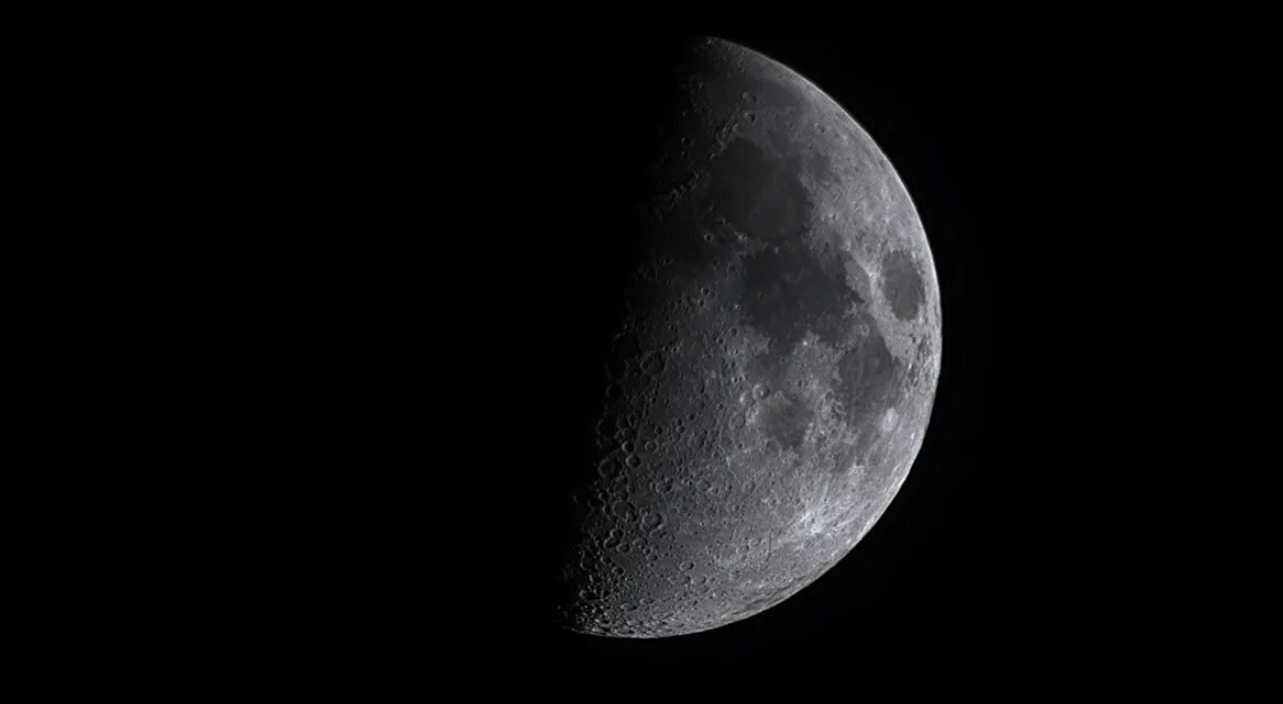
The Moon was once very different — with a magnetic shield, volcanoes, and possibly even a thin atmosphere. Image source: IFL Science
How Scientists Will Test the New Lunar Dynamo Model
Revising old data alone is, of course, not enough. The scientific community has already outlined several paths for verification. First, the Artemis 3 mission and subsequent expeditions should deliver fresh samples from regions of the Moon that Apollo never visited, primarily from the south pole area. This will provide an independent paleomagnetic record from different locations and different epochs.
Second, China’s Chang’e program has already delivered samples from the far side of the Moon, and their paleomagnetic analysis is still ongoing. If these data also confirm the revised, more modest values of the ancient magnetic field, the mystery will be officially closed.
But there is a nuance. Some researchers point out that the lunar magnetic field may have been unstable — intensifying after major impact events and fading during quiet periods. If that is the case, some samples will show a strong field while others will show a weak one, and both sides of the debate will turn out to be right in their own way.
For fifty years, scientists tried to understand how the tiny Moon managed to create a powerful magnetic field. The answer turned out to be elegantly simple: it never created anything supernatural. The early measurements simply overestimated the real values, and nature, as is often the case, managed without exotica — standard physics was more than enough.