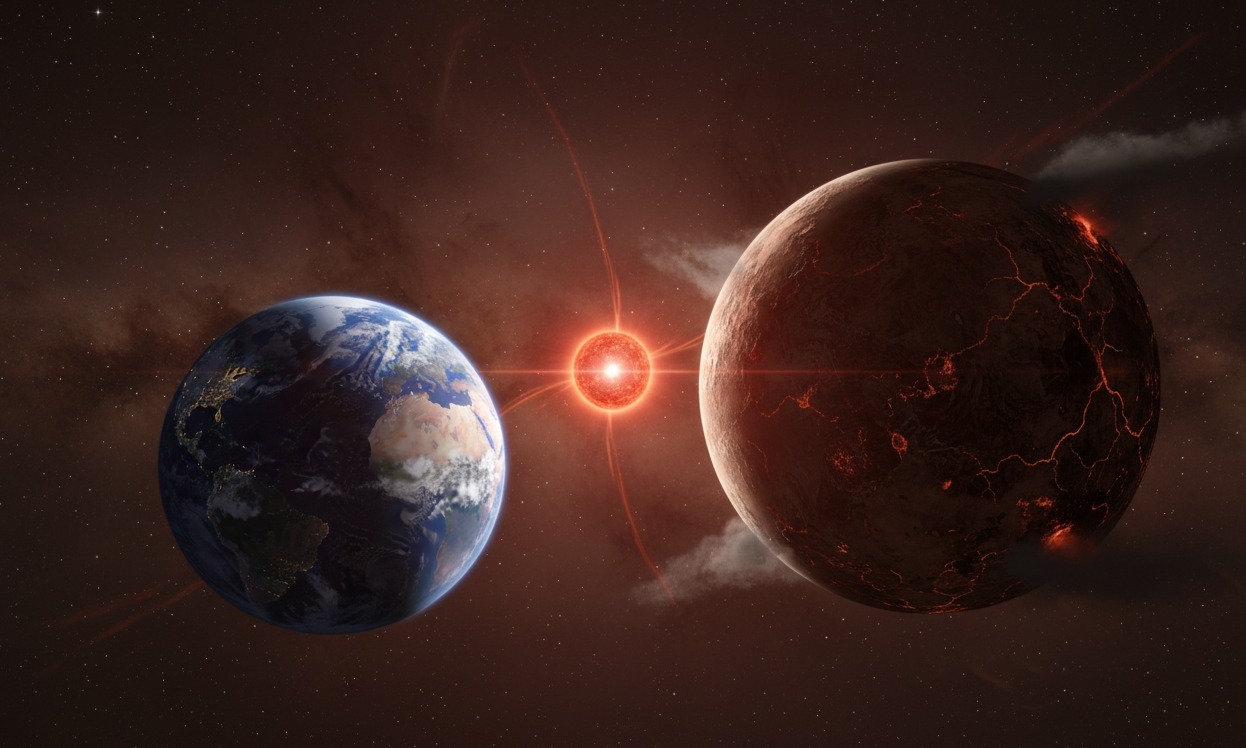
A radius only 1.2 times that of Earth — by exoplanet standards, TOI-1080 b is practically a twin of our planet
Every time astronomers find a rocky planet slightly larger than ours, hearts skip a beat: what if this time we get lucky and find life there? A team of scientists led by a Mexican astronomer has confirmed the existence of a new world just 83 light-years from the Sun. Planet TOI-1080 b turned out to be a moderately warm super-Earth with a possible atmosphere, and now researchers want to understand whether there could be something truly interesting there.
How Scientists Found the New Earth-Like Planet
The TESS space telescope (Transiting Exoplanet Survey Satellite) is currently observing approximately 200,000 bright stars near the Sun, searching for characteristic flickering — signals of so-called transits. These are moments when a planet passes in front of its star and slightly dims its light. It was exactly this kind of signal that was detected in the light curve of star TOI-1080 — an inactive red dwarf of spectral class M4V.
The group of scientists was led by Ilene Gómez Maqueo Chew from the National Autonomous University of Mexico. The suspicious signal in the TESS data was confirmed through observations with ground-based telescopes. It turned out that the flickering was indeed caused by a planet passing in front of the star. To date, the TESS mission has cataloged nearly 7,900 exoplanet candidates, of which 759 have already been confirmed. The research results have been published on the preprint server arXiv.
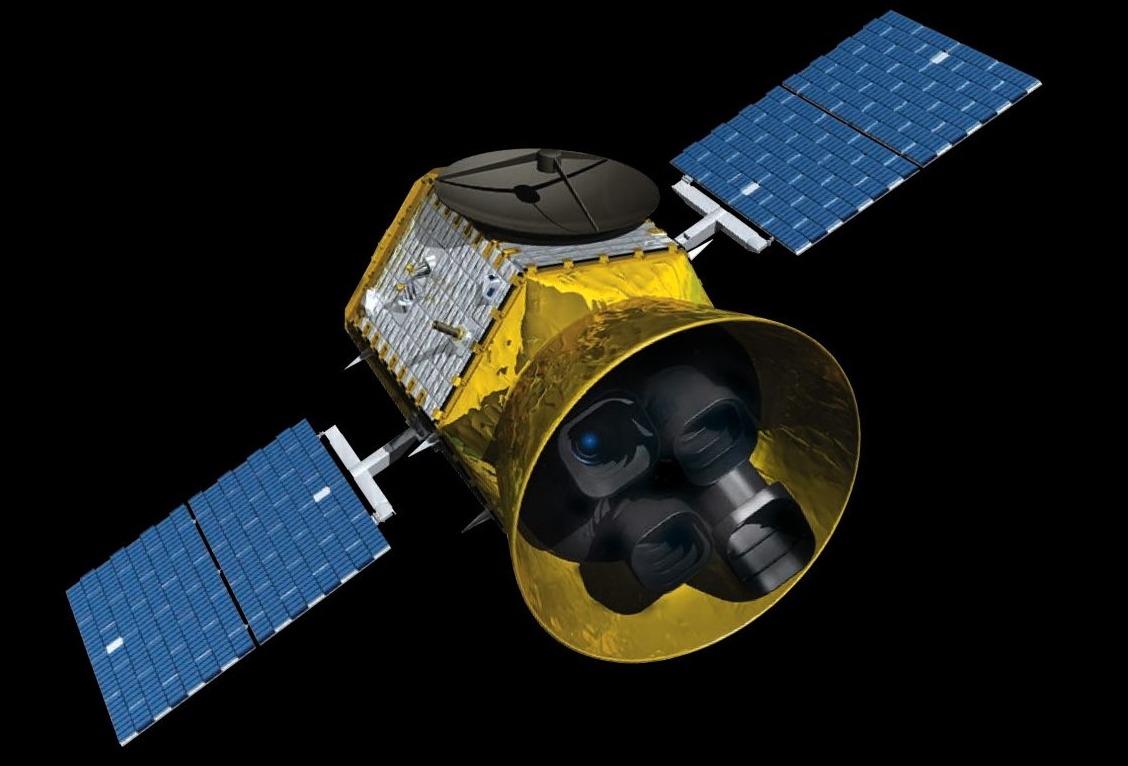
TESS Telescope. Image source: wikipedia.org
How Planet TOI-1080 b Resembles Earth
The new world turned out to be neither a gas giant nor a scorching hell, but something far more intriguing. Measurements showed that the radius of TOI-1080 b is approximately 1.2 times that of Earth, and its mass, according to scientists’ estimates, is most likely close to 1.75 Earth masses (upper limit — 10.7 Earth masses). Simply put, we are looking at a rocky super-Earth — a planet larger than ours, but still solid rather than gaseous.
A year on TOI-1080 b lasts only 3.97 Earth days. The planet orbits incredibly close to its star — at a distance of about 0.027 astronomical units. For comparison, Mercury is about 0.39 AU from the Sun, meaning TOI-1080 b is pressed 14 times closer to its star than the closest planet to our Sun. But here’s the trick: the host star is much dimmer and cooler than the Sun, so the equilibrium temperature of the planet is about 368 K (approximately 95 °C). That’s a lot for life as we understand it, but for rocky exoplanets this is considered a moderate figure.
THE MAIN INTRIGUE: scientists suggest that TOI-1080 b may possess an atmosphere rich in carbon dioxide or a dense oxygen layer. But for now, this is just a hypothesis. To confirm or refute the presence of an atmosphere, additional spectroscopic studies will be needed.
What Is Known About the Star TOI-1080
The red dwarf TOI-1080 is a modest but notable star in its own way. It is roughly five times smaller than the Sun, and its mass is only 0.16 solar masses. The surface temperature is about 3,065 K, making it significantly cooler than our luminary (for comparison, the Sun’s temperature is about 5,778 K).
Based on stellar models, astronomers believe that TOI-1080 is between 5 and 7 billion years old. This means the system is older than our Solar System, which is “only” 4.6 billion years old. Over such a span of time, a potential planetary atmosphere would have had enough time to form or, conversely, dissipate under the influence of stellar radiation. However, the fact that the star is inactive works in favor of atmosphere preservation: active red dwarfs are notoriously known for powerful flares capable of “blowing away” the gaseous envelope from nearby planets.

The red dwarf TOI-1080 may be part of a multi-planet system. Image source: interestingengineering.com
Could There Be Other Planets Near TOI-1080 b
M-class red dwarfs often turn out to be hosts of compact multi-planet systems. That’s why scientists didn’t stop at one discovery and checked whether other worlds might be hiding near TOI-1080 b.
The result was strict but not definitive. According to TESS data, there are no additional transiting planets larger than 0.9 Earth radii with orbital periods from 0.5 to 7.7 days in the system. For longer orbits, up to approximately 19 days, planets larger than 1.4 Earth radii can be ruled out. But this doesn’t mean the system is alone: smaller planets or worlds on inclined orbits that don’t pass in front of the star may have remained invisible to the transit method.
The thing is, the transit method only works when a planet’s orbit passes exactly between the star and the observer. If the inclination angle is slightly different, the planet simply won’t appear in the frame. So the question “does TOI-1080 b have neighbors” remains open.
Why Study Super-Earths Around Red Dwarfs
Red dwarfs are the most common stars in our Galaxy. If even a fraction of them have rocky planets with atmospheres, this radically increases the chances of detecting conditions suitable for life. TOI-1080 b is currently located inside the habitable zone of its star (that is, slightly closer than needed for liquid water on the surface), but the very fact of discovering a moderately warm rocky super-Earth with a possible atmosphere is already a serious claim.
The next step will be spectroscopic analysis of the atmosphere. If future observations confirm the presence of carbon dioxide or oxygen, TOI-1080 b will join a very short list of worlds deserving the closest attention. For now, we can only state: 83 light-years away from us, a small rocky world is orbiting, and it refuses to be boring.