
Want to turn on the TV for your dog? Here’s the content they’re actually interested in. Image source: sciencefocus.com
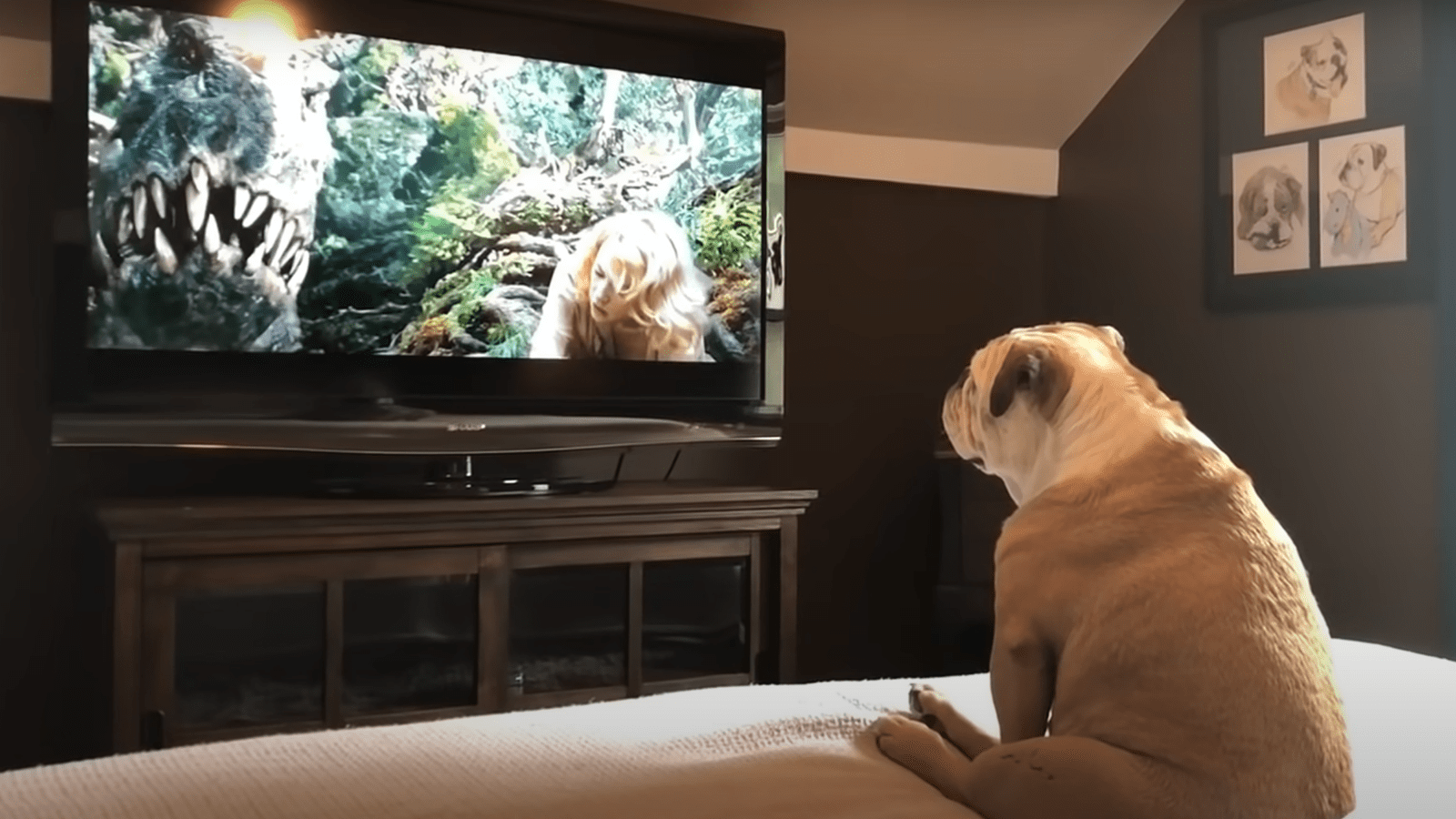
You turn on a show, settle onto the couch — and notice that your dog is also staring at the screen. A coincidence? Apparently not. A new study in the journal Scientific Reports has shown that dogs really do react to television — but their “genre” preference is quite specific. And most importantly — it all comes down to personality.
What dogs like on TV: reactions to animals and people
The study, led by Jeffrey Katz from Auburn University, was based on 513 surveys, of which 453 owners confirmed that their dogs watch television. The researchers developed a special scale — the Dog Television Viewing Scale (DTVS). Owners rated on a five-point scale how often their pets bark, growl, or reach a paw toward the screen in response to different stimuli.
The main finding is simple: animals on screen are more interesting than people and objects. Content featuring dogs, cats, or wildlife elicits more reactions than human faces, cars, or abstract scenes. Moreover, age, breed, and “viewing experience” did not play a statistically significant role.
But temperament did.
- Excitable dogs more often try to “chase” objects behind the screen — looking for them on the sides, reaching out with their paws.
- Anxious and fearful dogs react more to non-animal stimuli: a doorbell, a car horn, a human face.
This study not only sheds light on pet psychology but could also help veterinarians develop standardized tests for checking dogs’ vision. Image source: messagu.ru
How dogs see television: vision characteristics
A dog’s vision differs from that of a human. They have two types of cones instead of three, so their color spectrum is narrower.
In addition, their flicker fusion threshold is higher: some videos may look like a sequence of frames rather than smooth motion. And their resolution is lower — they have fewer photoreceptors.
Nevertheless, movement, contrast, and nature sounds compensate for these technical limitations. Moreover, a previous study from 2024 involving more than 1,000 dog owners showed similar results: other animals in on-screen scenes, especially dogs, consistently hold attention best of all.
Can you turn on the TV for your dog, and what content should you choose?
The researchers initially hoped to find universal “calming” videos. But the data showed the opposite: universal content doesn’t exist. For an excitable dog, a nature documentary can become an additional irritant — they’ll start reacting to movement and trying to “catch” animals on the screen. For an anxious dog — it can, on the contrary, amplify reactions to sounds and noises.
The practical advice is simple:
- observe your specific dog’s reactions;
- avoid loud, unexpected sounds;
- if your dog starts barking and looking for the “enemy” behind the TV — it’s better to change the content.
In the future, such studies could even help veterinarians — for example, by creating standardized video tests for checking vision in older dogs.
And yes, perhaps your dog watches TV also because you’re watching it together. For a dog, it’s not just a screen but part of a shared ritual.