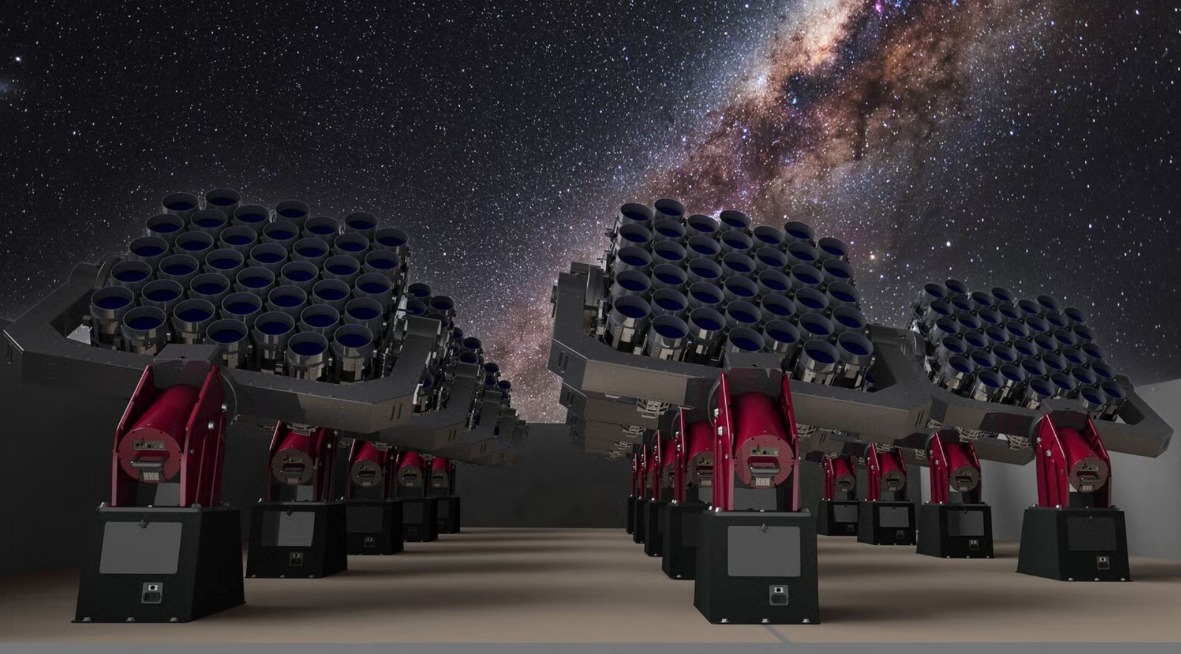
Each of the 30 mounts carries 38 Canon lenses with filters. It looks like a photographer’s dream, but this machine is for serious science. Image source: interestingengineering.com
Typically, to peer deeper into the Universe, astronomers build telescopes with enormous mirrors. The bigger the mirror, the more light it collects, and the farther scientists can see into the cosmos. Recently, a team of researchers from Yale University and the University of Toronto took an entirely different approach: instead of one gigantic mirror, they used 1,140 Canon lenses and assembled them into a next-generation telescope. It’s called MOTHRA, and its goal is to directly observe the cosmic web for the first time.
What Is the MOTHRA Telescope
MOTHRA stands for Massive Optical Telephoto Hyperspectral Robotic Array. The name, by the way, is a nod to the giant moth from Japanese monster movies — and that’s no coincidence: like the compound eye of an insect, the telescope collects light through many lenses simultaneously.
Unlike classical observatories with large mirrors, MOTHRA uses an array of 1,140 Canon telephoto lenses mounted on 30 robotic mounts — 38 lenses on each. All lenses are pointed at the same area of the sky, and their images are digitally combined. As a result, the array functions as a single giant lens approximately 4.7 meters in diameter. This makes MOTHRA the world’s largest all-lens telescope.
But MOTHRA’s main trick isn’t its size — it’s the ultra-narrowband filters capable of isolating the faintest glow of hydrogen gas drifting between galaxies. Conventional mirror telescopes produce scattered light due to diffraction and micro-scratches on the mirrors, and this “noise” hides dim structures. Lenses coated with special anti-reflective nanocoatings produce an order of magnitude less scattered light.
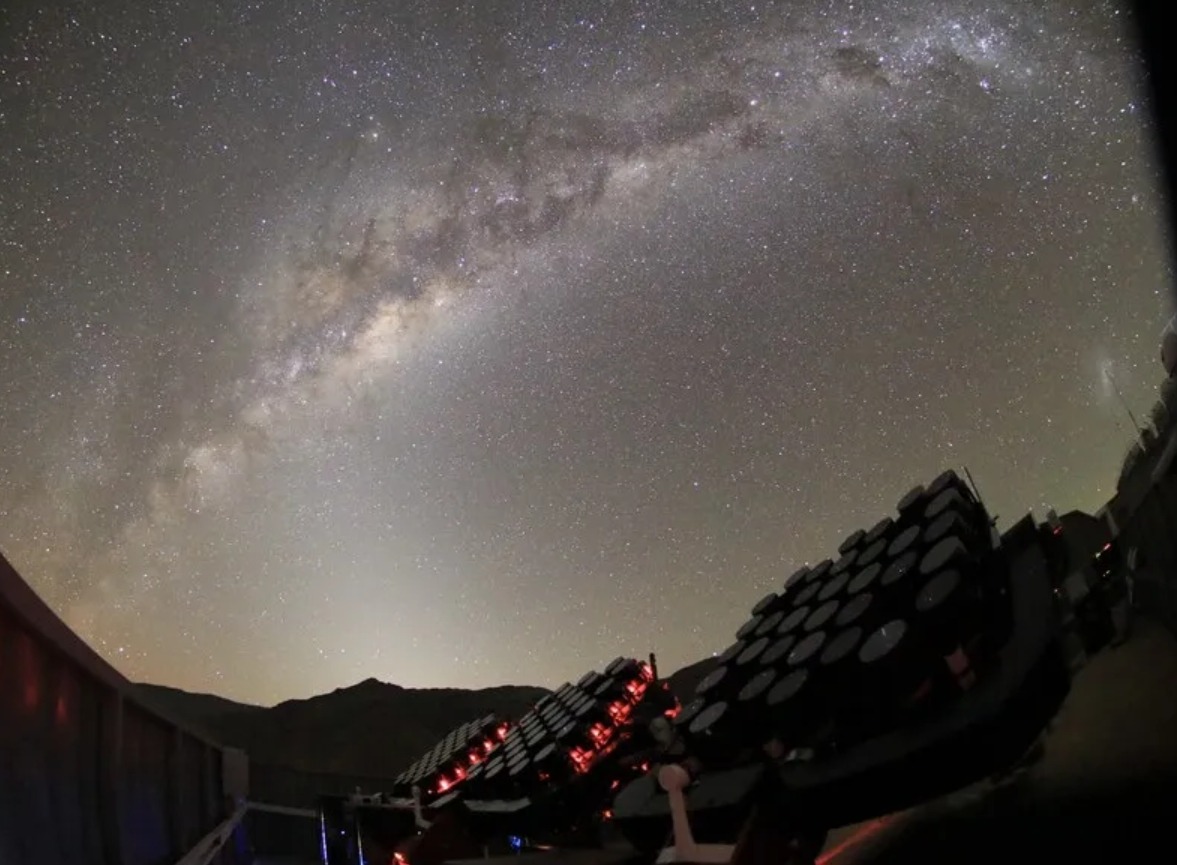
The partially assembled MOTHRA telescope system observes the Milky Way at the El Sauce Observatory in Chile. Image source: interestingengineering.com
How the Most Powerful Telescope Was Conceived
According to Interesting Engineering, the idea for MOTHRA grew out of the Dragonfly Telephoto Array project — a predecessor telescope created by the same scientists, Pieter van Dokkum and Roberto Abraham. In 2013, they assembled the first prototype from just three Canon lenses. Gradually, the array grew to 48 lenses, and the results were astonishing.
It was Dragonfly that discovered Dragonfly 44 — a galaxy comparable in mass to our Milky Way but consisting of 99.9% dark matter. It also found NGC 1052-DF2 — a galaxy that, conversely, appeared to be virtually devoid of dark matter. These discoveries showed that modest-looking photo lenses can detect things that are beyond the capabilities of enormous mirror telescopes.
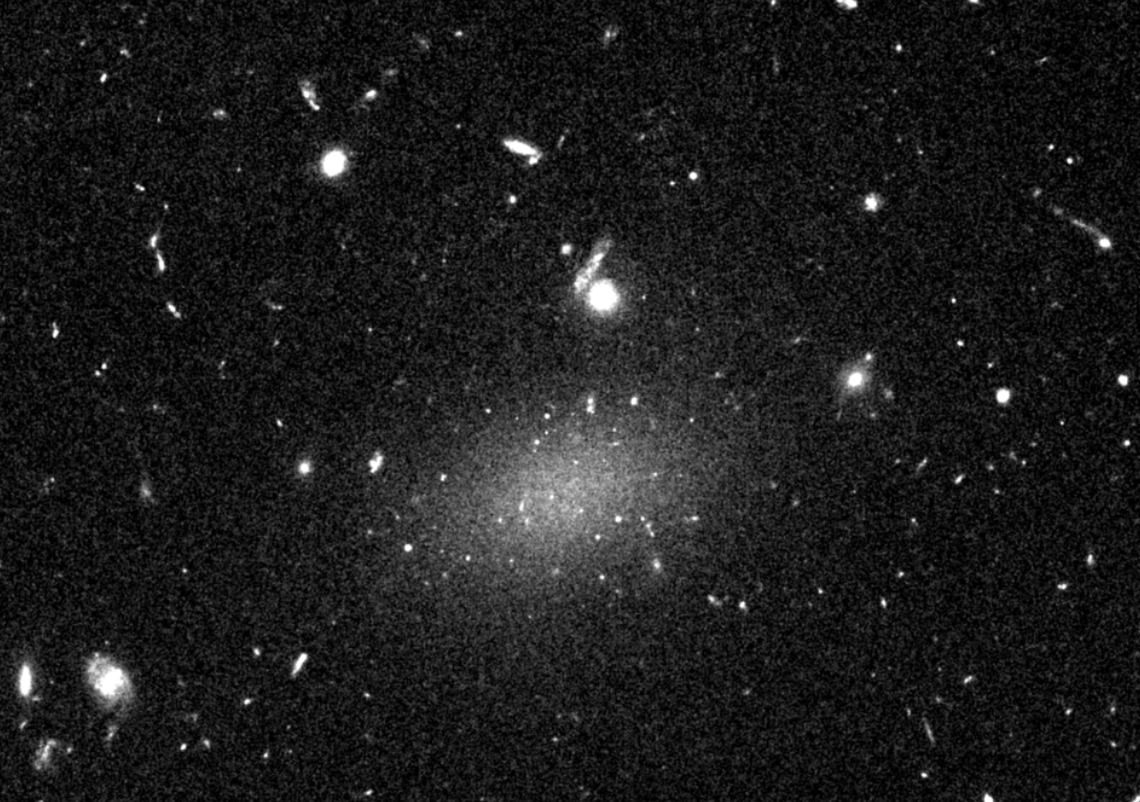
The Dragonfly 44 galaxy. Image source: wikipedia.org
What Is the Cosmic Web
The cosmic web is the largest structure in the Universe. It consists of long filaments of gas and dark matter connecting galaxies across colossal distances. Scientists believe these structures began forming shortly after the Big Bang. Over billions of years, gravity pulled matter into a web-like pattern stretching across the entire observable Universe.
Galaxies line up along these filaments like dewdrops on a spider’s web. But the gas between them is so faint that direct observation has remained virtually impossible until now. Astronomers have known about the cosmic web for decades but have mostly seen it indirectly: through computer models, gravitational lensing, and the absorption of light from distant quasars.
For comparison, the hydrogen in these filaments glows so faintly that even the MUSE instrument on the Very Large Telescope in Chile spent hundreds of hours of observations to obtain the first direct image of just a single filament. MOTHRA, on the other hand, promises to map the cosmic web systematically and with sensitivity that, according to the developers, exceeds any existing instrument on Earth or in space by at least an order of magnitude.

The existence of the cosmic web was predicted theoretically, and it has only been observed in a couple of instances. Image source: Live Science
Where the Largest Observatory Is Being Built
The telescope is being constructed at the El Sauce Observatory in Chile’s Río Hurtado valley, in the southern part of the Atacama Desert. This is one of the best locations on Earth for astronomical observation: it has more than 300 clear nights per year and virtually no light pollution. Construction began in the spring of 2025, and the telescope is expected to become fully operational by the end of 2026.
The project’s organizational structure is also unusual. A company called Dragonfly FRO — a so-called Focused Research Organization — was created to build MOTHRA. It is a nonprofit entity operating on a tech startup model: a clear mission, limited timelines, and maximum speed. As the creators explain, such projects are too large for a single academic lab but don’t fit into traditional government funding schemes either.
What the New Telescope Will Reveal About Dark Matter
If the project succeeds, MOTHRA will produce one of the most detailed maps of the cosmic web in history. The telescope will show not only where the gas between galaxies is located but also how it moves along the web’s filaments. And since ordinary matter follows dark matter, a map of the gas will essentially become a map of dark matter distribution — the mysterious substance that accounts for about 85% of all mass in the Universe.
All galaxies are connected by a giant web of invisible cosmic matter. This is our origin story, the engine that drives galaxy growth. And yet studying it has been incredibly difficult.
MOTHRA will also help scientists understand galactic feedback — the mechanism by which gas from the cosmic web falls into galaxies and fuels the birth of new stars, while supernova explosions and active black holes eject gas back into intergalactic space. This cycle determines how galaxies grow and evolve, but it has largely remained theoretical until now.