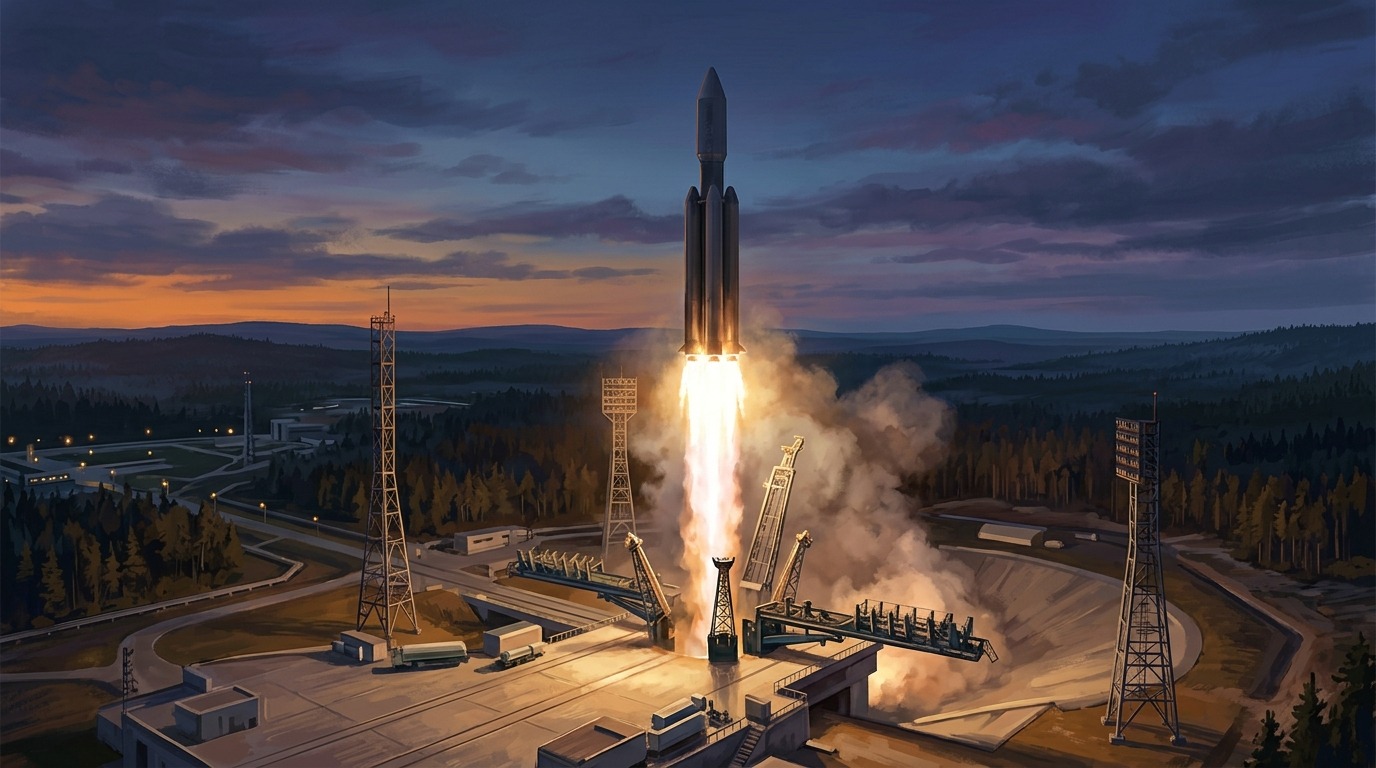
Rocket launch from the Plesetsk Cosmodrome
Russia is building its own Starlink analog — a satellite system called “Rassvet” (Dawn), which is designed to provide fast internet even in the Arctic, taiga, and over the ocean. While SpaceX has nearly 10,000 spacecraft in orbit, Russia’s project is only entering the stage of serial launches. The first batch of 16 satellites was launched into space on March 23, 2026, and full-scale operation is planned for 2027. So how does “Rassvet” differ from Starlink, and who needs all of this?
Russia’s “Rassvet” Satellite Internet
“Rassvet” is a low-Earth orbit satellite constellation by the company “Bureau 1440,” which is part of “IKS Holding.” The concept is the same as Elon Musk’s Starlink: launch hundreds of small satellites into low orbit to provide broadband internet on the ground. The promised specifications include speeds up to 1 Gbps per subscriber terminal and signal latency of no more than 70 milliseconds. This is comparable to a good home wired connection.
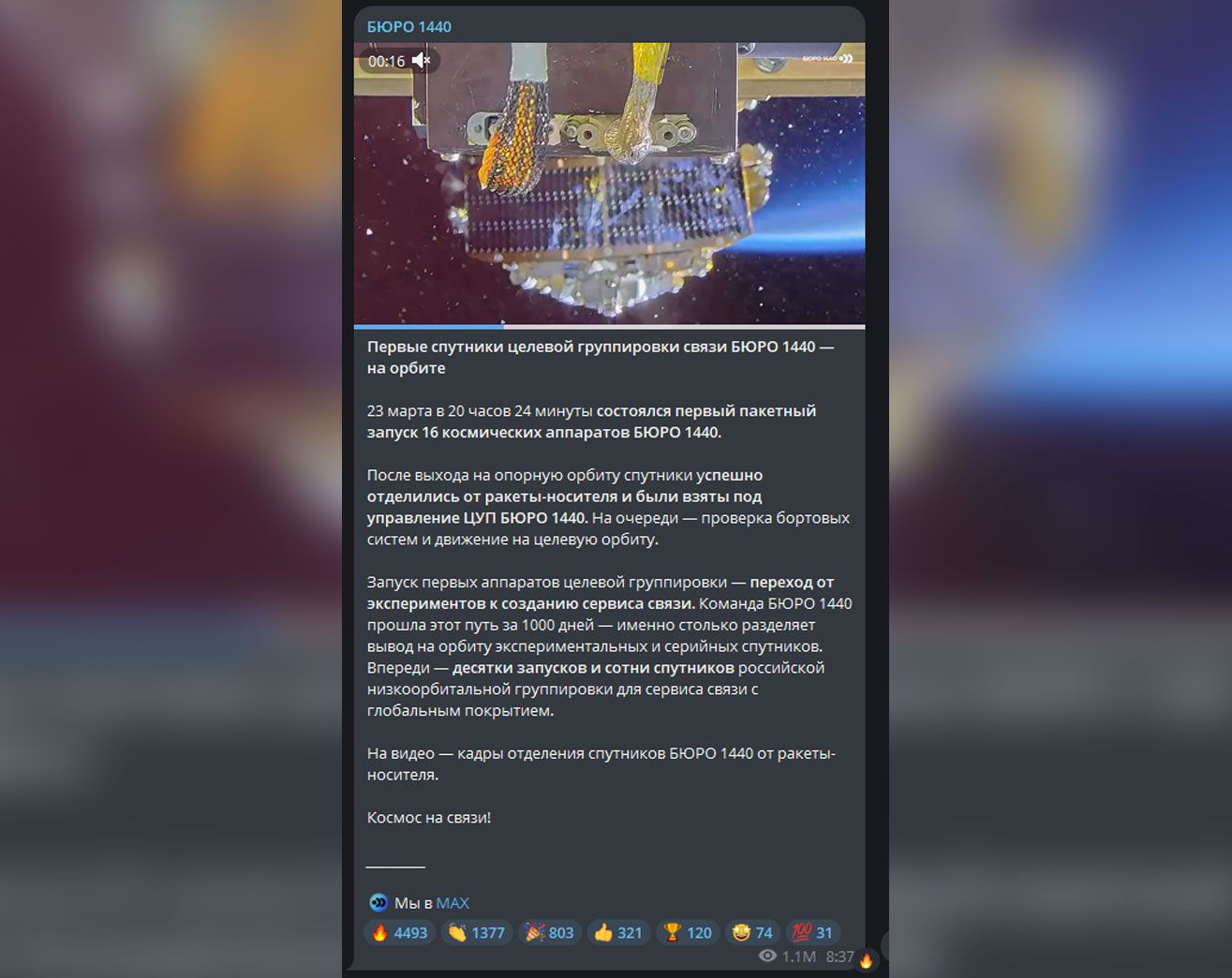
Post about the launch of “Rassvet” satellites in Bureau 1440’s Telegram channel
The company has been operating since 2020, and the first test satellites, “Rassvet-1,” flew in June 2023 — three spacecraft launched from the Vostochny Cosmodrome on a Soyuz-2.1b rocket. As early as August 2023, engineers conducted the first satellite video call in Russia from an area without cellular coverage — from Mount Fisht in Adygea.
In May 2024, three larger “Rassvet-2” satellites were sent into orbit. They were already equipped with laser communication terminals and 5G NTN standard equipment — a technology that allows a satellite to function as a “tower” for regular cellular networks.
Differences Between “Rassvet” and Starlink
The differences start with orbital altitude. Starlink satellites fly at about 550 km, while “Rassvet” operates at 800 km. It might seem like 250 kilometers is nothing by space standards, but for satellite communications, it’s significant. The higher the spacecraft, the larger the area of Earth it “sees” and the more subscribers it can serve simultaneously. This means “Rassvet” needs fewer satellites to cover the same territory.
There are other advantages to a higher orbit: at 800 km, the influence of residual atmosphere is weaker, so the satellites don’t need to fire their engines as frequently to maintain speed — this extends their service life. But there’s a downside: at a greater altitude, it’s harder to dispose of malfunctioning spacecraft, and there’s a higher risk of space debris accumulation. That’s precisely why SpaceX, conversely, plans to lower the orbit of its satellites from 550 to 480 km in 2026.
The key technology of “Rassvet” is proprietary inter-satellite laser communication. The satellites transmit data to each other directly using infrared lasers at speeds of 10 Gbps. This reduces dependence on ground stations: data can “hop” from satellite to satellite directly in orbit until it reaches the nearest reception point. During the “Rassvet-2” mission, engineers successfully transmitted data between spacecraft at distances ranging from 30 to 1,005 km without any loss. Starlink also has laser communication, but it’s being implemented gradually, whereas in the Russian project it has been built in as a fundamental feature from the very beginning.
The main difference is in scale. As of the end of February 2026, Starlink has more than 9,800 satellites in orbit. “Rassvet” currently has only six test spacecraft. Plans call for 156 satellites in 2026, 292 in 2027, and by 2035 the constellation could grow to 900 spacecraft. According to Bureau 1440 deputy head Dmitry Agafonov, global coverage requires 12 orbital planes with 20 or more spacecraft in each.
Why Satellite Internet Is Needed in Russia
For residents of major cities that already have fiber optics and 5G, satellite internet might seem redundant. But Russia is a country where vast territories lack cellular coverage. “Rassvet” is being created precisely for such areas. Here are the main applications:
- Transportation. Stable internet for train and airplane passengers along entire routes. “Bureau 1440” has already signed cooperation agreements with Russian Railways (RZD) and Aeroflot, and Rosaviatsia is discussing the installation of terminals for in-flight internet.
- Oil extraction and energy. Drilling platforms and power stations in remote areas need a constant data transmission channel.
- Emergency services (EMERCOM). A satellite channel provides communication for rescuers in disaster zones where ground infrastructure has been destroyed.
- The Arctic and the Northern Sea Route. At high latitudes, geostationary satellites don’t work — their signal simply can’t reach polar regions. Low-orbit spacecraft solve this problem.
According to RBC, in 2026 “Bureau 1440” plans to test satellite communications in the Nenets Autonomous Okrug — one of the most remote regions of the country. If the test is successful, it will become a strong argument in favor of the system’s practical value.
How Much Will “Rassvet” Satellite Internet Cost?
Tariffs for regular users don’t exist yet — as of February 2026, they haven’t been announced. “Bureau 1440” is primarily targeting corporate clients (B2B) and calculates costs individually for each company.
For reference, approximate prices for regional government authorities have been published. A channel of up to 10/2 Mbps will cost 25,000 rubles per month, up to 50/10 Mbps — 100,000, and up to 600/250 Mbps — 250,000 rubles monthly. This is expensive by home internet standards, but for a remote settlement or drilling platform where it’s physically impossible to run a cable, there are simply no alternatives.
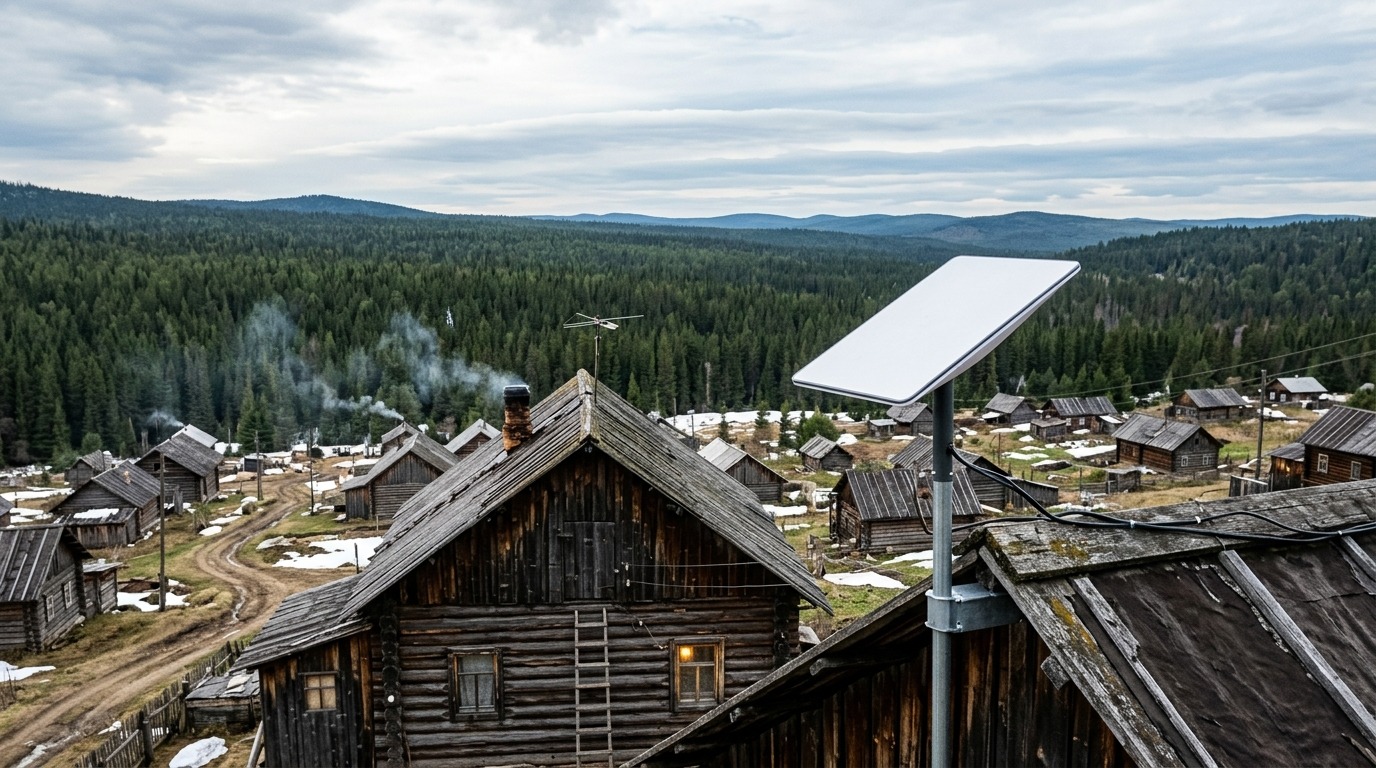
This is approximately what a satellite internet subscriber terminal on a rooftop might look like
To connect, you’ll need a subscriber terminal — a device with a flat phased-array antenna that receives and transmits signals directly from the satellite. In the future, another option is possible: cellular operators will install terminals on their base stations and broadcast the satellite signal over regular 4G/5G frequencies, so the subscriber will only need an ordinary smartphone.