Your favorite track suddenly has “beeps” instead of words, and an entire album has vanished from your library — sound familiar? Since the beginning of 2026, thousands of Russian listeners have faced exactly this situation. And the solution they found was unexpected: instead of subscribing to streaming services, people are buying old MP3 players where you can load music once and for all — and no service can ever touch it.
Russians are massively buying MP3 players due to streaming censorship: here’s what’s happening. Image: osnmedia.ru
Why Russians Are Buying MP3 Players Again in 2026
The reason for the frenzy is simple and clear. On March 1, 2026, amendments came into force in Russia under which artists and labels risk fines for any mention of prohibited substances in their songs. But platforms decided not to wait: even before the law took effect, services like Yandex Music began cutting words and lines from tracks, and some albums completely disappeared from platforms.
Listeners perceived this as a direct threat to their playlists. The thing is, in the era of streaming, you don’t own the music — you rent it. A service can delete a track at any moment, replace it with a censored version, or remove it from the catalog entirely. And while this used to be something hypothetical, it has now become an everyday reality. Some artists are playing it safe and bleeping out any words and lines that could potentially cause problems. As a result, tracks sometimes lose all meaning.
What’s Happening with Player Sales and How Avito Fits In
The numbers speak for themselves. According to the Telegram channel Baza, citing Avito, MP3 player sales in February 2026 grew by 23% compared to the same month last year. At the same time, 80% of buyers choose used devices, including models from the early 2000s. The average price of a retro player on the secondary market was 6,300 rubles.
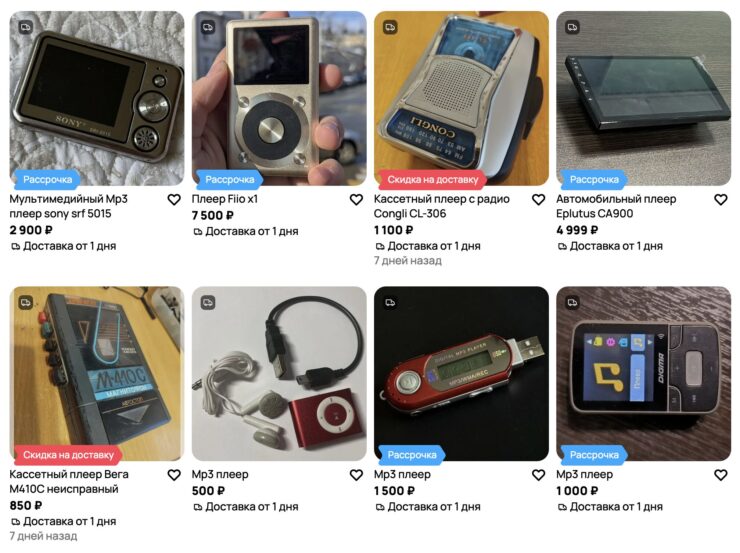
On Avito right now you can find players ranging from 500 rubles for nameless “flash drives with buttons” to tens of thousands for collectible models.
According to buyers, the logic is simple: music downloaded to a device won’t disappear or change without their knowledge. No service can reach it. For this guarantee, people are willing to regularly connect the gadget to a computer and manually load audio files — an inconvenience they consciously accept.
Interestingly, according to Google Trends data, in the first week of March, searches for “mp3 player” and “buy iPod” reached peak popularity in Russia. The trend went far beyond Avito.
How Much Does an iPod Cost in Russia
A separate story involves the iconic Apple iPod players. The last generation of iPod Classic was discontinued in 2014, while the Nano and Shuffle models were discontinued in 2017. But these are the very devices now experiencing a true renaissance.
An iPod Shuffle in good condition goes for about 3,000 rubles on Avito, one in excellent condition costs around 5,000 rubles, while sealed units in original packaging already go for 10,000 rubles. A 3rd-generation iPod Nano with a replaced battery can be found for 14,000–15,000 rubles on Yandex Market.
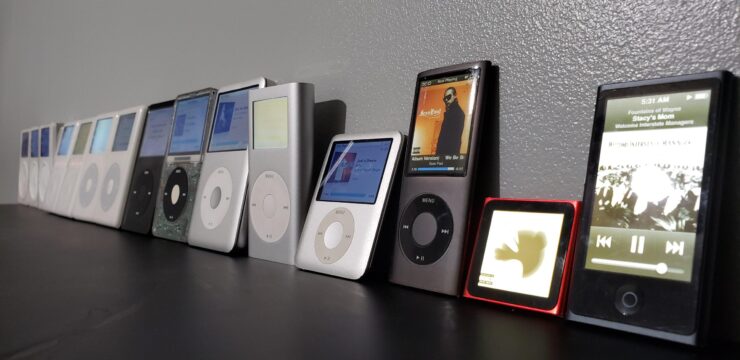
iPod Classic is easy to repair: a new back cover costs 1,500–2,000 rubles and can be replaced by hand. Image: Reddit
But the real hit of the secondary market is the iPod Classic. Modified units with the hard drive replaced by an SSD, memory expanded to 256 GB, and added Bluetooth and USB-C sell on Avito for 20,000–30,000 rubles. For comparison, a new iPod Classic 160 GB once cost around 12,000 rubles at Russian retail.
On the global market, the situation is similar. On eBay, prices for retro iPod models have surged by 60%, with the average range being $100–400 per unit. Premium variants sell for $600 and more. This is part of a global trend: sales of refurbished iPods have been growing by 15.6% annually since 2022.
Not Just the Law: Why the MP3 Player Trend Is Broader Than It Seems
It would be an oversimplification to attribute everything solely to the new law. In fact, analog devices were already gaining popularity amid the trend toward “tech without the extras.” After 2022, virtually all international services restricted their operations in Russia. Major Western labels — Universal Music Group, Sony Music Entertainment, and Warner Music Group — suspended operations in the Russian market, leading to the disappearance of parts of catalogs from domestic streaming libraries.
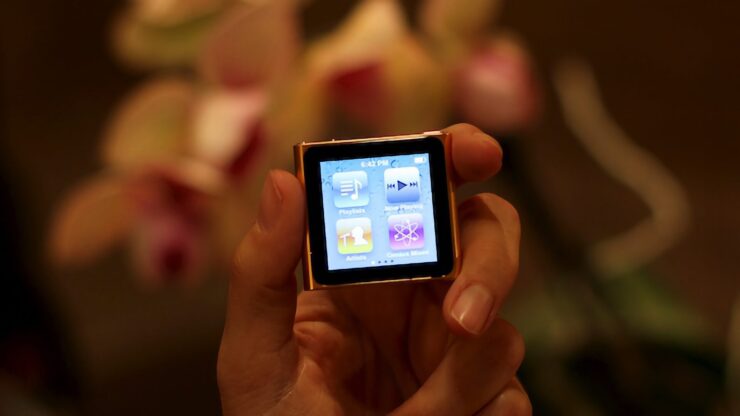
A dedicated device for music is also a way to avoid distractions from notifications, messengers, and the endless feed. Image: iMore
The main services for listening to music in the country remain Yandex Music, VK Music, and Zvuk. But their catalogs continue to shrink. For listeners, this was the last straw: why depend on a platform if it can take your music away at any moment?
At the same time, “digital burnout” is gaining momentum worldwide: young users are tired of smartphones where music is mixed with social networks, podcasts, and ads. On TikTok, hashtags #iPodComeback and #DumbPhone are racking up millions of views. People want a simple device for a single purpose, and an MP3 player fits perfectly.
Is It Worth Buying an MP3 Player in 2026
If you’re seriously considering a purchase, here’s what you should know. The cheapest no-name players can be found for a few hundred rubles, but the sound quality and build quality are accordingly low. The mid-range on Avito is those same 6,300 rubles, for which you can get a working device from the early 2000s with a nostalgic design.
For those who want not just nostalgia but good sound, the market offers modern Hi-Fi players from FiiO, Astell & Kern, and Sony. However, prices are entirely different: from 20,000 rubles for budget models to 370,000–450,000 rubles for flagships like the Astell & Kern SP3000.
The main thing to remember: on Mac, you can transfer music to a player via Finder, and on Windows — through iTunes. Uncensored audio files can still be found on the internet. And once loaded onto a device, they will stay there for exactly as long as you want.