Parents are thinking about buying their child’s first gadget earlier and earlier. We recently talked about the best smartphones for kids in 2026, but against the backdrop of our roundup, Russia has started discussing possible restrictions for schoolchildren. The topic of bans is increasingly coming up in the news, so many are wondering whether children can have a phone at all and whether restrictions will be introduced at the state level. Let’s figure out what’s happening now and whether to expect a full ban.

Will children really be banned from even using MAX?
Can Children Use a Smartphone
Today, a smartphone for a child has become a common thing. It’s needed not only for entertainment but also for staying in touch with parents, studying, and safety. Therefore, completely banning devices for children is quite difficult, and most experts talk specifically about reasonable restrictions rather than a complete ban.
At the same time, the topic of whether children can use phones without restrictions is regularly discussed at the government level. The State Duma has already raised the issue of the impact of gadgets on the health and academic performance of schoolchildren. In one of the discussions, it was noted that excessive smartphone use can negatively affect children’s development and their ability to concentrate. In particular, Russia’s Minister of Education Sergey Kravtsov stated:
It’s not normal when a three-year-old is given a smartphone or tablet so they don’t bother their parents. That’s not normal. It affects the child’s psychological development. <...> Therefore, there needs to be a certain age at which a child can start using a mobile phone.
The question of what age a child can have a phone also comes up frequently. There is no clear law on this matter, so the decision is usually made by parents. But at the level of schools and educational institutions, restrictions are already beginning to appear.
Can a Child Bring a Smartphone to School
The question of a child’s smartphone at school has already been partially resolved at the legislative level. Russia has adopted rules that restrict the use of mobile devices during classes. Now, many educational institutions have a smartphone ban at school during lessons. Students are allowed to bring their phones with them, but they cannot use them during class unless it is required for the learning process.
These measures are explained by the fact that children with smartphones get distracted, remember material worse, and use the internet more often instead of listening to the teacher. Therefore, the restrictions are introduced not to ban communication with parents, but to maintain discipline during lessons. At the same time, there are no plans to completely ban devices. Students can use their phones during breaks or after school, if permitted by the rules of the specific school.
Parental Control on a Child’s Android Phone
Even without government bans, parents can limit smartphone use. There is a built-in parental control on Android that allows you to monitor usage time, block apps, and restrict internet access.
This feature helps if a child spends too much time on the phone or installs unnecessary programs. Parental control on the phone is enabled through system settings or through the Google Family Link service. Instructions:
- Open “Settings.”
- Go to the “Digital Wellbeing” section.
- Select “Parental Controls.”
- Tap “Get Started.”
- Select the device type.
- Connect the child’s account.
- Set up restrictions.
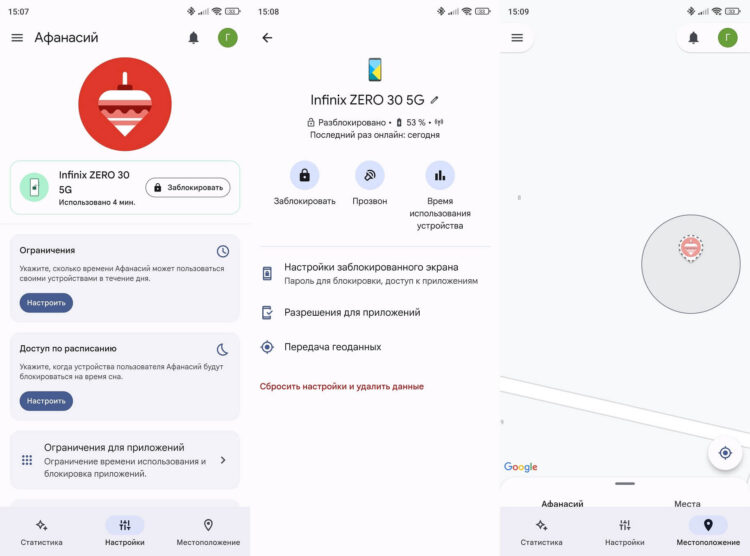
Parental control works through Family Link
After that, you can limit usage time, block games, or turn off the internet at certain hours. This method is considered more reasonable than a complete ban because it allows you to control rather than prohibit entirely.
When Will Smartphones Be Banned for Children
Talk about a possible full ban on phones is indeed happening. But right now, the discussion is not about a total restriction, but about possible rules of use. The idea of strengthening control over how children with smartphones spend their time is being discussed, as well as the introduction of additional recommendations for schools and parents. Some proposals concern restricting the use of gadgets in educational institutions, but not a complete ban.
The initiative is still at the consideration stage. There is no decision to completely ban smartphones for children, and none is expected in the near future. Most likely, new rules for schools and recommendations for parents will continue to emerge. Therefore, the question of whether a child can have a phone still remains at the discretion of the family, not the state.