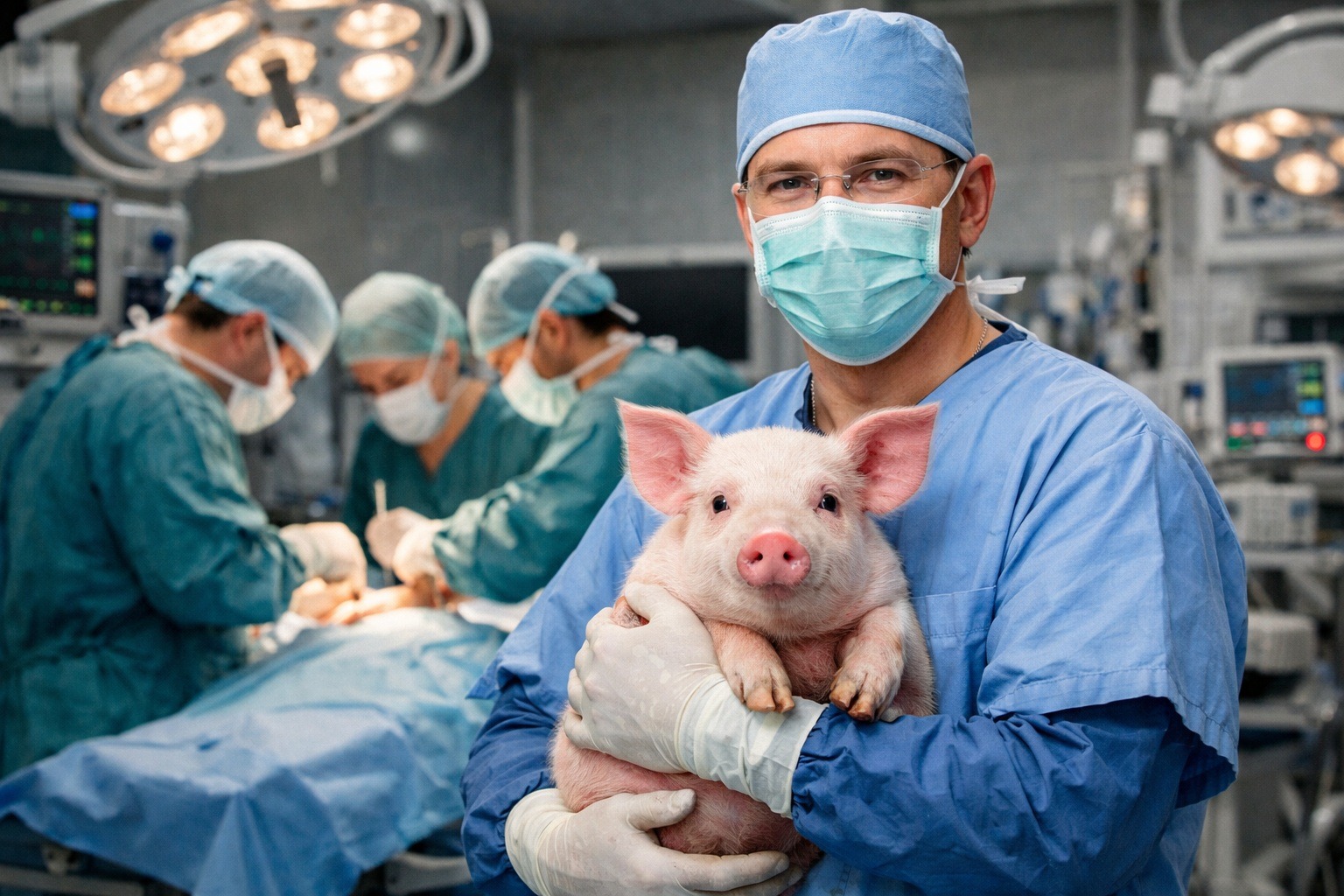
Even a few days of a transplanted organ functioning can give a patient a chance to wait for “their” donor
Every year, thousands of people around the world die without ever receiving a suitable donor organ. The wait for a kidney transplant can stretch on for years, and patients often simply don’t have that kind of time. But Russian scientists are working on a solution that until recently seemed impossible — transplanting organs from genetically modified pigs to humans. It sounds amazing, especially considering that organ transplantation could someday make humans immortal.
Why Pig Organs Are Suitable for Transplantation
The idea of transplanting animal organs to humans is nothing new. Scientists have spent decades searching for a way to solve the catastrophic shortage of donor organs, and pigs have turned out to be among the most promising candidates. The reason is that in terms of size and physiology, their organs are remarkably similar to human ones.
This approach is called xenotransplantation — transplanting organs from one biological species to another. Simply put, if a person’s own kidney has failed and there’s no suitable human donor available, a genetically modified pig can come to the rescue. More precisely, not an ordinary pig, but a specially bred mini-pig — a miniature breed whose organs are tailored for transplantation needs using genetic engineering.
The first organ for transplantation in Russia will be a kidney. And this is logical: kidneys are the most commonly needed organs for patients, and the waiting list for kidney transplants is one of the longest in the world. Meanwhile, in other parts of the world, transplanting pig organs to humans has already been attempted. For example, in 2025, surgeons tried transplanting a pig liver.

Mini-pigs will save human lives — how cute is that!
Pigs with Donor Organs in Russia
As reported by RIA Novosti, Eduard Chuiko, CEO of the company “M-Genomika,” said that the first mini-pig whose kidney could theoretically be transplanted to a human as a temporary organ could be raised in Russia as early as the first or second quarter of 2027.
Given the availability of infrastructure and the absence of obstacles, we could obtain the first such animal in Russia in just under a year. However, the more realistic timeline we are planning for is the first or second quarter of 2027, — Chuiko told RIA Novosti.
But there’s an important caveat. The first such organ won’t allow a person to live with it for months or years. At the initial stage, we’re talking about days — a mini-pig kidney will be able to function without rejection for only a few days. However, even this could be a lifesaver for those waiting for a suitable human organ. Essentially, the pig kidney will serve as a “bridge” that sustains the patient’s life at a critical moment.
When Will Russia Start Transplanting Pig Organs
According to Eduard Chuiko, by 2030 Russia could have a fully functional xenotransplantation capability. This means that with further technological refinement, a pig kidney could function in the human body for significantly longer than just a few days.
The project leader emphasized that the journey is just beginning. But there are no scientific obstacles to the project at this point. A team of top-tier scientists has been assembled and is working, including specialists from the Institute of Cytology and Genetics of the Siberian Branch of the Russian Academy of Sciences and the Meshalkin National Medical Research Center.
However, things are not entirely without challenges. Chuiko noted that there are certain financial and infrastructural difficulties.
The project is expensive and long-term; we are waiting for colleagues who are interested in working with us, — he concluded.
In other words, Russian science is technologically ready but needs partners and additional funding.
Pig Organ Transplants Around the World
Russia is not the only country working on transplanting pig organs to humans. Such experiments have already been conducted worldwide. One American patient survived for two months with a transplanted pig kidney. But then he died.
The operation is complex and risky, but it’s worth it. If just five years ago the very idea of transplanting a pig organ to a human sounded exotic, today we’re talking about specific timelines and clinical results.
The Russian project is notable in that it is built on its own scientific foundation and its own genetic developments. This is important because dependence on foreign technologies in such a sensitive field as transplantology can cost lives.