Telegram in Russia is in turmoil again, and this time talk of an accidental glitch doesn’t sound very convincing. In recent days, users have been massively complaining about problems sending messages, loading photos and videos, and for some, even the desktop version has stopped working properly. Against this backdrop, the theory that these are no longer technical issues but the next stage of blocking — and possibly even the final one — is growing louder.
Telegram in Russia appears to be done. Image: wired.com
The situation is further fueled by another factor. Back on February 26, RBC reported, citing sources, that a full Telegram block could be introduced as early as the first days of April. There is no official public confirmation of a specific date, but in practice, users are already seeing what typically precedes strict restrictions: the service is formally available but works increasingly worse and less predictably.
Why Telegram Is Slowing Down in Russia
Looking at the bigger picture, the problems didn’t start yesterday. As early as February 10, RBC reported that authorities had decided to begin throttling Telegram in Russia, and industry sources spoke of partial restrictions on the service. That’s when users began massively complaining about outages, and later it became clear that media files, voice messages, video circles, stories, photos, and videos were the most affected.
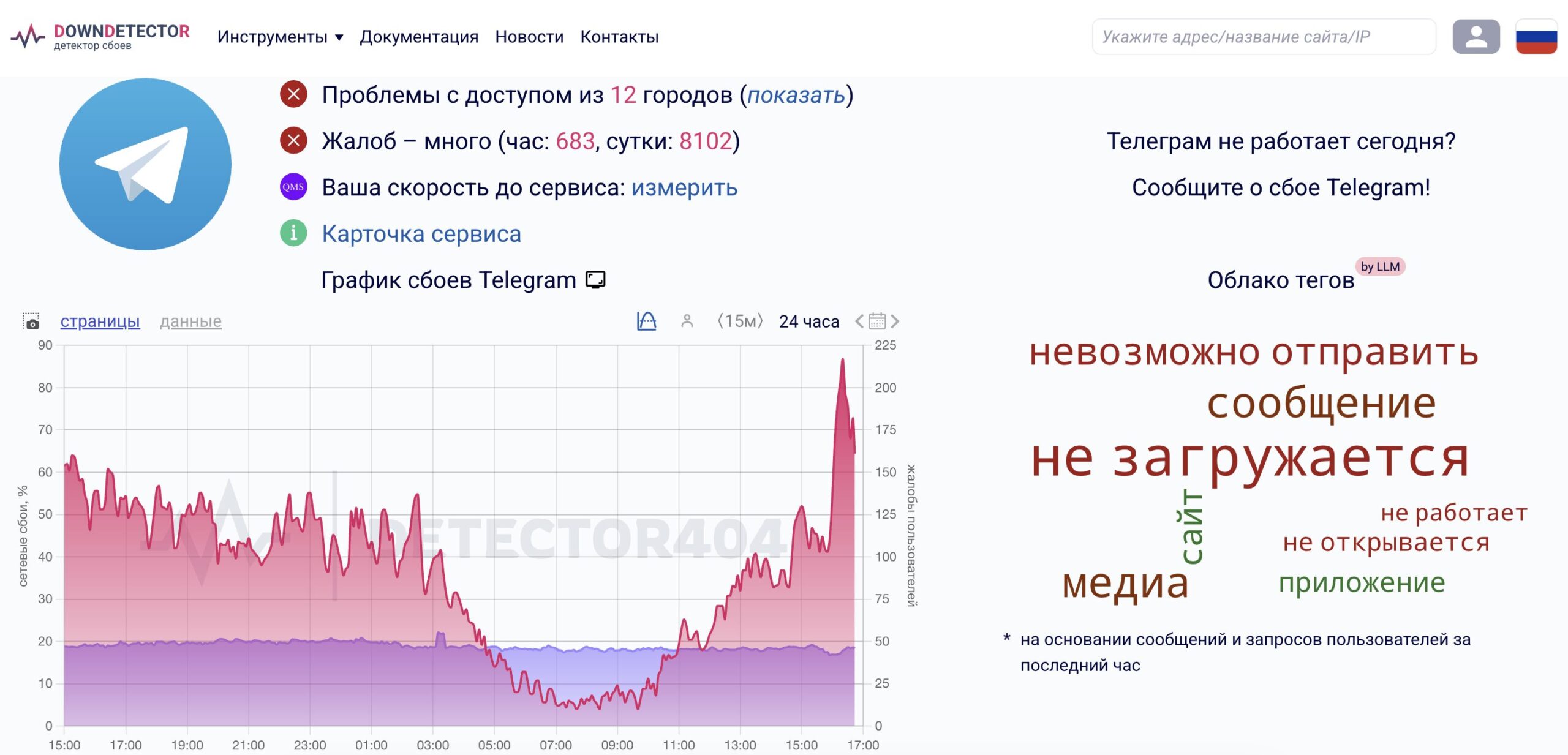
The stream of complaints doesn’t stop
What we’re seeing now is no longer isolated incidents but a sustained trend. According to Kommersant, on the morning of March 16, the Sboi.rf website had received more than 2,500 complaints since the start of the day, while Detector404 recorded over 8,000 reports of issues. Meanwhile, on March 15, Sboi.rf registered about 12,000 reports — significantly above the usual baseline.
This is precisely why the theory that the block is already being tested in specific networks and regions seems quite plausible. Experts cited by Kommersant FM say directly that access heavily depends on the provider, type of connection, and region, and there is no uniformity across the country yet. This looks very much like a gradual tightening of restrictions with testing of how the system behaves under different conditions, rather than a one-time shutdown.
When Telegram Could Be Fully Blocked
For now, the most accurate way to put it is this: the risk of a full block has become significantly higher than it was a month ago. RBC reported that the first days of April are being discussed in relevant government agencies, and the publication’s sources called this decision final. At the same time, Roskomnadzor and associated structures continue to pressure the platform through demands to remove prohibited content and comply with Russian legislation.
One of the key conflicts surrounding Telegram right now is related not only to content but also to infrastructure. The regulator is linking the messenger’s continued operation in Russia to hosting servers in the country and complying with local requirements. Against this backdrop, the current outages no longer look like a standalone incident but rather part of a broader story that could end either with even more severe throttling or a full-fledged block.
At the same time, it’s important to understand one thing. Even if a specific date for a full block is indeed being discussed, in practice, this process may not be instantaneous. First, the service’s performance deteriorates, then individual features stop working reliably, and then everything starts depending on the network, VPN, and region. And this is exactly what Telegram users in Russia are observing right now.
What to Do If Telegram Is Working Poorly in Russia

There are almost no alternatives to Max left in Russia. Image: vedomosti.ru
For users, the main takeaway is fairly simple: relying on Telegram as a fully stable communication channel in Russia is no longer possible. Even if everything works for you today, that doesn’t mean it will tomorrow, because problems can appear selectively: one person can’t load photos, another can’t send messages, and a third can’t launch the desktop client. It’s precisely this fragmentation that makes the current situation particularly unpleasant.
For channel authors, businesses, and those who maintain work chats on Telegram, this is an even more serious signal. When a messenger isn’t shut off with a single switch but is slowly strangled function by function and region by region, adapting becomes even harder. From the outside, the service seems to still be alive, but in reality, it’s already ceasing to be a reliable tool for communication, news, and work. And that’s exactly why talk of a Telegram block in Russia today sounds not like panic but like a perfectly pragmatic scenario for the coming months.