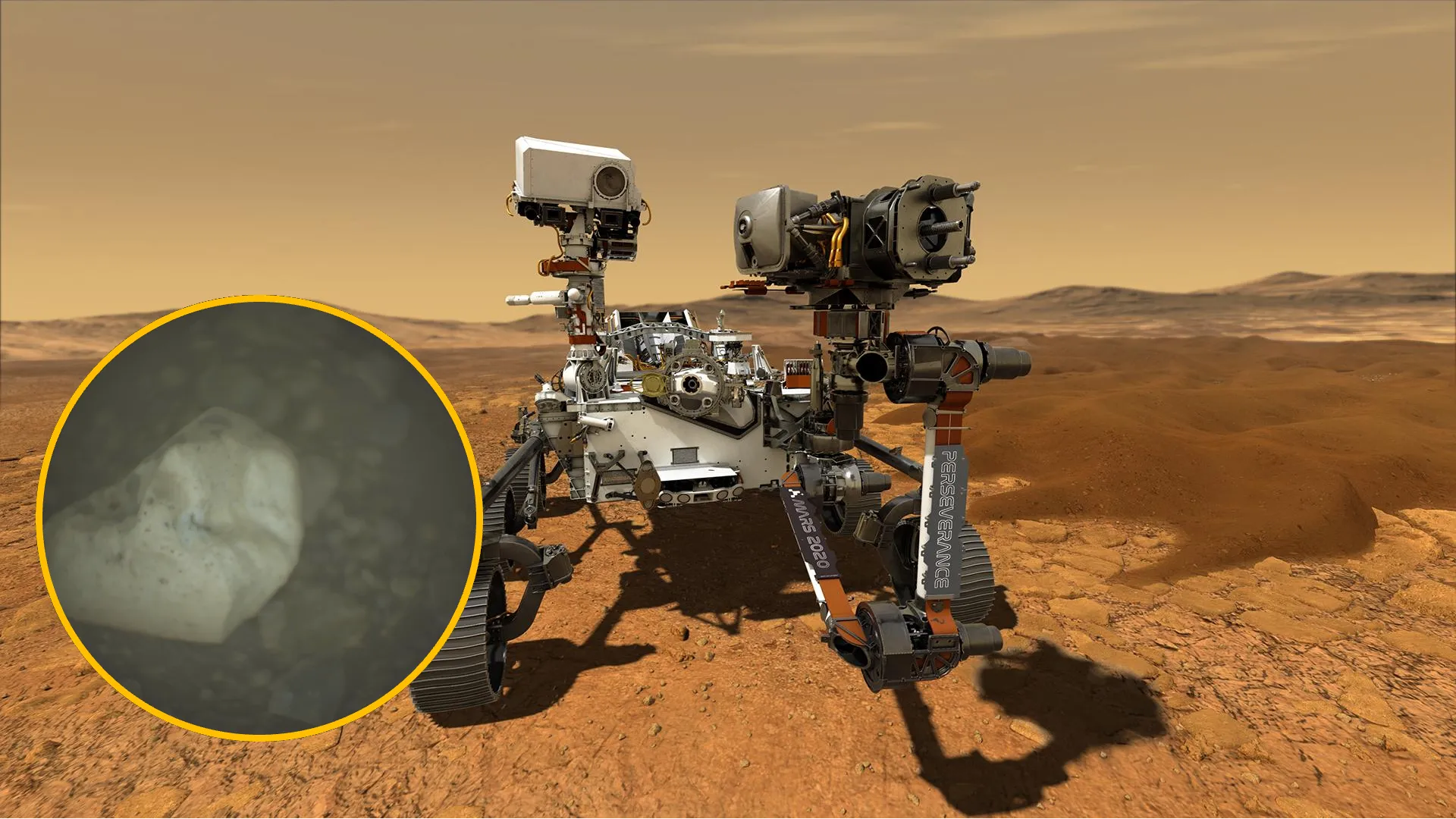
NASA’s Perseverance rover discovered crystals that turned out to be precious. Image source: livescience.com
The Perseverance rover found small crystals in Martian rocks that are chemically similar to rubies. This is the first time precious stones have been discovered on the Red Planet. But the most interesting part isn’t the crystals themselves — it’s how they could have formed there: without volcanoes, without tectonics, without the usual Earth-like conditions.
What Was Found on Mars: Corundum, Rubies, and Sapphires
To understand exactly what was found on Mars, it’s worth looking at the mineral itself. Corundum is aluminum oxide (Al₂O₃), one of the hardest natural minerals. On the Mohs scale, it is second only to diamond. This is precisely what the rover discovered. Pure corundum by itself is colorless and not particularly impressive. But add impurities to its crystal lattice — and everything changes.
A small amount of chromium colors corundum red — and we have a ruby. Titanium and iron impurities produce a blue hue — resulting in a sapphire. Essentially, rubies and sapphires are the same mineral, just with different “additives.” That’s why they are grouped under the common term “precious stones of the corundum group.”
On Earth, corundum is rare and typically forms under extreme temperatures and pressures — deep within the Earth’s crust, where tectonic plates collide and grind rock. That’s why the discovery on Mars raised so many questions: such conditions simply don’t exist there.
How the Perseverance Rover Found Precious Stones on Mars
The discovery was made using the SuperCam instrument mounted on the rover’s mast. This is no ordinary camera — SuperCam can fire a green laser at rocks. The laser pulse heats a tiny area of the rock’s surface to a plasma state, and this plasma begins to glow. Each chemical element emits light at strictly defined wavelengths, like a unique “fingerprint.” By analyzing this light, scientists determine the composition of the rock without touching it.
This is how three float rocks (rocks that once broke off from a cliff and lie separately) were examined. One of them was named Coffee Cove. In all three, laser analysis showed clear spectral signatures of corundum with chromium inclusions — which is the chemical description of a ruby.
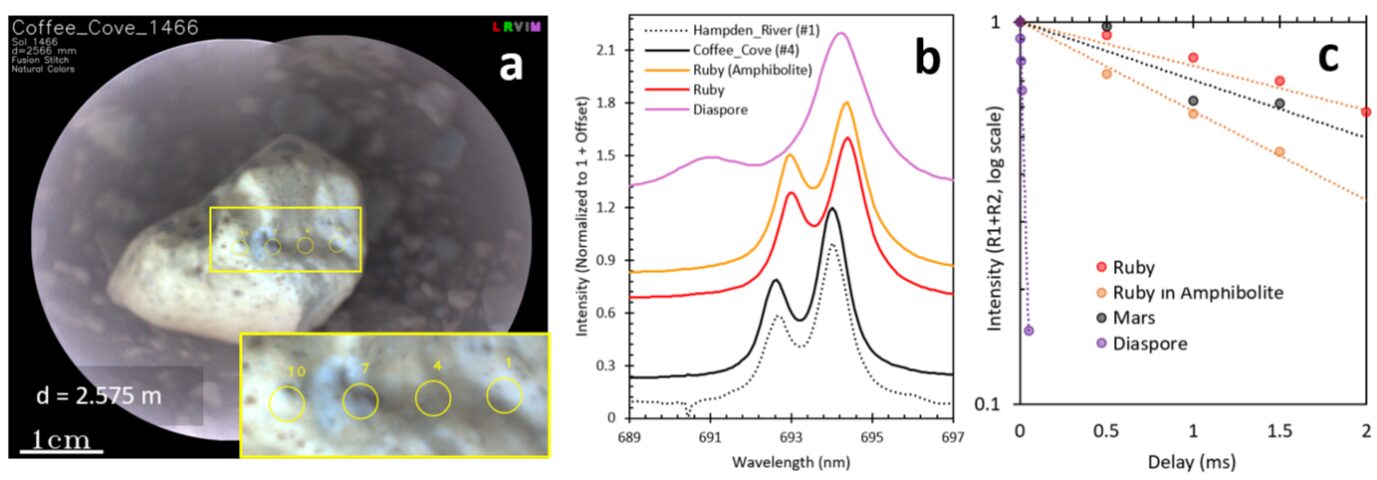
(a) The very Coffee Cove with indicated locations and fields of view for luminescence analysis. (b) Comparison of luminescence spectra of obtained rocks with laboratory spectra obtained from ruby studies. (c) Comparison of luminescence lifetime with laboratory data. Image source: hou.usra.edu
However, there is an important caveat. The crystals turned out to be so small that the rover’s camera cannot see them. And the exact chemical composition of the impurities — how much chromium exactly, whether iron and titanium are present — could not be determined remotely. Therefore, researchers cannot yet say with certainty that these are rubies rather than another variety of corundum.
“We cannot quantitatively assess the chromium content, and other elements — iron and titanium — may also be present,” explained planetary geologist Valérie Payré from the University of Iowa. — “Therefore, it is difficult to conclude whether these are rubies or other types of corundum, such as sapphires.”
Why Rubies on Mars Formed Differently Than on Earth
On Earth, corundum formation is a process that requires powerful geological forces. Tectonic plates collide, one slides beneath another, rocks descend tens of kilometers deep, where temperature and pressure transform ordinary minerals into precious crystals. Then erosion and volcanoes gradually bring them to the surface.
Mars is different. The Red Planet has no convincing evidence of active plate tectonics — neither now nor in its observable geological past. There is no conveyor of collisions, subductions, and remelting that creates rubies and sapphires on Earth. This means Martian corundum crystals must have formed through some other mechanism.
How Meteorites Could Have Created Rubies on Mars
Researchers suggest that corundum crystals on Mars formed from cosmic body impacts. When a large meteorite strikes a planet, for fractions of a second at the point of impact, tremendous temperatures and pressures arise — sufficient to transform ordinary aluminosilicate rocks into corundum. Essentially, a meteorite impact compresses millions of years of Earth’s tectonic work into a single instantaneous explosion.
For Mars, this explanation seems logical. The planet’s surface is covered with craters far more densely than Earth’s: Mars has neither a dense atmosphere to burn up small asteroids nor active erosion to erase impact traces. By some estimates, just one large object left nearly 2 billion craters on Mars. Each such impact is a potential “factory” of extreme minerals.
Jezero Crater, where the Perseverance rover operates, is precisely an impact structure about 45 kilometers in diameter. It once contained a lake fed by rivers, and the rocks here are a complex mixture: sedimentary, volcanic, and impact-metamorphic. It was in this cocktail that the tiny ruby-like crystals were discovered.
Are There Large Rubies and Sapphires on Mars?
One natural question: are there larger crystals on Mars — ones visible to the naked eye? Olivier Beyssac, one of the study authors from the French National Centre for Scientific Research, considers this possible but unlikely: “Corundum is quite rare even on Earth and rarely forms large crystals — the same should be expected on Mars.”
This is the first time in history that gemological-class minerals — meaning potentially suitable for cutting — have been identified on the surface of another planet. The discovery itself, of course, does not mean anyone will fly to collect Martian rubies anytime soon. The crystals are microscopic, reaching them is incredibly difficult, and they have no practical value in a jewelry sense.
But for science, the significance of the find lies elsewhere entirely. Corundum with specific impurities is a marker of the specific conditions under which it formed: temperature, pressure, and chemical composition of the environment. By studying such crystals, geologists can reconstruct the history of impact events on Mars and better understand what processes shaped its crust.
Additionally, in Jezero Crater, the rover is simultaneously searching for traces of ancient life on Mars. The rock sample “Comet Geyser” — the 24th collected by the rover — has already been called by NASA “excellent for studying biosignatures.” In the future, scientists will still need to deliver Mars samples to Earth. Understanding the mineralogy of these rocks helps separate biological traces from purely geological ones. So these tiny Martian rubies are yet another key to understanding what the Red Planet truly was and remains.