
Science shows we know very little even about an ordinary rainbow
Have you ever wondered why a rainbow always looks the same — a beautiful arc stretching across half the sky? Why not a square, a straight stripe, or a zigzag? At first glance it seems self-evident, but pure physics lies behind this familiar shape. And there’s also one fact that most people never learn in their entire lives. Spoiler: what you see is not an arc. It’s a circle. Just a hidden one.
How a Rainbow Forms
To understand the shape, you first need to understand how a rainbow appears. It requires just two ingredients: sunlight and water droplets in the air. That’s why you see rainbows after rain, when the clouds part and the sun shines from one side while millions of tiny droplets still hang in the air.
Each droplet works like a tiny prism. When a ray of sunlight enters a droplet, several things happen at once: the light refracts upon entry, reflects off the inner wall of the droplet, and refracts again upon exit. With each refraction, white light splits into its components — red, orange, yellow, green, blue, indigo, and violet. That is how the spectrum is born.
By the way, if you’re curious why the rainbow has seven colors — that’s largely a convention. In different countries people count anywhere from two to eight colors, and it all depends on language and culture.
Why a Rainbow Is Arc-Shaped
This is where it gets really interesting. A water droplet doesn’t reflect light in just any direction — light exits at a strictly defined angle. For the visible spectrum, this angle ranges from 40 to 42 degrees relative to the direction of the incoming sunlight.
This is the key point. Of all the millions of droplets hanging in the air in front of you, you see color only from those that are positioned at exactly this angle — 40–42 degrees from your line of sight toward the sun. Droplets at other angles also refract light, but it goes in a different direction and simply doesn’t reach your eyes.
Now the question: if you take a point — your eye — and draw all the lines at the same angle in every direction, what shape do you get? That’s right — a cone. The base of this cone, viewed from the front, looks like a circle. That’s why a rainbow is round — it’s not an arc, it’s the base of an imaginary cone whose apex is at your eye and whose other end points toward the sun behind your back.
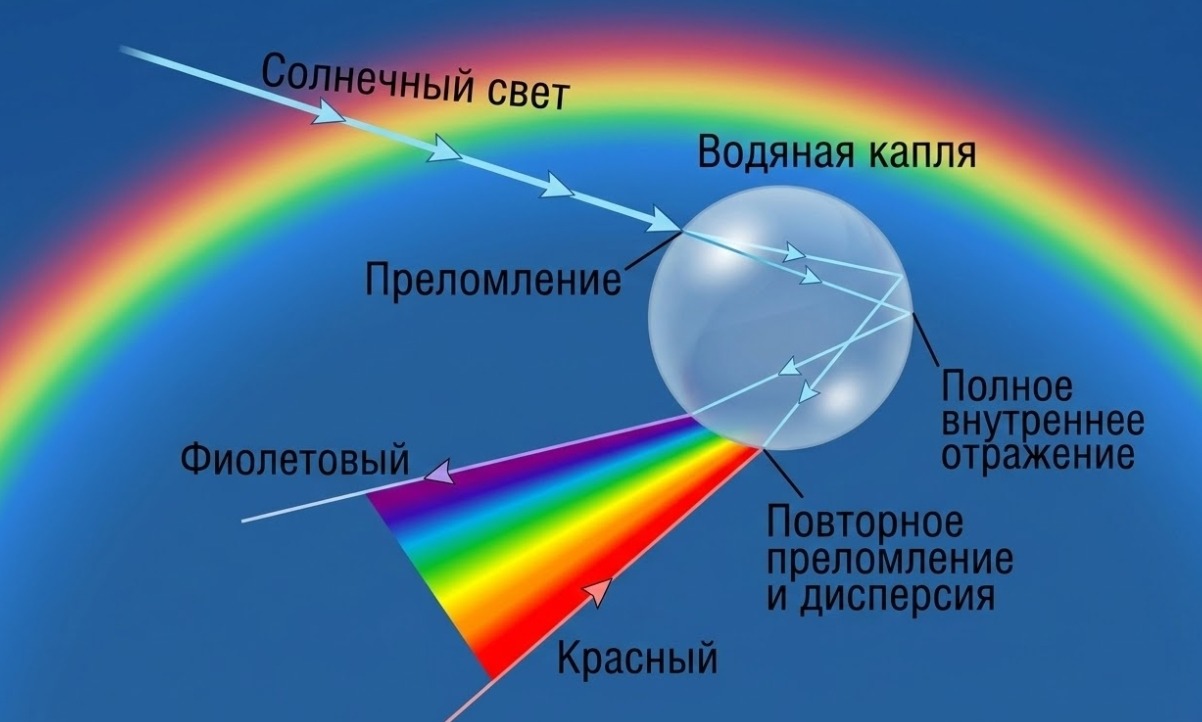
Diagram of rainbow formation: refraction, reflection, and dispersion of sunlight in a water droplet
Why We Only See Half a Rainbow
If a rainbow is a circle, why do we never see the whole thing?
It’s simple: the horizon. The Earth cuts off the lower half of the circle. When you stand on the ground and look at the sky, the lower part of the cone goes below the surface — where there are no raindrops. Only the upper part remains — the familiar arc.
But a full circle can be seen. Airplane pilots and skydivers sometimes observe a rainbow as a complete ring, especially when flying above clouds or rain at high altitude. If the horizon doesn’t get in the way, the entire cone becomes visible.
There’s another curious fact: every person’s rainbow is their own. It doesn’t exist at a specific point in space. Walk closer — it moves away. Ask a friend to stand next to you — they’ll see “their own” rainbow, because the 40–42 degree angle is measured from their eye, not yours. That’s why you can never reach the end of a rainbow — it physically doesn’t exist.
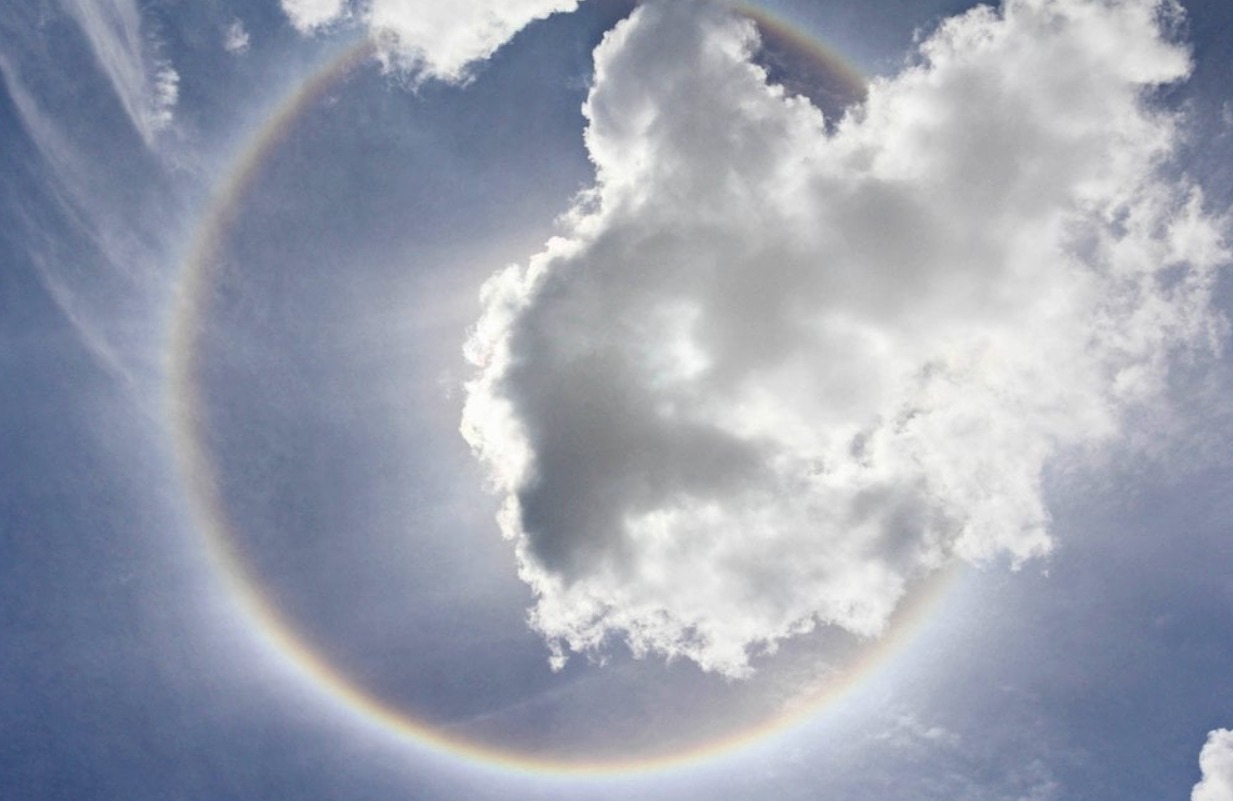
Photo of a circular rainbow. Now you’ve seen everything. Image source: scienceabc.com
Why Rainbow Colors Are Always in Order
Notice that in a rainbow, red is always on the outside and violet on the inside. This is also a consequence of physics.
Different colors refract inside a droplet at slightly different angles. Red exits at about 42 degrees, violet at about 40. Because of this two-degree difference, they form arcs of different radii: red slightly higher, violet slightly lower. All other colors line up between them in order.
This also explains why in a double rainbow the colors are in reverse order — there the light reflects inside the droplet twice, which flips the entire sequence.
How to See a Circular Rainbow
Anyone can see a circular rainbow, and you don’t need an airplane. A garden hose and a sunny day are enough. Stand with your back to the sun, aim a mist of water in front of you, and look at it. You’ll see a rainbow. If you lower the spray, the arc lowers too, and at some point, if the ground doesn’t interfere, you can notice the arc continuing below the horizon line, tending to close into a ring.
The same effect can be caught near a waterfall or fountain — the spray creates the necessary cloud of droplets, and if you position yourself correctly, you’ll see a nearly complete arc.