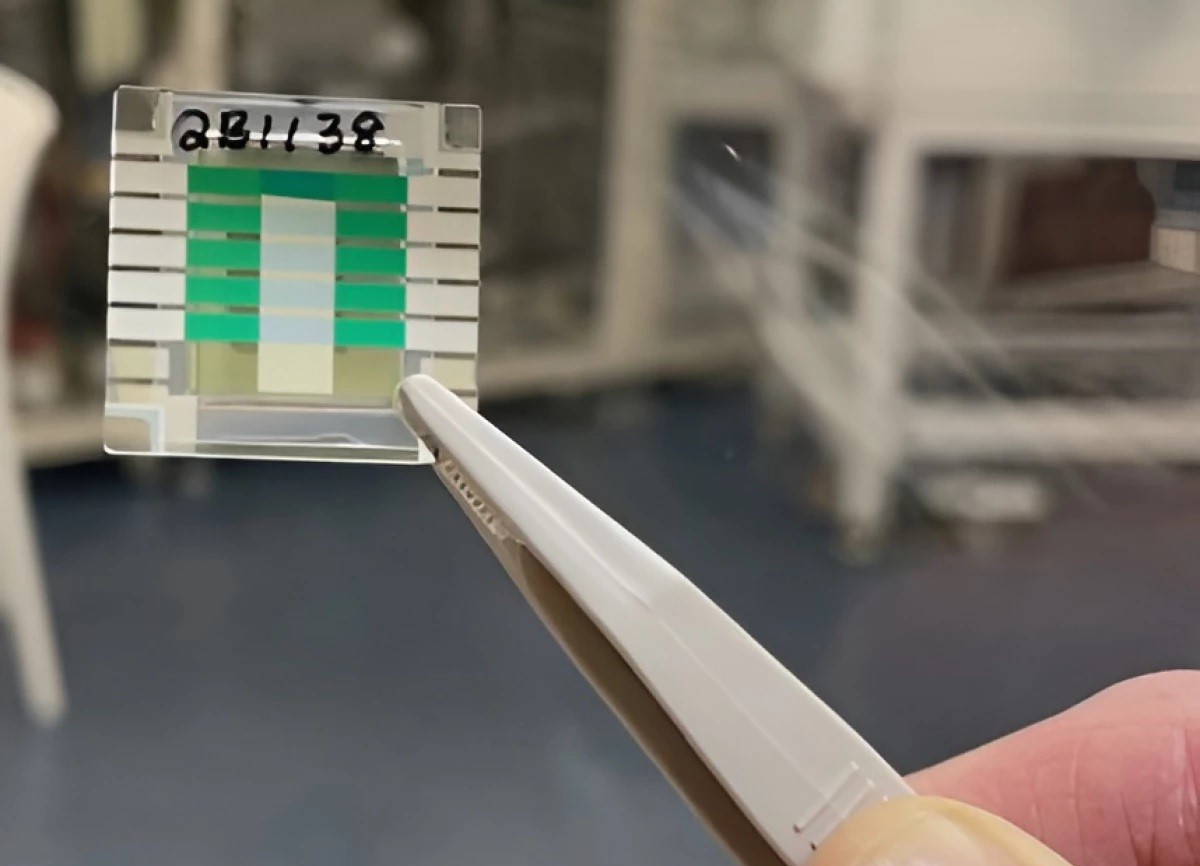
This device is the world’s first fully functional experimental quantum battery
Australian scientists have for the first time assembled a quantum battery that performs a complete cycle: it charges, stores energy, and delivers it as electrical current. The prototype charges via laser in femtoseconds and stores energy a million times longer than the charging duration. Even compared to developments involving 5-minute charging, this looks like technology from an entirely different league. It’s like a phone that charges in half an hour and runs for over a hundred years, except the actual time intervals are still much smaller for now.
*femtosecond — one quadrillionth of a second. 1 fs = 10⁻¹⁵ s
Quantum Battery: How It Differs from a Conventional One
Conventional batteries — lithium-ion, lead-acid, any familiar type — store energy through chemical reactions. Ions move between electrodes, and that’s how the battery charges and discharges. A quantum battery works entirely differently: instead of chemical reactions, it uses the principles of quantum mechanics — superposition and interactions between light and electrons, which potentially allows it to charge much faster.
To put it simply: in a conventional battery, each molecule absorbs energy individually, like people in a coffee line — one at a time. In a quantum battery, a phenomenon called “superabsorption” is at work — energy is absorbed collectively rather than one molecule at a time, allowing the system to take in energy faster than classical models predict.
Imagine that instead of a line, everyone gets their coffee simultaneously — and the more people there are, the faster each one is served. That’s exactly how molecules behave in a quantum battery.
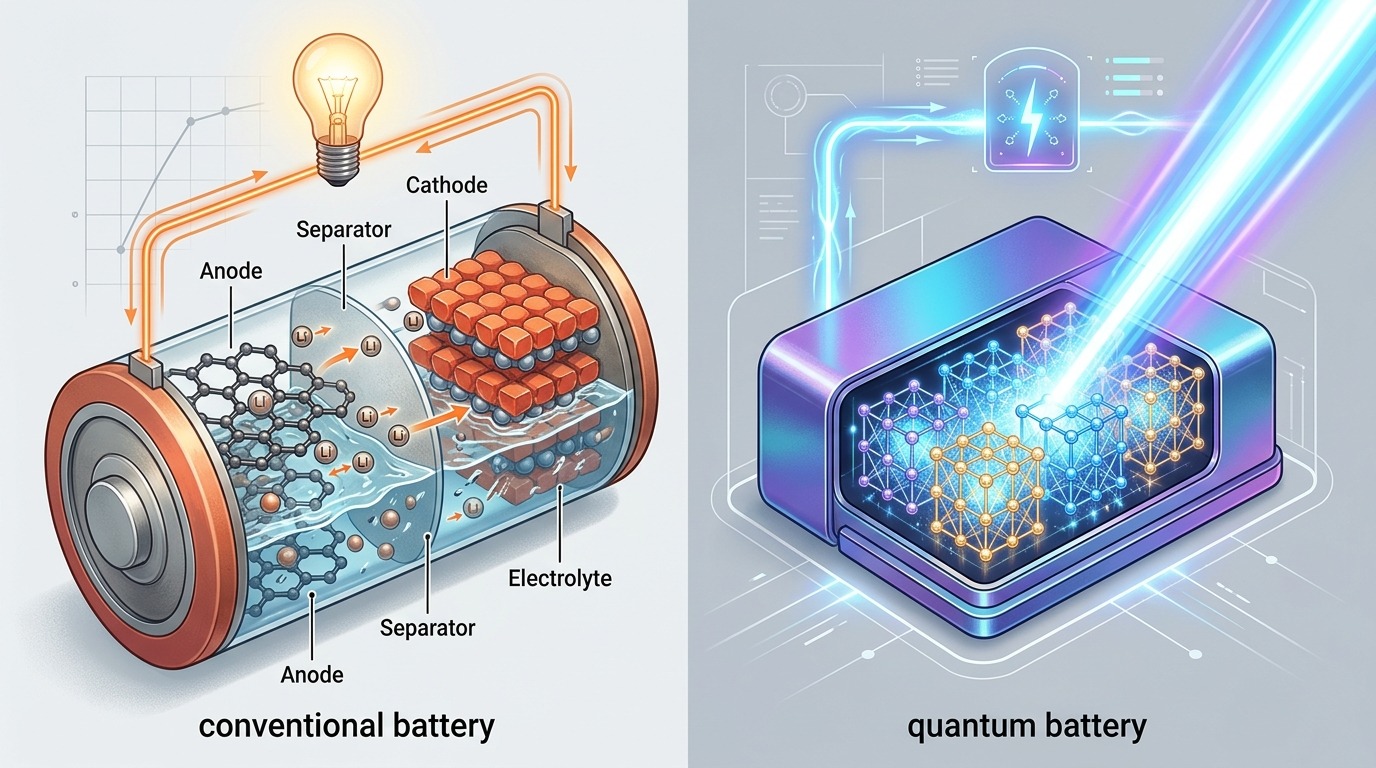
Comparison of the working principles of a conventional and quantum battery
How a Quantum Battery Is Built: The First Prototype
The battery is a multilayered organic microcavity and charges wirelessly — using a laser. According to lead researcher Dr. James Quach from CSIRO, the microcavity is a tiny multilayered “sandwich” of several different materials that traps light in a specific way.
The prototype builds on work from 2022, when the same team first demonstrated the exotic behavior of quantum batteries: charging time decreased proportionally to 1/√N, where N is the number of molecules. However, that prototype couldn’t deliver stored energy as electrical current.
In the new device, additional layers have been added that convert energy into electrical current — and this became the key step toward a practical quantum battery. The platform superextensively captures light energy and for the first time provides a full charge-discharge cycle for a quantum battery.
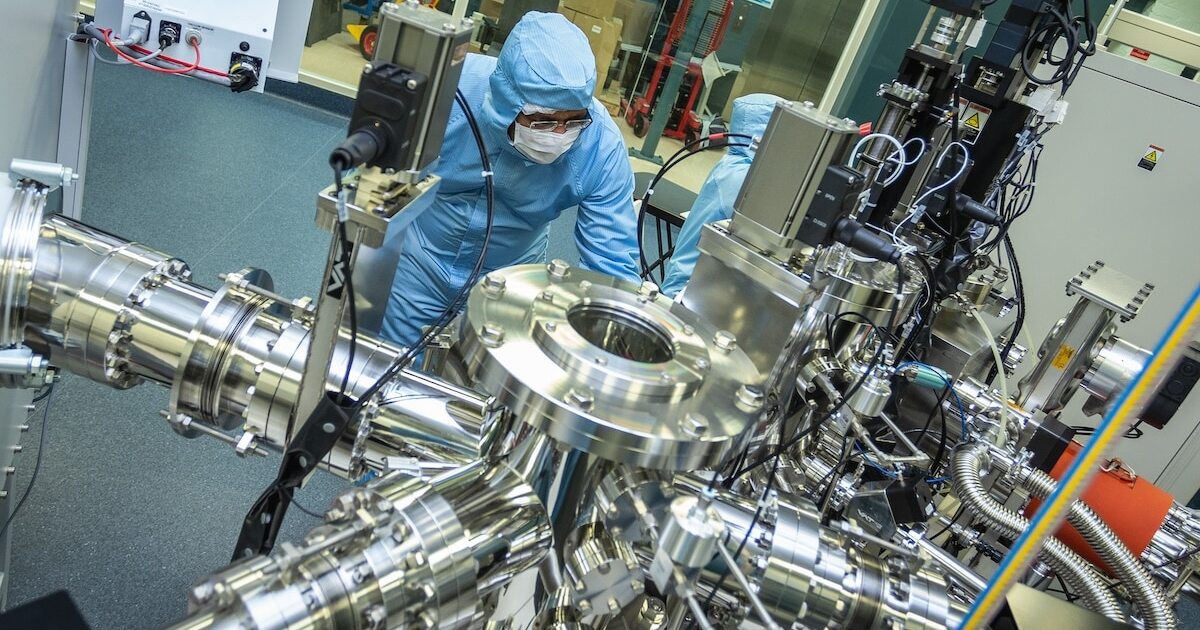
CSIRO laboratory where quantum battery prototypes are assembled
Using ultra-precise spectroscopy, the team confirmed that the prototype stores energy for six orders of magnitude longer than its charging duration. Six orders of magnitude is a millionfold difference. The battery charged in femtoseconds (quadrillionths of a second) and held the charge for nanoseconds. Yes, the numbers are still small, but the logic itself is critically important: in the world of new energy storage, it’s far harder not to quickly charge a system but to retain energy in it for a long time.
Why a Quantum Battery Charges Faster When It’s Bigger
This is perhaps the most counterintuitive property of quantum batteries. We’re all used to the idea that a small smartphone charges in a couple of hours, while a large electric vehicle takes all night. The bigger the capacity, the longer the wait. Quantum batteries behave exactly the opposite way — they charge faster as they get larger. Modern batteries don’t work this way.
The reason lies in so-called collective quantum effects. If a quantum battery has N cells and each one individually charges in one second, then when charged collectively, each cell takes only 1/√N of a second. Double the battery size — and charging takes just over half the previous time.
Superabsorption arises thanks to constructive interference — when waves combine to produce a greater effect than each would individually. Molecules under coherence conditions absorb light more efficiently than if each acted independently. The more molecules there are, the more pathways exist for constructive interference.
And here’s another unexpected twist. Quantum systems typically suffer from decoherence — the loss of quantum properties due to environmental interference. But in the case of a quantum battery, a certain amount of decoherence actually helps stabilize the stored energy: coherence enables fast charging, while decoherence prevents the energy from being released immediately.
How Much Energy Does a Quantum Battery Store and Where Will It Be Used
Before imagining smartphones of the future, let’s come back down to earth. The capacity of current quantum batteries is only 5 billion electronvolts, and they hold a charge for just a few nanoseconds — far too little to power ordinary devices like a phone. For scale: 5 billion electronvolts is roughly one two-hundred-thousandth of the energy of a flying mosquito.
But this is the world’s first prototype that performs a complete cycle — charging, storage, and discharge. Professor of Chemical Physics at RMIT, Daniel Gomez, called the device “the closest approximation to a working quantum battery ever achieved.” And importantly: unlike competing approaches (such as superconducting qubits), the Australian prototype operates at room temperature — without expensive cryogenic cooling.
Where could such batteries prove useful first? Quantum batteries could be ideally suited for powering quantum devices — particularly quantum computers. They could become exactly the solution that quantum computers need for scaling. And in the distant future, according to the authors, the technology could find applications in electric vehicles and drones — up to charging on the fly with a laser beam.
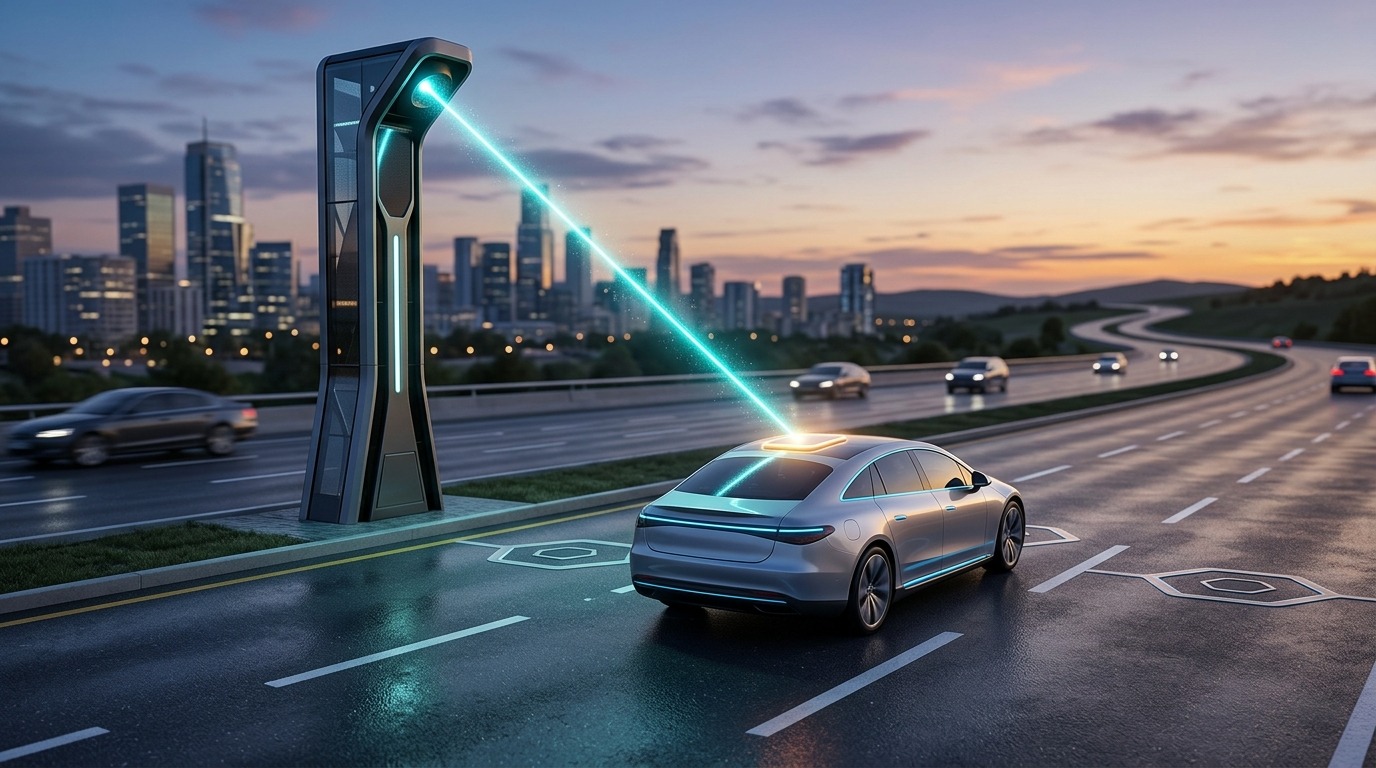
Future concept: an electric vehicle being charged by laser while driving
What Stands in the Way of Mass Adoption of Quantum Batteries
The researchers emphasize: serious technical challenges lie ahead. The main limitation is energy retention: the system charges quickly, but storing the accumulated energy for a useful period of time isn’t yet possible. According to Dr. Quach, the immediate goal is to extend the energy storage time. If this barrier can be overcome, the team will be closer to commercially viable quantum batteries.
The CSIRO team is already exploring hybrid designs that would combine the exceptional charging speed of quantum batteries with the long-term storage of conventional ones, creating systems at the intersection of quantum and classical physics.
It’s worth mentioning that shortly before the CSIRO publication, a team from the Southern University of Science and Technology in China, together with the Spanish National Research Council, demonstrated an alternative approach — a superconducting quantum battery on 12 qubits that charges twice as fast as its classical counterpart. The global race for quantum energy storage is gaining momentum.