
Previously unknown cells have been found in pregnant women
American scientists have created the most detailed map to date of the tissues at the boundary between the uterus and the placenta, and found cells there that no one had previously described. These cells appear only during pregnancy and then disappear. It seems that they may determine whether a pregnancy proceeds normally or with complications.
How the Placenta Connects to the Blood Supply
In the very earliest stages of pregnancy, a process unfolds in a woman’s body that many people don’t even suspect. The placenta, a temporary organ that provides the fetus with oxygen and nutrition, must reliably “connect” to the mother’s blood supply. To do this, specialized fetal cells literally invade the uterine wall and its arteries, remodeling the vessels so that blood flows freely to the placenta.
It’s similar to how tree roots grow into the soil. If they don’t penetrate deep enough, the tree won’t get water, but if they go too deep and uncontrollably, that also threatens problems. It’s the same with the placenta: too weak an “invasion” of cells is associated with dangerous high blood pressure in pregnant women (preeclampsia), while too deep an invasion is linked to another dangerous condition where the placenta cannot separate from the uterine wall after delivery.
Until now, scientists had created similar cell maps, but they covered only individual stages of pregnancy. The new study was the first to trace the entire picture from early stages to delivery.
How Scientists Compiled the Pregnancy Cell Atlas
The study was published on April 8, 2026, in the journal Nature. A team of researchers analyzed approximately 200,000 individual cells using single-cell genomic technologies and compared them with nearly one million cells in their original positions within tissues using spatial transcriptomics — a method that allows not only identifying the cell type but also seeing exactly where it is located within the tissue.
Using machine learning, the researchers were able to predict how deeply a given fetal cell would “invade” the uterine wall based on its gene activity. This level of detail allowed them to see what previous studies had missed. And it was in this massive dataset that the researchers spotted cells that no one had previously identified as a separate type.
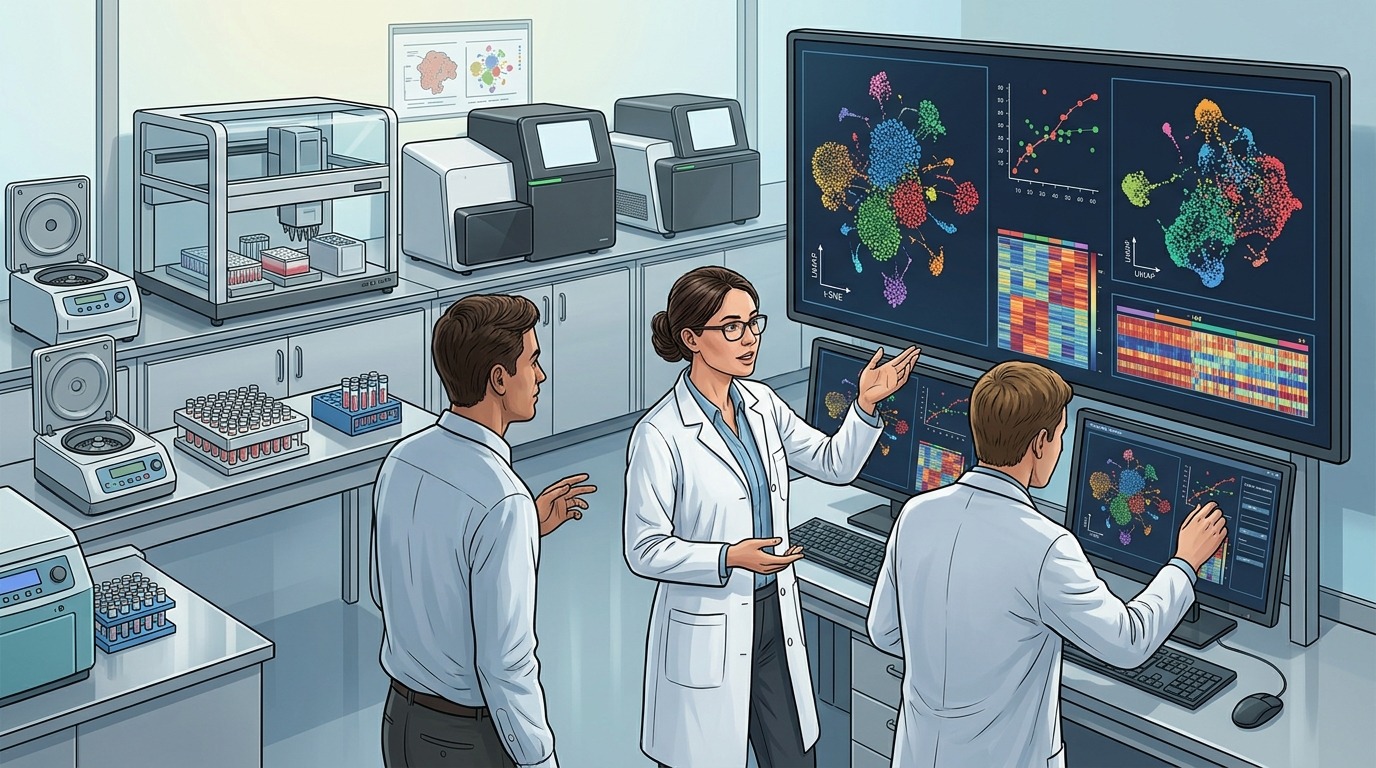
A genomic research laboratory analyzing single-cell sequencing data
What New Cells Were Discovered in Pregnant Women
The new cell subtype was named DSC4 (decidual stromal cell 4), meaning the fourth subtype of decidual stromal cells. Decidual cells are maternal cells of the uterine lining that remodel to support pregnancy. They have been studied for a long time, but this particular subtype had not been previously described.
These cells are not present in the uterus outside of pregnancy. They appear abruptly at the very beginning of gestation, when the uterine lining remodels to accept the embryo. As the study’s first author Cheng Wang explained, DSC4 cells are located at the very “front line,” exactly where placental cells begin their invasion into the uterine wall.
The main function of these cells is to act as a “speed limiter.” They send signaling molecules that prevent placental cells from penetrating too quickly and too deeply. DSC4 cells are positioned “at the frontline of the maternal-fetal interface” and carry proteins that regulate the behavior of other cells at this critical boundary.
Studying Pregnancy Complications
One of the main goals of the study was to understand exactly which cells “break down” during pregnancy complications. To do this, the scientists overlaid their cell map onto data from large-scale genetic studies of preeclampsia, preterm birth, and miscarriages involving more than 10,000 patients.
These genetic studies had previously identified links between certain gene variants and the risk of complications. But it was unclear in which specific cells these genes were active. Now the researchers were able to precisely pinpoint specific types of placental and uterine cells that actively use “risky” genes and are therefore most vulnerable.
For preeclampsia, the result was particularly revealing: the most affected cells turned out to be involved in remodeling of maternal arteries — the very process in which the uterine vessels are restructured to ensure sufficient blood flow to the placenta. The results indicate that preeclampsia may be a consequence of disrupted communication between maternal and fetal cells that normally coordinate this process.
This is not merely academic interest. Preeclampsia affects up to 5–8% of pregnancies and remains one of the leading causes of maternal mortality. If it becomes possible to determine exactly which cells and molecular pathways are disrupted, this could pave the way for early diagnosis and, in the future, targeted therapy.
What the Pregnancy Cell Atlas Will Mean for Future Research
The atlas that was created covers normal pregnancy from early stages to delivery. This is a baseline “health map” against which everything that goes wrong can now be compared. The team’s next step is to study tissues from complicated pregnancies and find potential therapeutic targets.
The discovery of DSC4 cells is also a reminder of how little we still know about what happens in a woman’s body during pregnancy. For decades, scientists studied the placenta and uterus, yet an entire cell subtype remained unnoticed. Senior study author Jingjing Li called the moment of discovering these cells “exciting,” and in this case it is no exaggeration, since we are talking about a cell that sits at the very junction of two organisms and may largely determine pregnancy outcomes.
For now, this is just the beginning: the functions of DSC4 have been described at the cellular and molecular level, but clinical application is still far off. Nevertheless, the very fact that in 2026 a fundamentally new cell type can be discovered in the human body shows that modern analytical technologies continue to change our understanding of even long-studied tissues.