The POCO X8 and POCO X8 Pro share a name, but an AndroidInsider reviewer found that they have surprisingly little in common. The reviewer spent a week with the POCO X8 before comparing it with the Pro. The Pro is built around flagship-class performance, faster memory and a real ultra-wide camera. The standard X8 offers a larger screen and a much bigger battery. The reviewer concludes that the Pro suits gamers and buyers who want performance headroom for years. The X8 suits people who value battery life over benchmark scores. The reviewer also advises against the entry-level 128 GB X8, which uses slower storage.
What you need to know
- The POCO X8 uses a Snapdragon 6s Gen 4, which scored just over 900,000 points in AnTuTu in the reviewer’s test. The X8 Pro’s Dimensity 8500 Ultra scored more than 2 million.
- The 128 GB POCO X8 uses slower UFS 2.2 storage, while the 256 GB version uses UFS 3.1. Every X8 Pro configuration uses UFS 4.1 storage and LPDDR5X RAM.
- The POCO X8 has an 8,340 mAh battery with 67 W charging. The X8 Pro has a 6,500 mAh battery with 100 W charging.
- The X8 Pro pairs its 50 MP main camera with an 8 MP ultra-wide. The X8 pairs its main camera with a 2 MP depth sensor, which the reviewer considers useless.
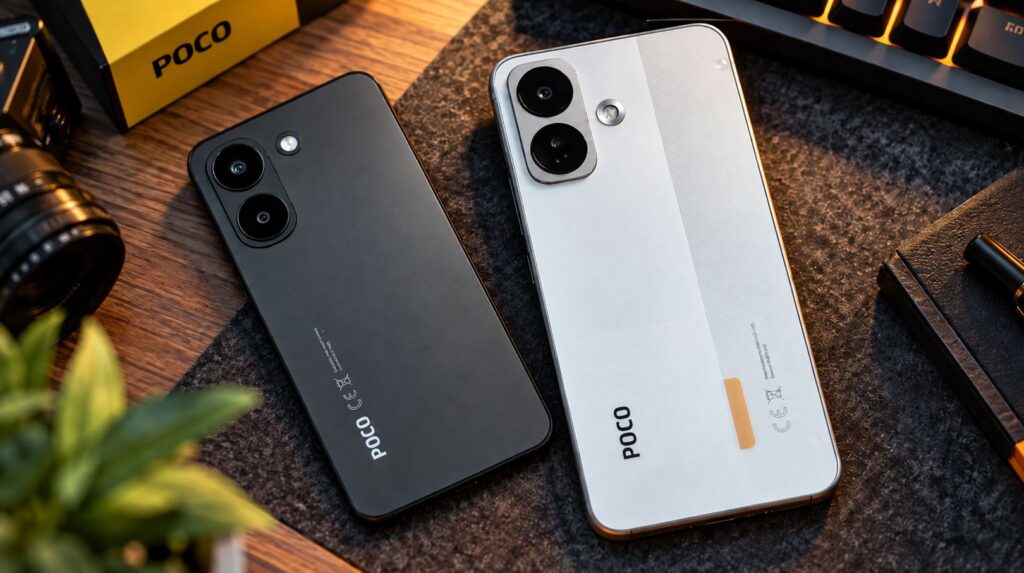
The design of the POCO X8 and POCO X8 Pro
Display and build: a big X8 versus a compact Pro
The POCO X8 has a 6.83-inch display, while the X8 Pro has a 6.59-inch display. Both are AMOLED panels with a 120 Hz refresh rate and peak brightness of up to 3,500 nits. The screens are nearly on par, but the Pro is noticeably more compact.
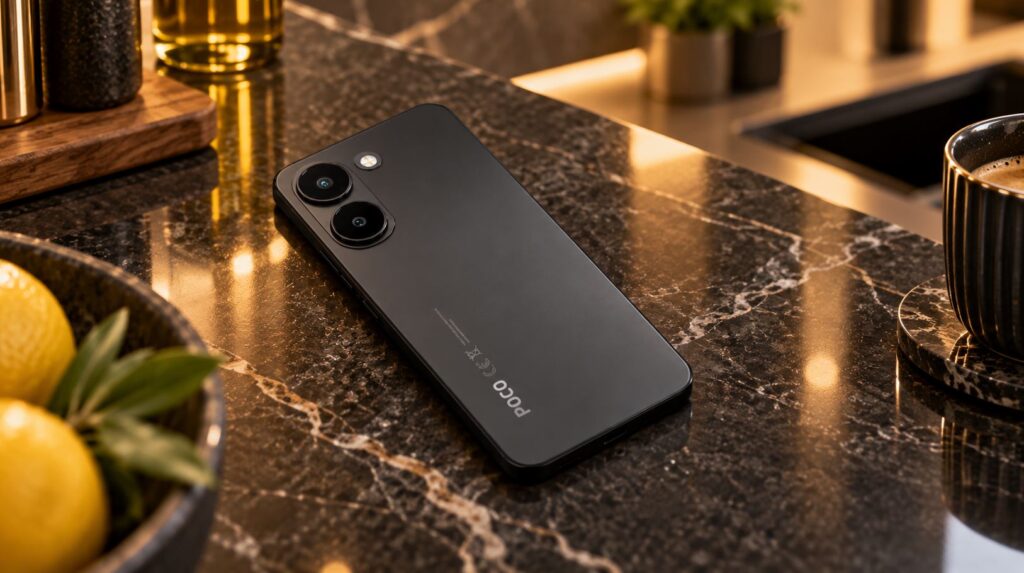
The POCO X8 Pro in dim light
The reviewer says the two phones feel different in daily use. The standard X8 weighs 223 g, which the reviewer says is noticeable in the hand. Its large display also has a small bottom bezel, or “chin.” The Pro has even bezels on all sides, much like more expensive flagships. In the reviewer’s view, this makes the Pro look more premium and feel more comfortable to hold.
Both phones have a metal frame. Both boxes also include a case and a screen protector film. The reviewer’s advice is straightforward: if you prefer smaller phones, choose the X8 Pro.
Performance: midrange versus flagship-class
The reviewer calls performance the main dividing line between the two models. The POCO X8 runs on a Snapdragon 6s Gen 4. In the reviewer’s testing, it scored just over 900,000 points in AnTuTu. The X8 Pro uses a Dimensity 8500 Ultra and scored more than 2 million points, which is more than double.
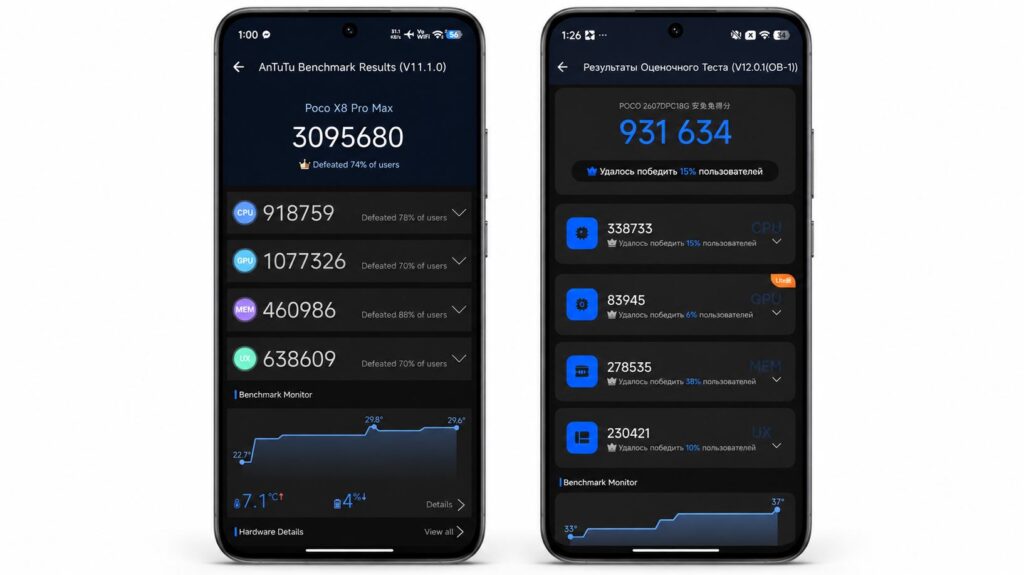
AnTuTu results: POCO X8 Pro on the left, POCO X8 on the right
According to the reviewer, the gap is barely visible in everyday tasks. Messaging apps, web browsing and video playback run smoothly on both phones. The X8 did not lag and hardly warmed up during the review period. Demanding games are a different story. The reviewer says the Pro handles them with headroom to spare, while X8 owners will need to lower graphics settings.
The reviewer also argues that extra performance determines how long a phone stays lag-free, and that RAM matters as well as the chipset. The X8 is offered with 6 to 12 GB of RAM, while the Pro comes with 8 to 12 GB. The reviewer’s advice is not to skimp on RAM, because 6 GB is no longer enough today.
Storage and memory: fast on the Pro, a catch on the X8
The reviewer points out that memory type affects how quickly apps open and games install. Every X8 Pro configuration uses UFS 4.1 storage and LPDDR5X RAM.
The standard X8 has a catch, which the reviewer discovered during testing. The 256 GB versions use UFS 3.1 storage, which the reviewer describes as quick. The 128 GB version, however, uses slower UFS 2.2. Every X8 configuration uses LPDDR4X RAM, which the reviewer considers the bare minimum in 2026. As a result, the reviewer recommends avoiding the entry-level version.

The reviewer notes that UFS 4.1 reads data twice as fast as UFS 3.1. You will not notice the difference when messaging or using social media. However, the reviewer says heavy games load faster and large files copy without long waits.
Cameras: one useful rear camera versus two
Both phones have a similar 50 MP main camera with optical image stabilization. The reviewer says both take good photos in daylight. The X8 impressed the reviewer with its color and detail, and its stabilization helps in the evening.
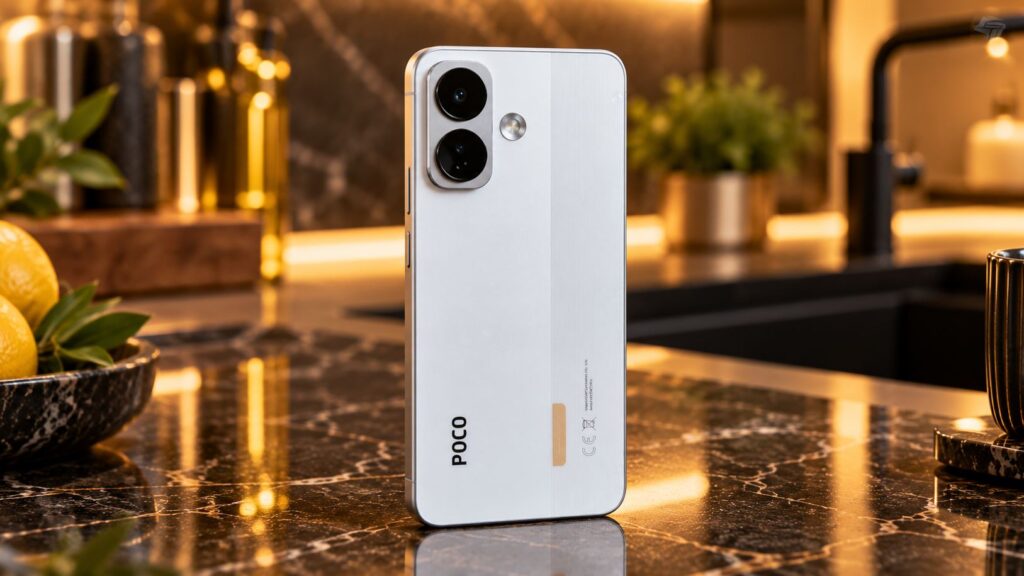
The main camera of the POCO X8
The second rear camera is where the phones differ. The Pro has an 8 MP ultra-wide camera. The reviewer says it lacks sharpness indoors, but it is at least a genuine ultra-wide. It can capture a group around a table or an entire building in one frame. The X8 has a 2 MP depth sensor instead, which the reviewer describes as useless.
The Pro’s front camera is also slightly better, at 20 MP versus 16 MP. Even so, the reviewer would not call either phone a camera phone. The Pro is built around performance, and the reviewer says corners were cut elsewhere.
Battery and charging: where the standard X8 wins
Battery life is the area where the standard model comes out ahead. The POCO X8 has an 8,340 mAh battery, compared with 6,500 mAh in the X8 Pro. The reviewer says the X8 easily lasted two days with heavy use. On a three-day trip, it did not need charging at all.
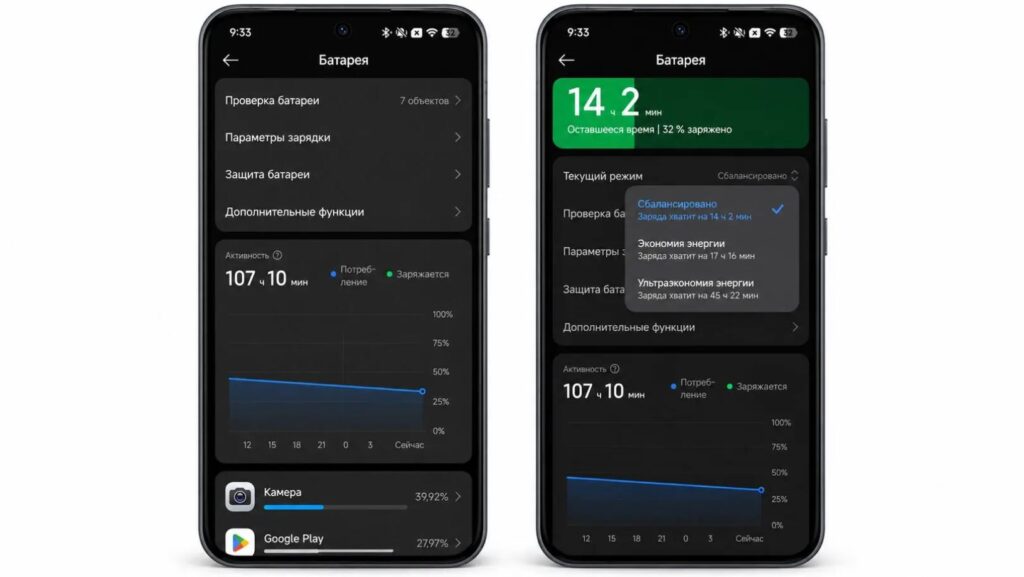
The POCO X8’s impressive battery life
According to the reviewer, the Pro also delivers respectable battery life. It lasts about two days with light use and roughly a day and a half with heavy use. It also charges faster, at 100 W versus 67 W. A charge from 10% to 100% takes under an hour, and the required charger is included in the box.
The source also notes that an AndroidInsider colleague called battery life the X8’s biggest strength when the phone was announced. The reviewer agrees that the X8 is the more practical choice for travel.
POCO X8 vs POCO X8 Pro: specifications at a glance
| Specification | POCO X8 | POCO X8 Pro |
|---|---|---|
| Display | AMOLED, 6.83 inches, 120 Hz | AMOLED, 6.59 inches, 120 Hz |
| Chipset | Snapdragon 6s Gen 4 | Dimensity 8500 Ultra |
| RAM | 6, 8 or 12 GB, LPDDR4X | 8 or 12 GB, LPDDR5X |
| Storage | 128 GB (UFS 2.2) or 256 GB (UFS 3.1) | 256 or 512 GB, UFS 4.1 |
| Rear cameras | 50 MP main and 2 MP depth sensor | 50 MP main and 8 MP ultra-wide |
| Battery and charging | 8,340 mAh, 67 W | 6,500 mAh, 100 W |
Which one should you choose?
The reviewer concludes that although the phones belong to the same series, they are completely different devices. The X8 Pro offers flagship-class performance, fast storage and a usable ultra-wide camera. It is aimed at gamers and buyers who want performance headroom for several years.
The standard X8 has a midrange chipset but a very large battery. It is better suited to people who care more about battery life than benchmark scores. For buyers who choose the X8, the reviewer recommends the 8 GB/256 GB configuration. That version avoids the slower UFS 2.2 storage and the 6 GB RAM option, both of which the reviewer advises against.