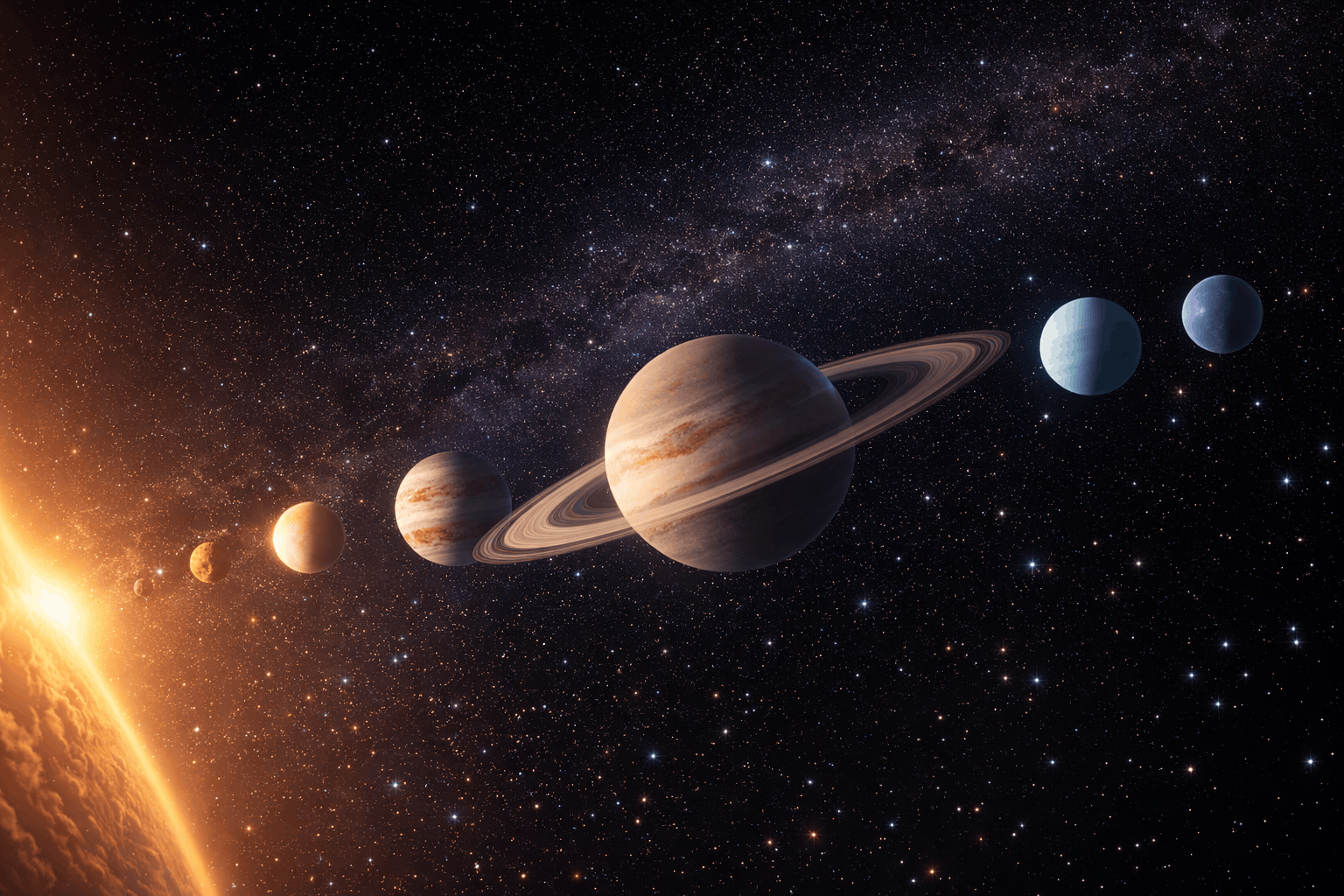
A planetary parade that millions will see: what to expect on February 28, 2026.
On February 28, 2026, six planets will line up in the evening sky. Four of them will be visible to the naked eye, and two more can be seen through binoculars or a telescope. Such configurations don’t happen every year, especially at a convenient evening time. The key is not to confuse an astronomical alignment with a pretty picture in the sky. Let’s figure out what exactly will happen and when is the best time to look.
Planetary Parade on February 28, 2026: Which Planets Will Be Visible
This refers to a so-called great alignment — when 5–6 planets gather in one sector of the sky. On February 28, 2026, these will be: Mercury, Venus, Saturn, Jupiter, Uranus, and Neptune.
The best time is approximately one hour after sunset. The period of good visibility runs from late February to early March, with the exact date potentially shifting by 1–3 days depending on latitude.
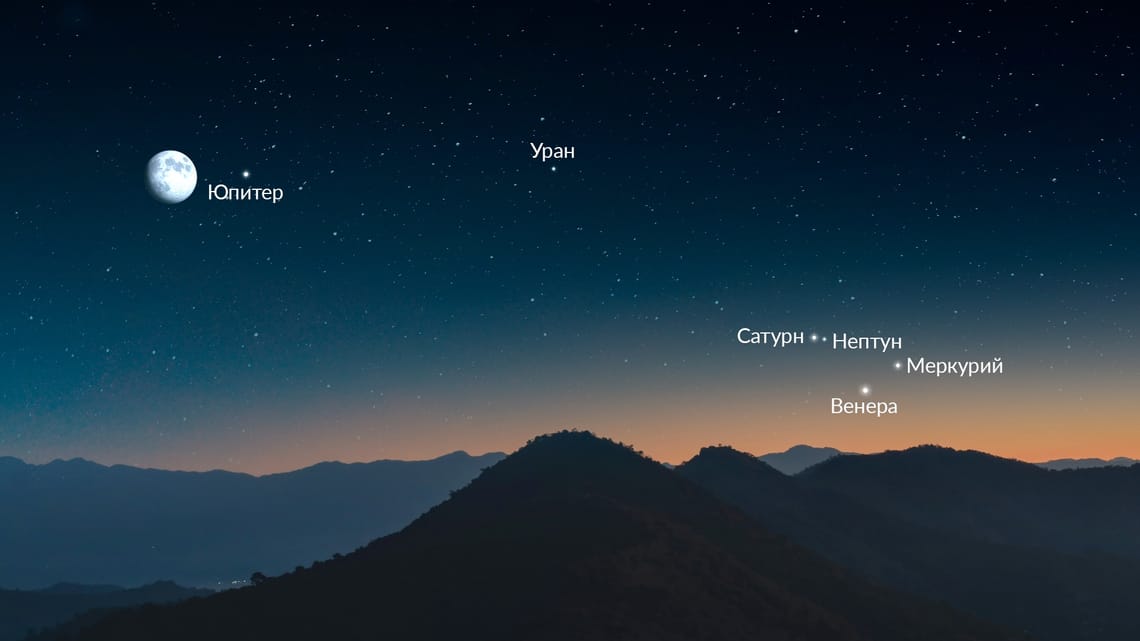
Planetary alignment on February 28, 2026, view from the Northern Hemisphere. Image source: starwalk.space
Visible without optics:
- Venus — the brightest object after the Moon;
- Jupiter — bright and non-twinkling;
- Saturn — with a soft golden glow;
- Mercury — the most challenging of the “visible” ones, low above the horizon.
Through binoculars:
- Uranus — near the Pleiades;
- Neptune — approximately 1° from Saturn.
An additional effect will be created by the Moon, illuminated at about 90% and located near Jupiter (about 4°). However, its light will make finding Uranus and Neptune more difficult.
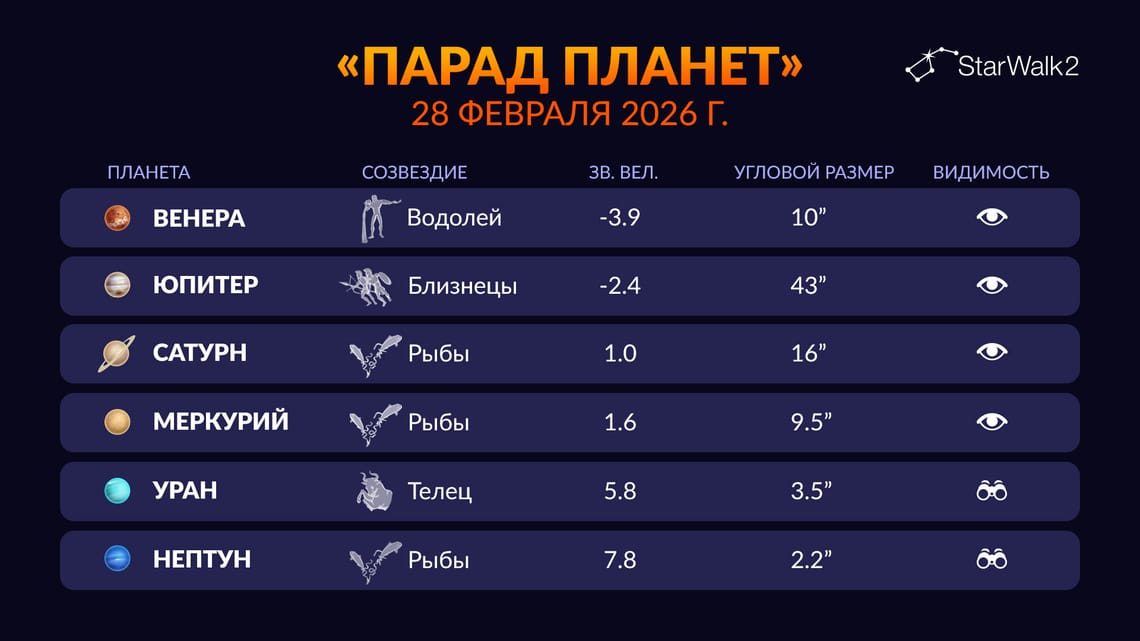
In which constellations to look for planets during the parade and how brightly they will shine. Image source: starwalk.space
Where Will the Planetary Parade Be Visible on February 28 and Where to Look in the Sky
The planets don’t line up in a perfect straight line. This is a visual effect related to the fact that they move along the ecliptic — the apparent path of the Sun across the sky. On February 28, they will form a smooth arc in the sky:
- west / southwest — Mercury, Venus, Saturn, Neptune;
- higher up — Uranus;
- southeast — Jupiter near the Moon.
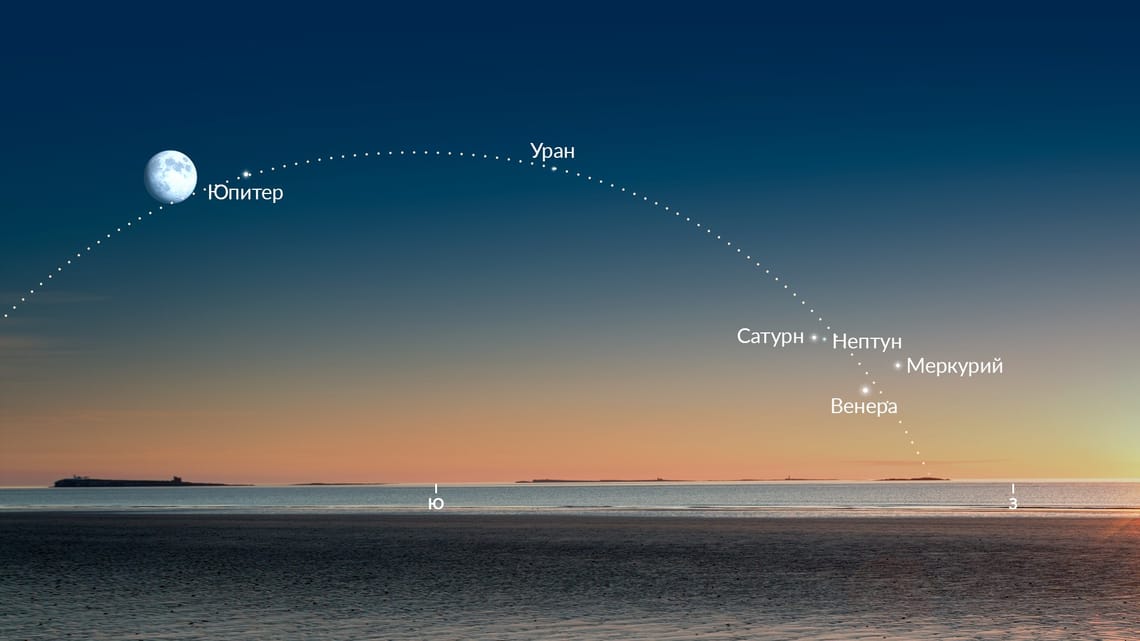
The planetary parade on February 28 forms a smooth arc. Image source: starwalk.space
In central Russia (including Moscow and the Moscow region), the planets will be visible from approximately 6:40 PM to 8:00 PM Moscow time.
It’s important to start observing early: Mercury and Venus will set first, followed by Saturn and Neptune, while Uranus and Jupiter will remain visible the longest.
When Is the Next Planetary Parade After February 28, 2026
Other configurations are also expected in 2026:
- April 18 — a minor morning alignment (Saturn, Mars, Mercury, Neptune);
- June 12 — a mini-alignment (Mercury, Jupiter, Venus);
- August 12 — a great morning alignment of six planets (Jupiter, Mercury, Mars, Uranus, Saturn, Neptune);
- November 14 — a minor morning alignment of four planets (Mercury, Venus, Mars, Jupiter).
The next great alignment after 2026 is on July 2, 2027.
Truly rare events, when nearly all planets end up on the same side of the Sun, occur only a handful of times per century — for example, May 19, 2161.