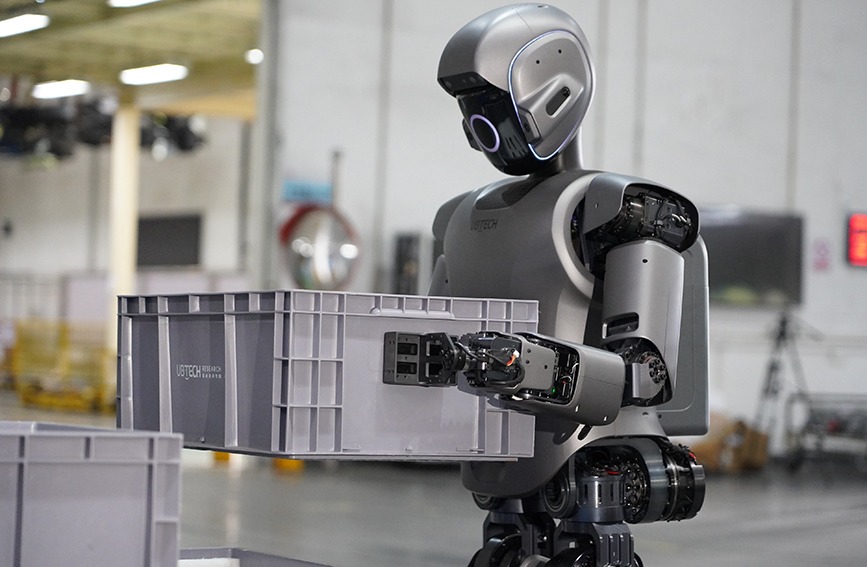
An industrial humanoid robot undergoes training at the Dongfeng Liuzhou Motor Co., Ltd. factory in Liuzhou, Guangxi Zhuang Autonomous Region in southern China. Image source: en.people.cn
In the city of Liuzhou in southern China, an experiment is underway that until recently seemed like a science fiction scenario: about 120 humanoid robots are undergoing an “internship” at a real automobile factory. They are learning to sort parts, carry containers, and navigate workshop floors — all under the supervision of live instructors. This is not a trade show demonstration or a promotional video: the robots are training for real work on production lines.
Humanoid Robots in Manufacturing: How the Internship Works
At the Dongfeng Liuzhou Motor factory — a subsidiary of one of China’s largest automakers — 11 UBTech Walker S1 robots are being trained to perform real tasks on the shop floor. Under an instructor’s guidance, they activate visual navigation systems, move to assigned workstations, and carry out material handling operations.
In a specially designated training zone of 200 square meters, the robots practice sorting parts, moving containers, and collecting empty bins. Essentially, these are the same routine warehouse and logistics operations that humans perform at regular factories — often under harsh conditions and for many hours at a time.
Walker S1 is a humanoid robot standing 172 cm tall and weighing 76 kg, with 41 degrees of freedom (that many “joints,” each responsible for a separate movement). Powerful actuators allow each arm to lift up to 15 kg, and the robot walks at a speed of about 0.83 m/s and can climb stairs. RGB and depth cameras, lidar, and force sensors provide 3D mapping and spatial orientation.
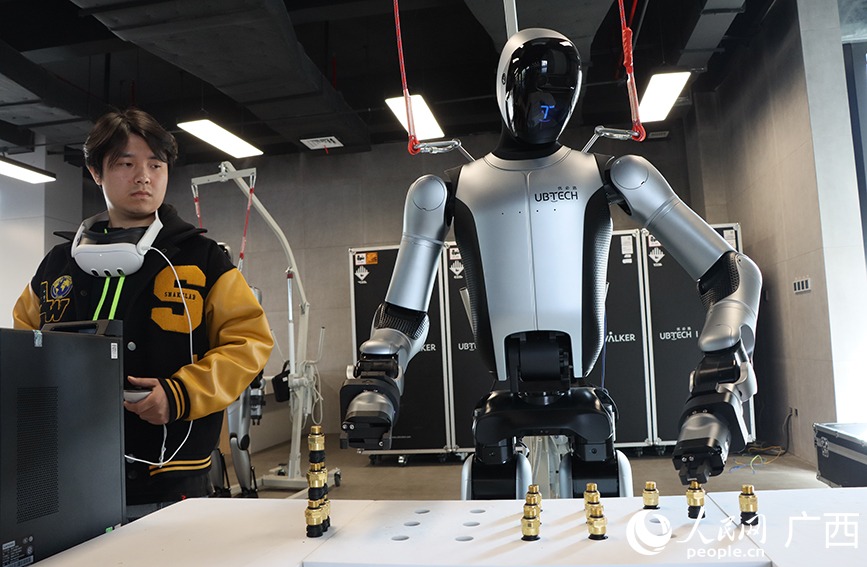
A robot trains under an instructor’s guidance at the Dongfeng Liuzhou Motor factory. Image source: en.people.cn
Why It’s So Hard for a Humanoid Robot to Pick Up a Tiny Screw
One of the most revealing scenes from the Liuzhou factory is a robot repeatedly trying to pick up a tiny screw the size of a fingernail with two fingers. This process shows that such actions are anything but intuitive for machines and must be programmed step by step.
For a human, picking up a screw is a matter of seconds. We don’t even think about how we do it: our fingers automatically adjust to the size, weight, and texture of the object. It is precisely in such small details that one can see why humanoid robots are so difficult to make useful.
A robot has neither “muscle memory” nor intuition. Unlike humans, who rely on experience and instinct, robots are entirely dependent on algorithms. For effective training, it is necessary to understand how their joints move and how the vision system interprets the surrounding environment — then instructors can refine control methods and improve task execution accuracy.
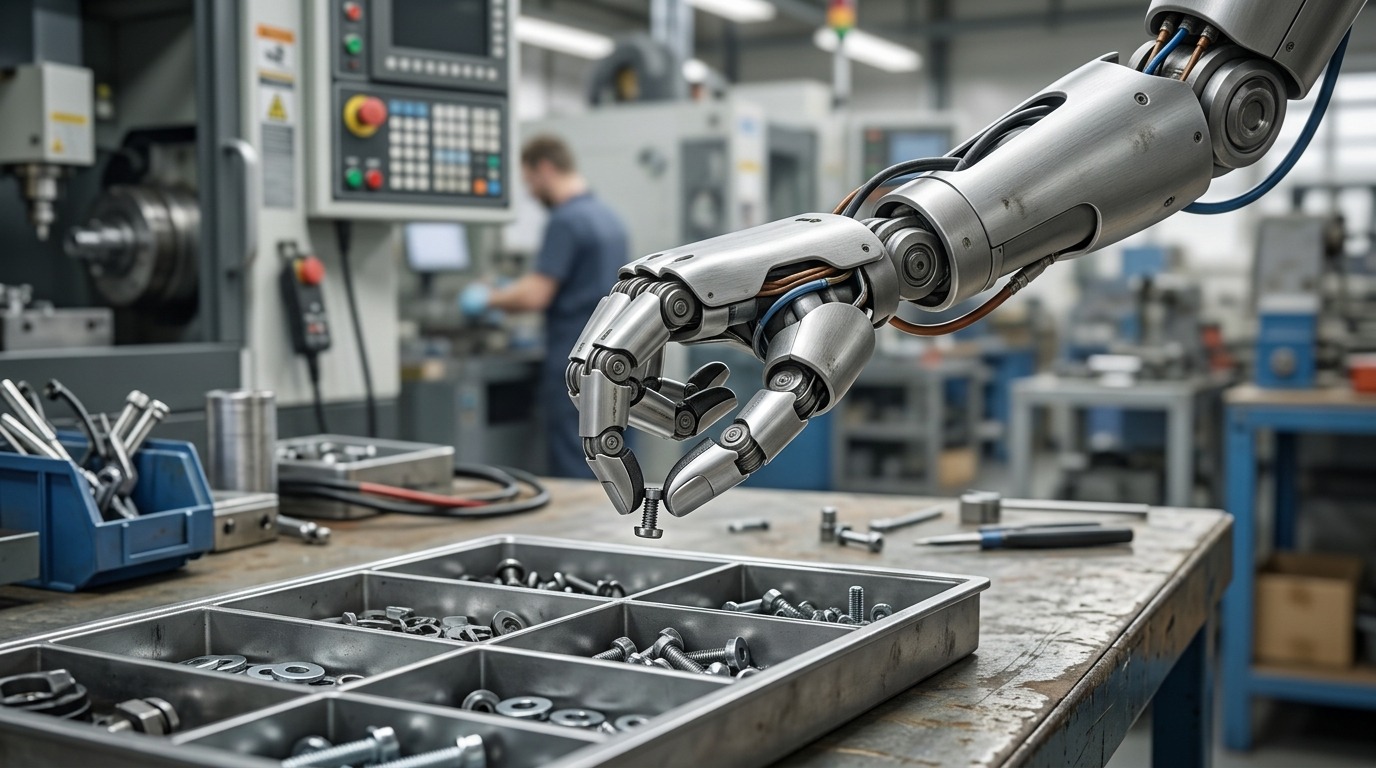
A robot learns to grasp small parts with two fingers
That is precisely why visual recognition systems are a key element of training. According to People’s Daily Online, Liuzhou’s diverse industrial base provides realistic conditions in which robots can be trained in complex, real-world factory environments before being deployed on production lines. Lighting, humidity, and changing workshop layouts all create additional challenges for machine vision that don’t exist in sterile laboratories.
AI-Powered Humanoid Robots: How They Are Trained in Liuzhou
To address the training data problem, Liuzhou has established a dedicated data collection and embodied AI testing center. The center functions as a “school for robots,” replicating full-scale production environments of key local industries: automotive manufacturing, construction machinery, pharmaceuticals, and even the production of luosifen — the famous local noodle dish.
It sounds amusing, but the logic is serious: the more diverse the training conditions, the better the robot adapts to the unpredictability of the real world. A pharmaceutical workshop with its sterile environment and an automotive assembly line present entirely different challenges for navigation and manipulation.
In total, about 120 robots undergo hands-on training at this center alongside live mentors, gradually building skills for industrial operations. For now, the robots are still in the early stages of preparation. Their gradual integration is expected to transform traditional manufacturing through the adoption of adaptive intelligent automation.
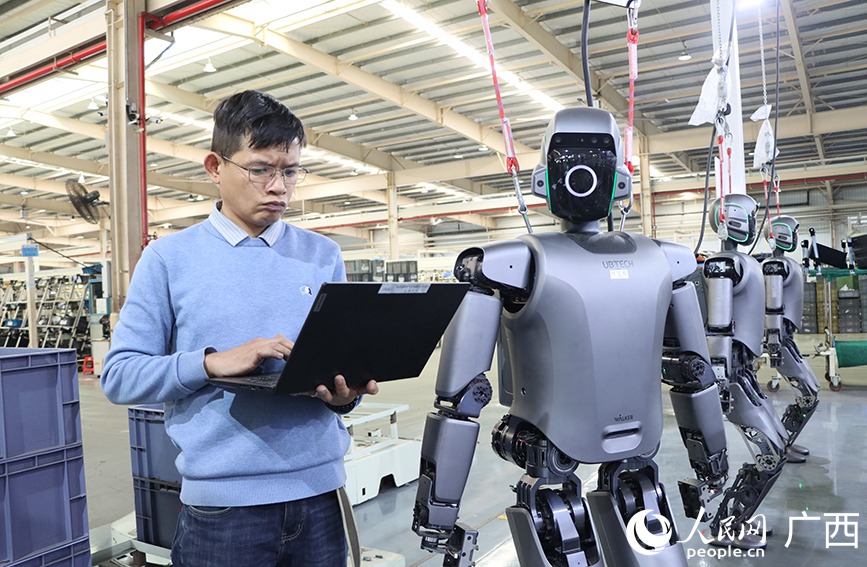
On the instructor’s command, 11 robots instantly activate their visual navigation systems and head to their assigned workstations. Image source: en.people.cn
Humanoid Robots in China: From Individual Prototypes to Mass Production
The internship in Liuzhou is just part of a larger picture. China is rapidly ramping up its capacity for producing humanoid robots. In March 2026, UBTech partnered with Siemens Digital Industries Software to scale up the production of such robots. On March 29, 2026, a high-capacity production line began operating in Guangdong Province, becoming the first factory in China capable of producing up to 10,000 such robots per year. The facility is a joint project of Leju Robotics and Dongfang Precision Science and Technology.
The line includes 24 precision assembly stages and 77 inspection checkpoints. A finished robot rolls off the line every 30 minutes — roughly 50% faster than with traditional assembly methods. The system uses a flexible manufacturing scheme: thanks to automated guided vehicles and digital control systems, the factory can switch between different robot models without major reconfiguration, enabling it to serve various industries — from automotive to home appliances.
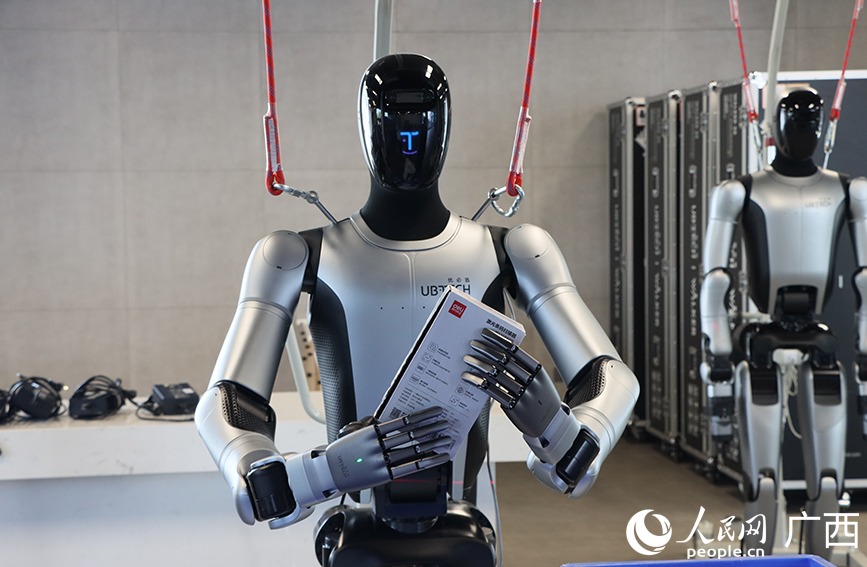
A robot sorts parts at the Dongfeng Liuzhou Motor factory. Image source: en.people.cn
What Mass Deployment of Humanoid Robots Means for the Labor Market
It is important to understand that this is currently an early, experimental stage. The humanoid robots in Liuzhou are still “interns”: they are not replacing workers on the assembly line but are only learning. Dongfeng Liuzhou Motor CEO Lin Changbo calls the robots “apprentices” and says the company expects them to increase efficiency, reduce costs, and handle physically demanding and dangerous tasks.
Meanwhile, competition in the industry is intensifying. The company Agibot recently announced the production of its 10,000th humanoid, and Unitree Robotics is raising $580 million to build a factory with a capacity of 75,000 robots per year. Major Chinese automakers — BYD, Geely Auto — are also actively entering the humanoid robotics space.