The OnePlus 15 and POCO F9 Ultra use the same Snapdragon 8 Elite Gen 5 chip and sell for roughly the same price, but they suit different buyers. After comparing their specifications side by side, the source author concludes that the POCO F9 Ultra offers more for the money. It has a bigger battery, a longer-reach periscope zoom, a larger display and a 2.1 speaker system with a dedicated subwoofer. The OnePlus 15 is the better pick for people who value a lighter, thinner, tougher phone with faster wired charging and cleaner software.
What you need to know
- Both phones run the Snapdragon 8 Elite Gen 5. According to the source, both heat up and throttle under sustained load, especially in a case.
- The POCO F9 Ultra has an 8,050 mAh battery and a 5x periscope camera. The OnePlus 15 has a 7,300 mAh battery and a 3.5x telephoto.
- The OnePlus 15 weighs 211 g and has IP66, IP68, IP69 and IP69K ratings. The POCO F9 Ultra weighs 235 g and is rated IP68.
- According to the source, OnePlus has announced that phones updated to Android 17 will move from OxygenOS to OPPO’s ColorOS 17. The source describes the switch as voluntary.
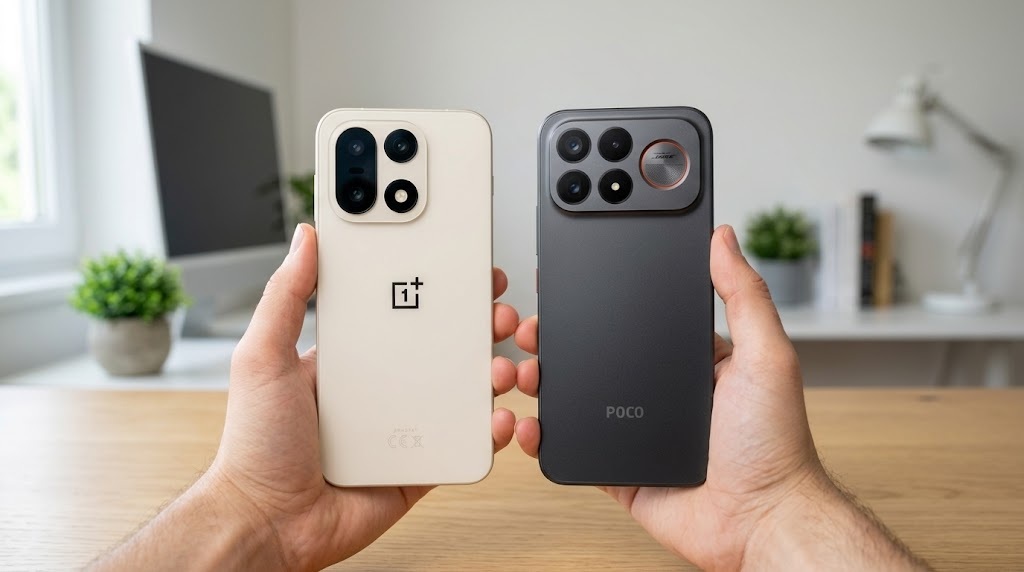
The OnePlus 15 and POCO F9 Ultra smartphones
Same chip, same price, different priorities
The source presents the two phones as popular choices in the same price bracket, with nearly identical prices. Both use the Snapdragon 8 Elite Gen 5, which the source calls one of the fastest Android processors.
According to the source, both handle gaming, video editing and dozens of open browser tabs with no difference you could notice without benchmarks. The two phones also share a weakness: under prolonged load, both get noticeably warm and lower their clock speeds, particularly inside a case. On performance, the source calls it a draw.
Key specifications at a glance
| Feature | OnePlus 15 | POCO F9 Ultra |
|---|---|---|
| Processor | Snapdragon 8 Elite Gen 5 | Snapdragon 8 Elite Gen 5 |
| Battery | 7,300 mAh | 8,050 mAh |
| Wired / wireless charging | 120 W / 50 W | 100 W / 50 W |
| Rear cameras | Three 50 MP cameras, 3.5x telephoto | 200 MP main, 50 MP ultrawide, 50 MP 5x periscope |
| Display | 6.78 inches, 165 Hz | 6.9 inches, 185 Hz (in about two dozen games; 120 Hz otherwise) |
| Audio | Stereo speakers | Bose 2.1 sound with rear subwoofer |
| Weight / thickness | 211 g / 8.1 mm | 235 g / 8.7 mm |
| Water and dust protection | IP66, IP68, IP69, IP69K | IP68 |
| Software | OxygenOS | HyperOS 3 |
Battery: a 750 mAh advantage for POCO
The POCO F9 Ultra has an 8,050 mAh battery, compared with 7,300 mAh in the OnePlus 15, roughly a tenth more capacity. The source says both phones comfortably last more than a day, but the POCO has a noticeably larger reserve.
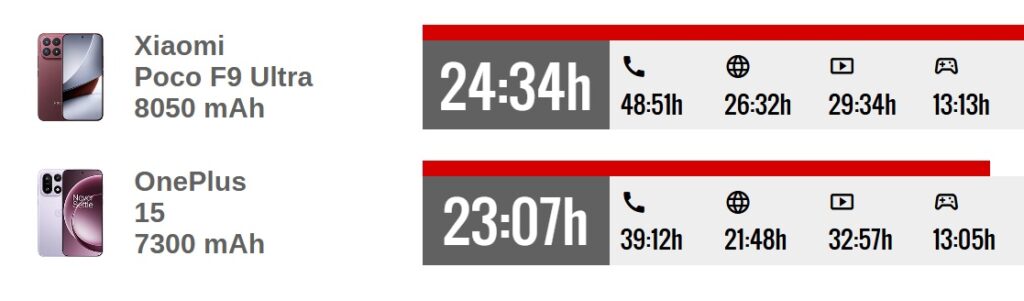
Battery life test results for the OnePlus 15 and POCO F9 Ultra. Source: gsmarena.com
The OnePlus charges faster: 120 W wired versus 100 W for the POCO. Both support 50 W wireless charging. The source argues that if you charge overnight, charging speed matters little, while the extra 750 mAh helps every day. The author gives this round to POCO.

Cameras: 5x periscope versus 3.5x telephoto
The POCO F9 Ultra pairs a 200 MP main camera with a 50 MP ultrawide and a 50 MP periscope lens offering 5x magnification. The OnePlus 15 uses three 50 MP cameras, and its telephoto lens zooms to 3.5x.

Telephoto shot taken with the OnePlus 15. Source: gsmarena.com

Telephoto shot taken with the POCO F9 Ultra. Source: gsmarena.com
According to the source, this means the POCO can capture a concert stage, a sign across the street or a child at a school event closer and more clearly, without the smeared look of digital zoom. In ordinary daylight shooting, the source rates both phones at flagship level, but names POCO the winner on zoom.
Sound and display: POCO’s subwoofer and larger screen
The source highlights a rare feature on the POCO F9 Ultra: Bose 2.1 sound with a separate subwoofer on the back panel. The source says this adds bass to films and games that regular stereo speakers cannot deliver. The OnePlus 15 has stereo speakers that the source describes as good but conventional.
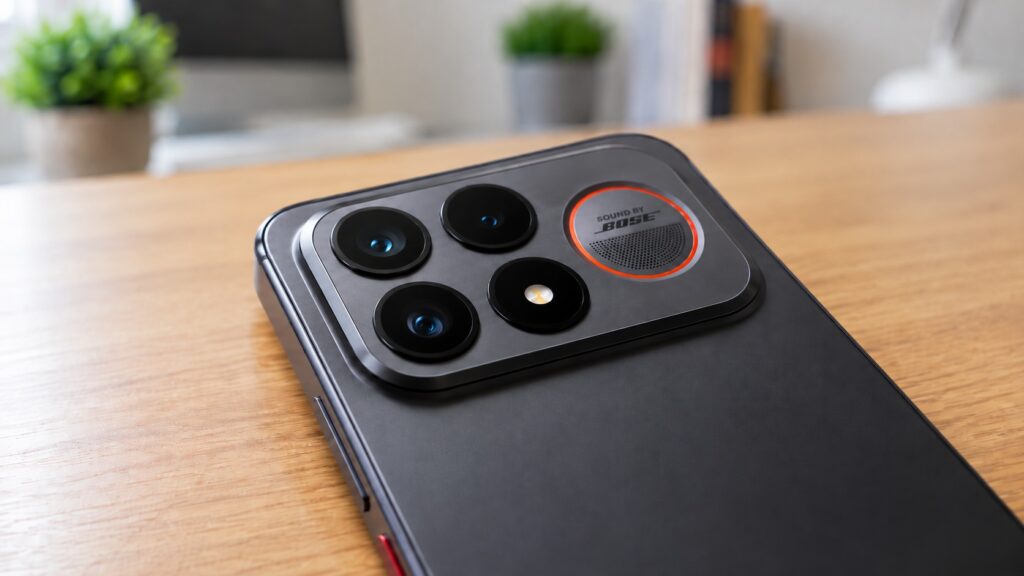
The POCO F9 Ultra’s subwoofer
The POCO also has the bigger display: 6.9 inches at 185 Hz, versus 6.78 inches at 165 Hz on the OnePlus. However, the 185 Hz mode works only in about two dozen games; everything else runs at 120 Hz. The source concludes that POCO is more appealing for films and games, but notes that the larger screen comes with a trade-off.

Build and durability: OnePlus is lighter and tougher
The trade-off is size and weight. The POCO F9 Ultra weighs 235 g and is 8.7 mm thick. The OnePlus 15 weighs 211 g and is 8.1 mm thick. The source says the 24-gram difference is noticeable both in a pocket and in the hand.
OnePlus also leads on protection. It carries IP66, IP68, IP69 and IP69K ratings, which the source says means it can withstand even a pressurized jet of hot water. The POCO is rated only IP68, and its back panel is made of fiberglass. For buyers who want a neat, durable body, the source gives this round to OnePlus.
Software: OxygenOS versus HyperOS 3
OnePlus takes a second point for software. The source describes OxygenOS as one of the cleanest and fastest Android skins, with no ads and no intrusive preinstalled apps. It says POCO’s HyperOS 3 has improved but still comes with more extra apps and notifications.
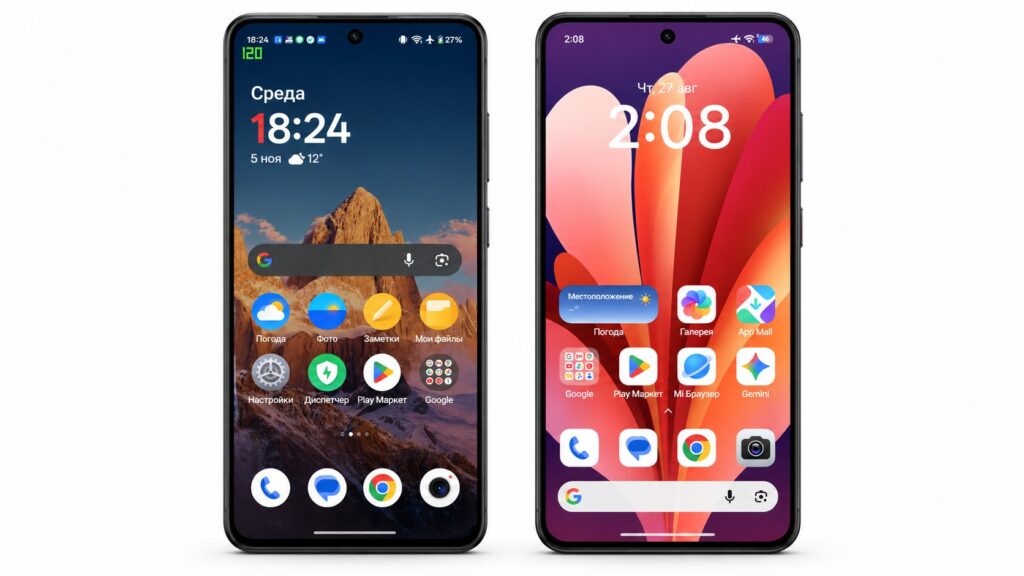
The OnePlus 15 interface (left) and the POCO F9 Ultra interface (right)
There is a caveat. According to the source, OnePlus has announced that phones receiving the Android 17 update will move from OxygenOS to OPPO’s ColorOS 17. The source says the switch is voluntary and describes ColorOS as tidy as well, but notes that OnePlus’s own software skin is becoming a thing of the past.
Verdict: which phone suits whom
The source summarizes the choice this way. The OnePlus 15 is better where convenience and reliability matter: it is lighter and thinner, has IP69K protection, charges faster and runs cleaner software. The POCO F9 Ultra is better where features matter: it has a bigger battery, longer zoom, a larger screen and subwoofer-backed sound.
For their own use, the source author would choose the POCO F9 Ultra, arguing that it delivers more for the same money. The author recommends the OnePlus 15 to buyers who want a relatively light phone and do not want to put up with HyperOS.