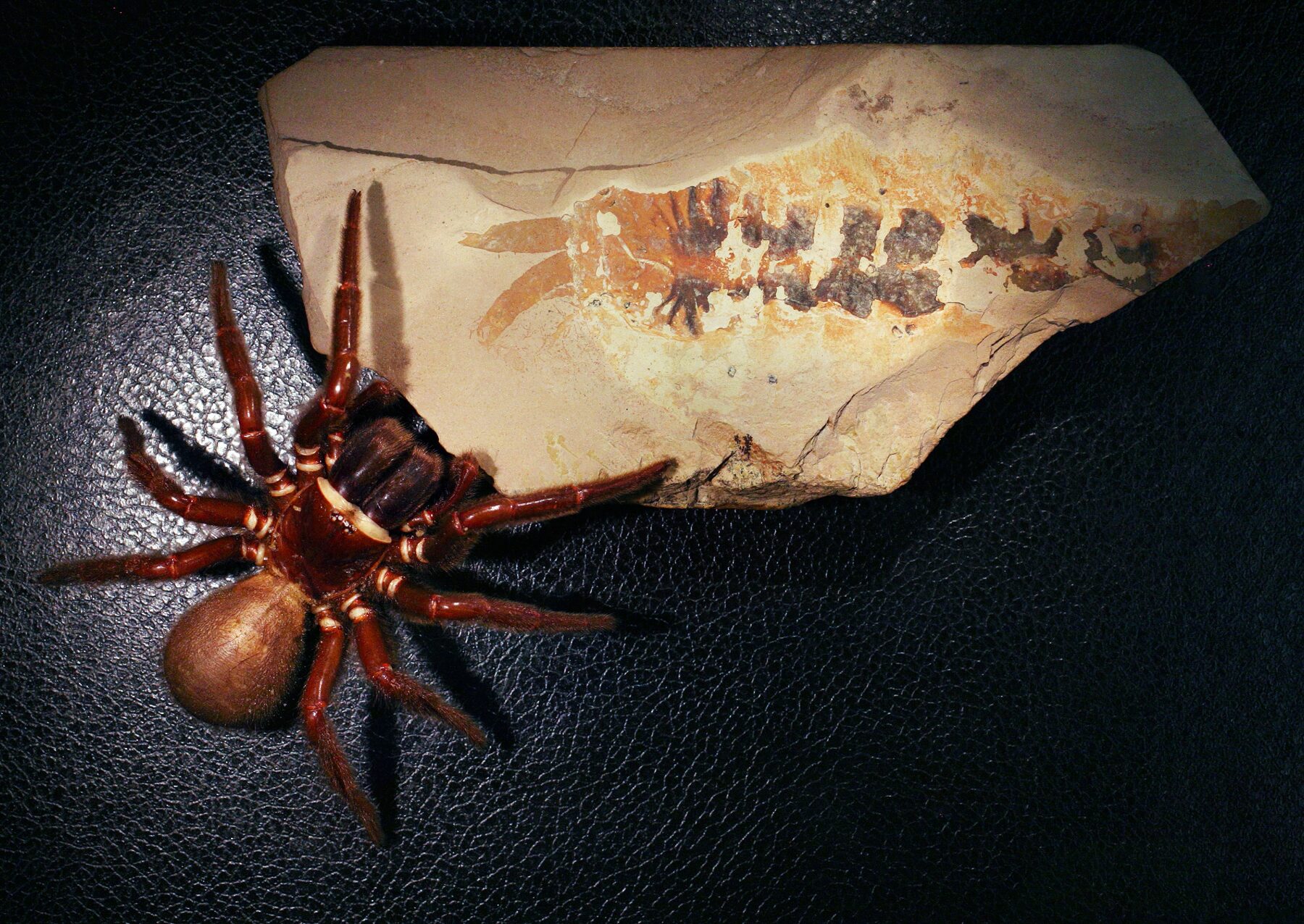
A modern spider next to a fossil
A fossil that a Harvard paleontologist initially considered unremarkable turned out to be the oldest known relative of spiders, scorpions, and horseshoe crabs. The 500-million-year-old marine predator was found to have pincers in a place where no one expected them. A single find has pushed back the evolutionary history of an entire class of animals by 20 million years and helps us better understand what happened during the Cambrian explosion.
The Most Ancient Spider Ancestor: What Was Found in the Utah Desert
The fossil creature from the Cambrian period (538.8–485.4 million years ago) has been named Megachelicerax cousteaui. It is a 500-million-year-old marine predator that lived in an era when the oceans were home to other unusual forms of life, including giant arthropods. Discovered more than 40 years ago in the desert of western Utah, it has now been recognized as the oldest known chelicerate — a member of the arthropod group that includes modern spiders, scorpions, horseshoe crabs, and sea spiders.
The fossil was collected from the Middle Cambrian Wheeler Formation in the House Range. It was found by amateur paleontologist Lloyd Gunther and donated to the University of Kansas museum in 1981 for further study. For decades, the specimen sat in the collection without attracting much attention — until Harvard University paleontologist Rudy Lerosey-Aubril took it on.
Why Claws on the Head Are an Anomaly for Ancient Arthropods
To understand why this discovery made such an impression on paleontologists, one important detail is needed. Cambrian arthropods in this location on the head typically had antennae, not claws. Lerosey-Aubril discovered claws where, according to all known data, they were not supposed to be.
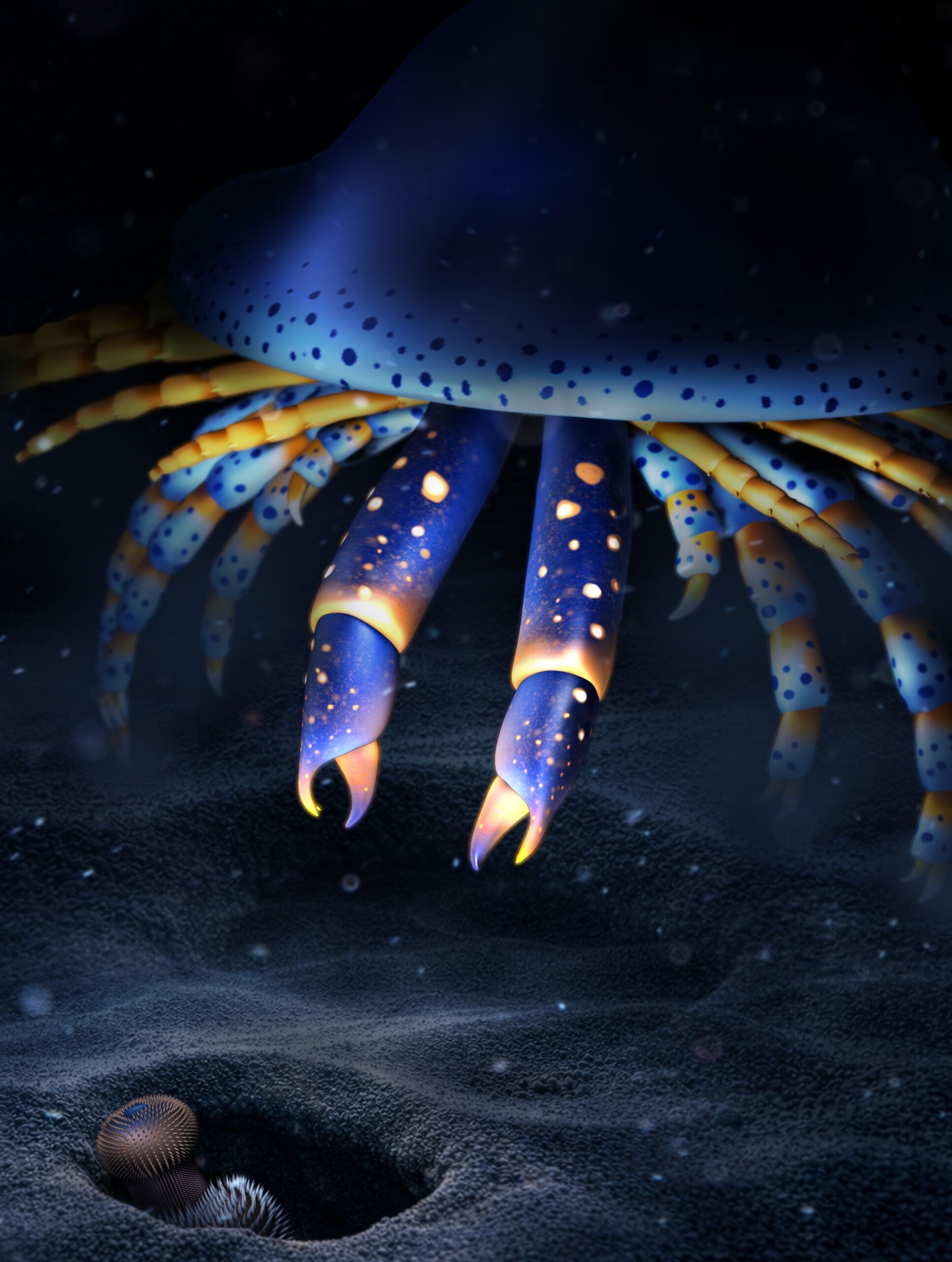
Artistic reconstruction of Megachelicerax cousteaui — a marine predator from the Cambrian period
These claws are known as chelicerae. It is after them that the entire chelicerate group (Chelicerata) is named — a vast class that includes spiders, mites, scorpions, and horseshoe crabs. Chelicerae are essentially the “calling card” of all arachnids: mouthpart appendages located in front of the mouth and used for capturing food. In spiders, they have evolved into venomous fangs; in scorpions, into small pincers near the mouth.
“Claws are never found in this position in Cambrian arthropods,” Lerosey-Aubril explained. According to him, it took several minutes for it to sink in: he had just exposed the most ancient chelicera in history.
How the Discovery Pushed Back Spider Origins by 20 Million Years
Lerosey-Aubril spent more than 50 hours carefully cleaning the fossil with a needle under a microscope to study the creature’s hidden anatomy. What was revealed turned out to be unexpectedly complex for an animal of that age.
The body of M. cousteaui is just over 8 centimeters long. It has an exoskeleton with a head shield on top and nine separate body segments. The limbs under the head are adapted for feeding and sensory functions, while the limbs along the trunk are used for breathing and swimming.
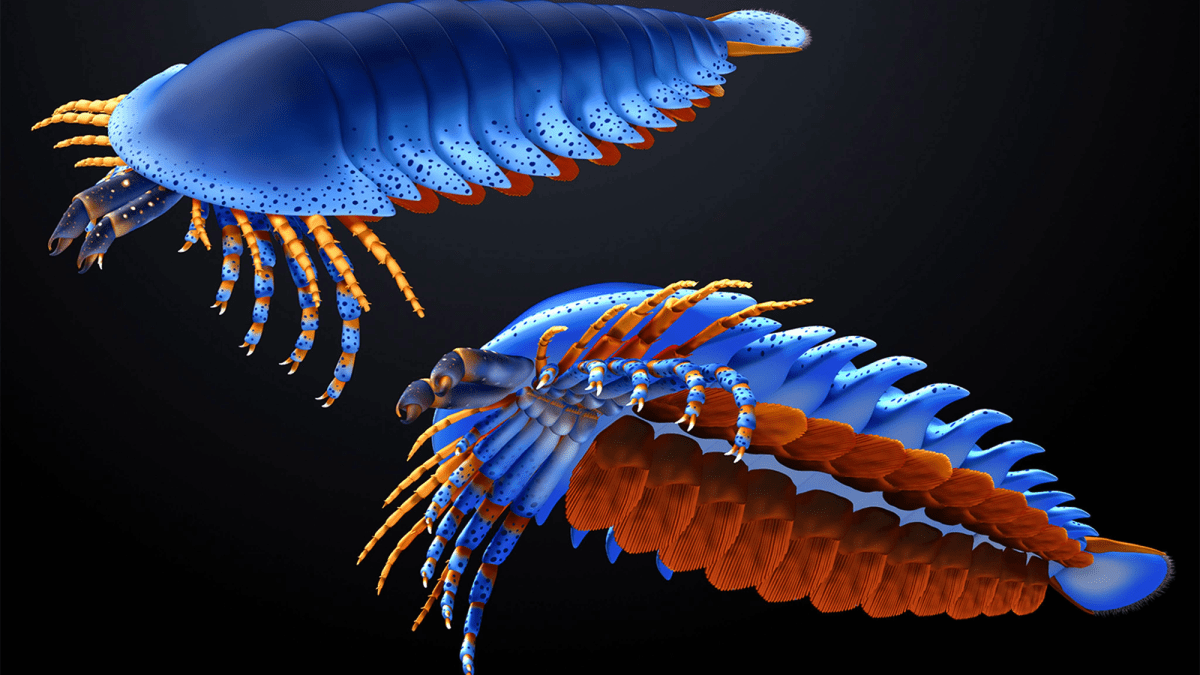
The remarkably complex anatomy of the Cambrian chelicerate Megachelicerax cousteaui
This single specimen pushes back the evolutionary history of chelicerates by 20 million years and also helps explain the evolution of claws. Before this discovery, the oldest known chelicerate was a creature approximately 480 million years old. M. cousteaui lived 20 million years earlier — at the very height of the Cambrian explosion, a period of rapid emergence of new life forms about 540–500 million years ago.
Today, chelicerates include more than 120,000 living species. And all of them, it turns out, trace their lineage to creatures that already half a billion years ago had acquired their signature “weapon” — mouth claws.
How Spider Bodies Took Shape: What the New Find Revealed
Despite its colossal age, M. cousteaui looks surprisingly modern compared to other creatures of that period.
“Except for a few signs of its antiquity, this half-billion-year-old chelicerate would look right at home in modern oceans,” says Lerosey-Aubril.
M. cousteaui is a key transitional species that links Cambrian arthropods, which lacked front claws, with much later chelicerates resembling horseshoe crabs. Before this find, scientists were unsure in what order chelicerates developed claws and the division of the body into two functionally distinct sections.
“Megachelicerax shows that chelicerae and the division of the body into two specialized regions arose even before the head appendages lost their outer branches and came to resemble the legs of modern spiders,” explained study co-author Javier Ortega-Hernández, curator of invertebrate paleontology at Harvard’s Museum of Comparative Zoology.
Put simply: previously there were several competing hypotheses about exactly how the “construction kit” of the arachnid body was assembled. The new find reconciled these hypotheses: it turned out that “everyone was partly right.” Scientists had also found other transitional forms of arachnids, including a chimera spider with a tail, which also helped refine their evolutionary history.
Why the Ancient Predator Was Named After Jacques-Yves Cousteau
Megachelicerax cousteaui is named after the famous French explorer Jacques-Yves Cousteau. Lerosey-Aubril is also French, and together with Ortega-Hernández, they chose this name to honor Cousteau’s contribution to understanding the beauty and vulnerability of the underwater world.
“Cousteau and his team inspired entire generations to look beneath the surface of the water. It seemed fitting to name this ancient marine creature after a man who changed the way we see life in the ocean,” said Lerosey-Aubril.
The story of the discovery itself is also a lesson. The fossil was found by an amateur paleontologist, then donated to a museum, where it was stored for decades before scientists were able to uncover its scientific significance. Lerosey-Aubril encourages people to go outdoors and search for fossils — because the rocks around us may hold stories that no one has told yet.
Why the Megachelicerax Discovery Changed Our Understanding of Cambrian Evolution
Paleontology is the science that studies ancient life through fossil remains: petrified skeletons, imprints, and traces. It reconstructs the picture of life on Earth millions and billions of years before us. And the Cambrian period is one of its most intriguing subjects, because it was then that the oceans were full of strange marine creatures that today could easily be mistaken for an artist’s fantasy.
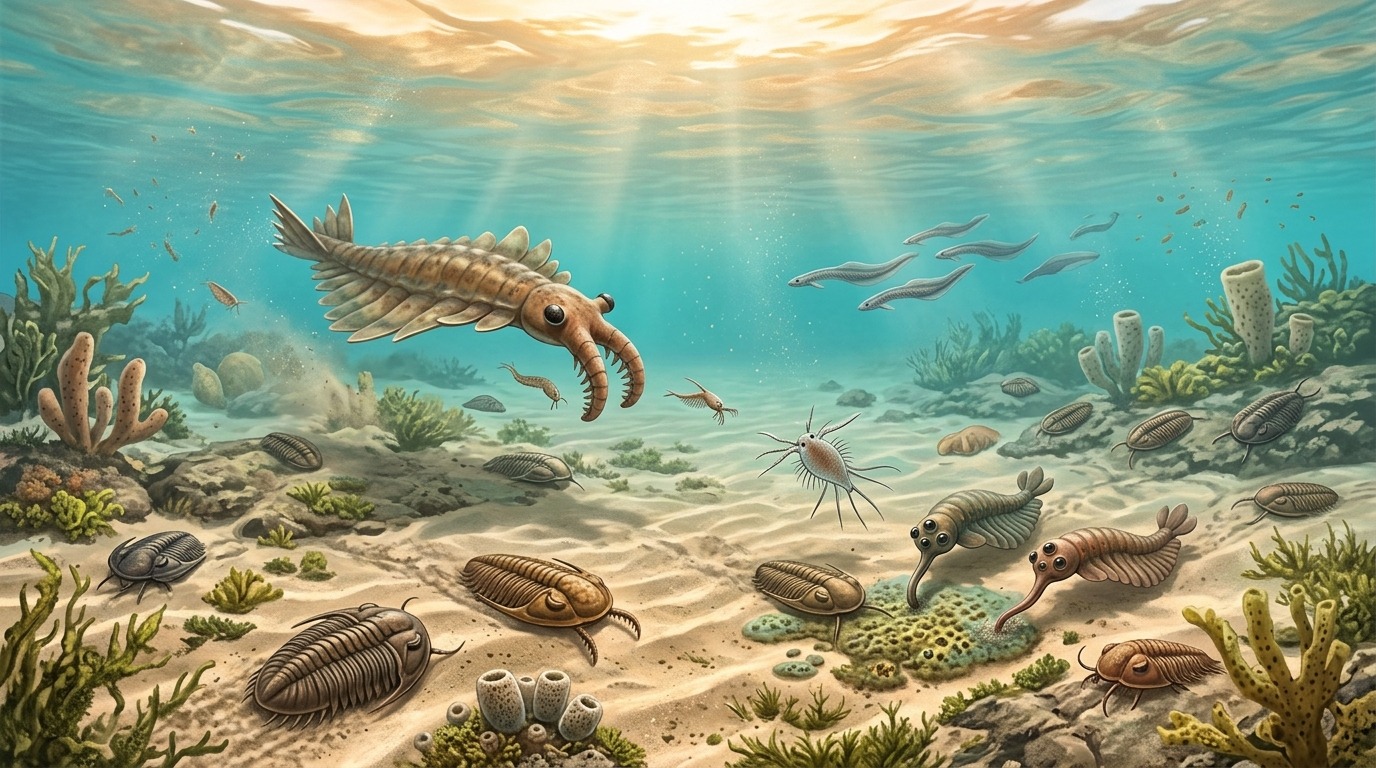
The Cambrian ocean — the cradle of the first complex animals on Earth
The discovery of Megachelicerax marks a key stage in the formation of the chelicerate body plan and shows that the most important elements of this plan had already emerged during the Cambrian explosion — a period of extraordinarily rapid evolutionary innovation.
“This tells us that by the middle of the Cambrian, when the pace of evolution was incredibly high, the oceans were inhabited by arthropods with anatomical complexity comparable to modern forms,” noted Ortega-Hernández.
Interestingly, the early appearance of complex anatomy did not lead to immediate ecological dominance or rapid diversification of chelicerates. The building blocks of the “spider body” were assembled half a billion years ago, but it took tens of millions of years more for this group to fully flourish.