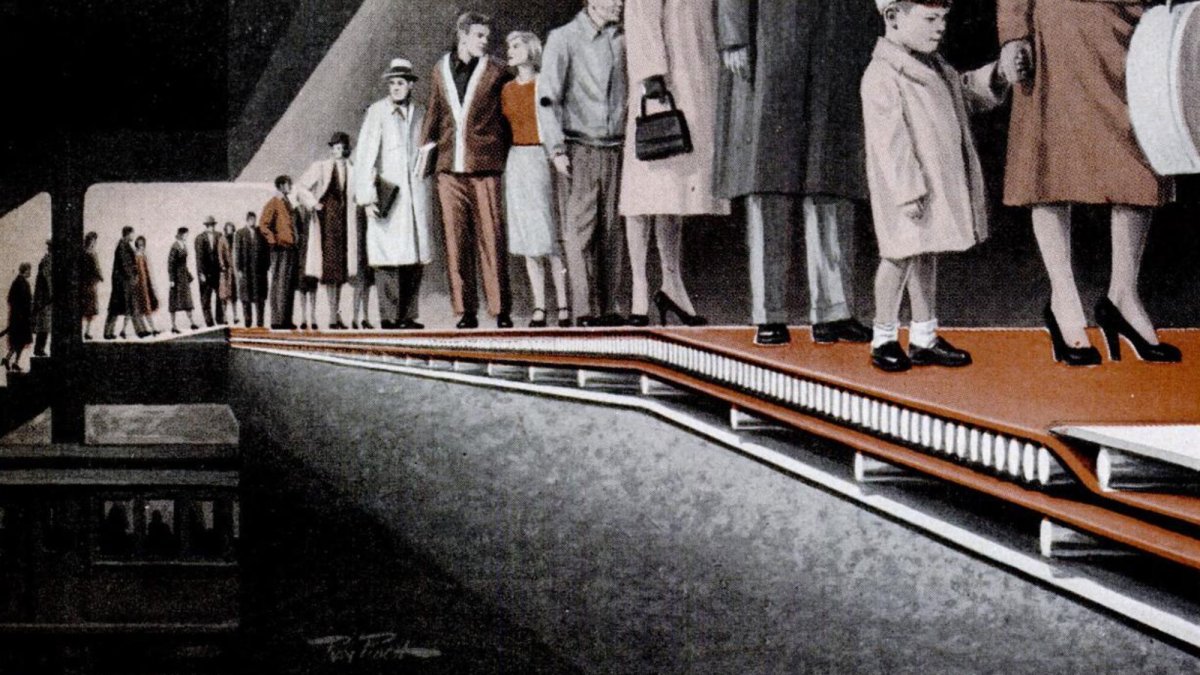
This is what Speer’s moving sidewalk could have looked like above the bustling Broadway of the 1870s
In 1871, New York wine merchant Alfred Speer patented a moving sidewalk for Broadway — and nearly changed the face of urban transportation forever. State legislators approved the project twice, but the governor vetoed it both times. More than 150 years have passed since then, and engineers and urbanists have returned to this idea again and again — yet moving sidewalks never made it beyond airports and exhibitions. Let’s explore why this simple, convenient, and elegant concept has repeatedly lost to reality and never appeared on city streets.
How a Wine Merchant Invented the Moving Sidewalk in the 19th Century
Alfred Speer was a colorful figure even by 19th-century standards. Born in 1823 in New Jersey, he had been a cabinetmaker, patented a cylindrical piano, founded the largest vineyard in the state, became a well-known winemaker, and even helped found the city of Passaic by publishing its first newspaper. But he entered transportation history thanks to a different idea — one that sounded almost like an early scenario about what the transport of the future might look like.
In the early 1870s, Broadway was a chaotic mix of horses, carriages, and pedestrians. Speer, whose wine shop stood opposite City Hall, believed that this congestion was driving away customers. His solution was ambitious: an elevated sidewalk above the street, moving at 10 mph, with chairs for those who wished to sit. He called his invention the “Endless Traveling Sidewalk.”
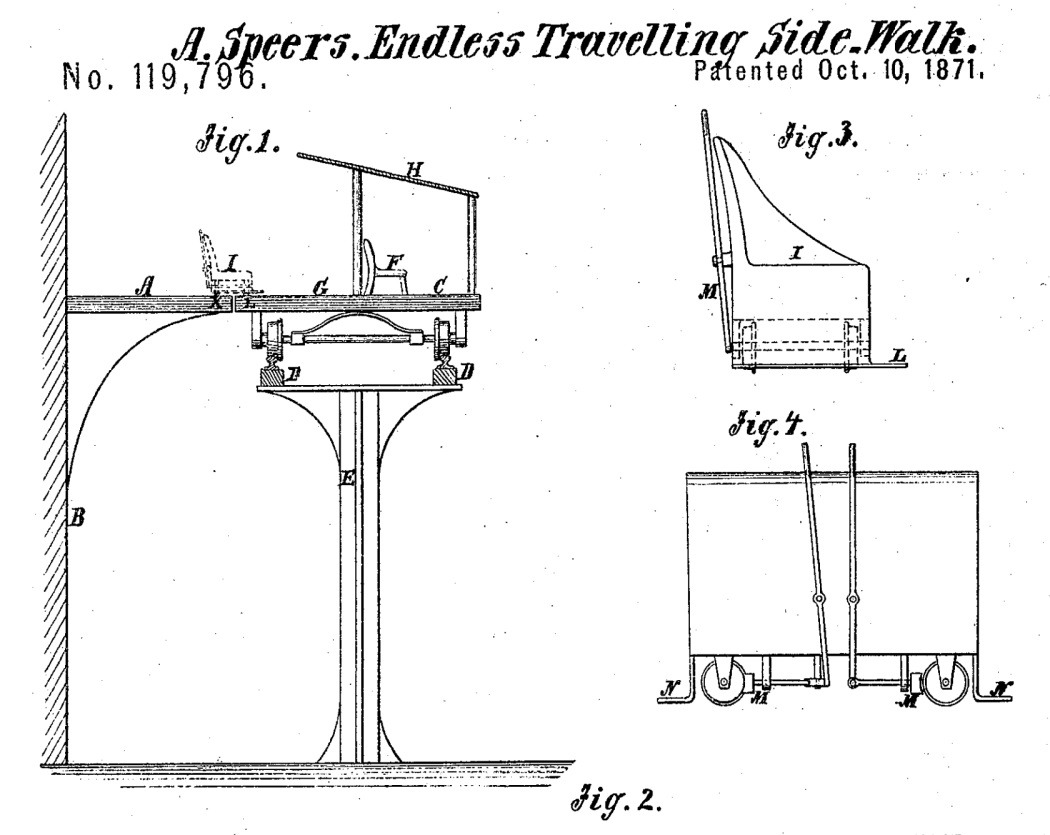
Alfred Speer’s 1871 patent for the “Endless Traveling Sidewalk” shows comfortable chairs that were supposed to move along the sidewalk.
Speer later refined the project: he added several parallel tracks at different speeds — from walking pace to 15 mph — with enclosed carriages, ladies’ rooms, and smoking lounges every 30 meters. The system was to run in a continuous loop from the Bowery district to Central Park. Passengers wouldn’t need to wait at stops — they could step on and off at any point.
The project gained the support of influential people, including politician Horace Greeley, and was approved twice — in 1873 and 1874 — by the New York State Legislature. But Governor John Dix vetoed it both times: he was concerned about the cost, the impact on street-level sidewalks, and the fact that the structure would overhang Broadway in two places. By 1890, Speer’s patent had expired, and his idea was never realized.
Moving Sidewalks at Exhibitions: The First Working Systems
The world’s first working moving sidewalk appeared not on a city street but at the World’s Columbian Exposition in Chicago in 1893. It stretched more than 800 meters along the pier, connecting the ferry terminal with the exhibition pavilions. The design offered two platforms: a slow one with benches (2 mph) and a faster one for walking (4 mph). The Chicago Tribune wrote about it as a “moving sidewalk that delivers passengers to the entrance.” But it didn’t last long — a fire destroyed it the following year.
In 1900, an even more ambitious version appeared at the Paris Exposition. The system stretched more than three kilometers around the main pavilions. The New York Times noted that passengers “of any age and sex” easily stepped on and off the platform. Journalists were impressed — but it went no further than the exhibition.
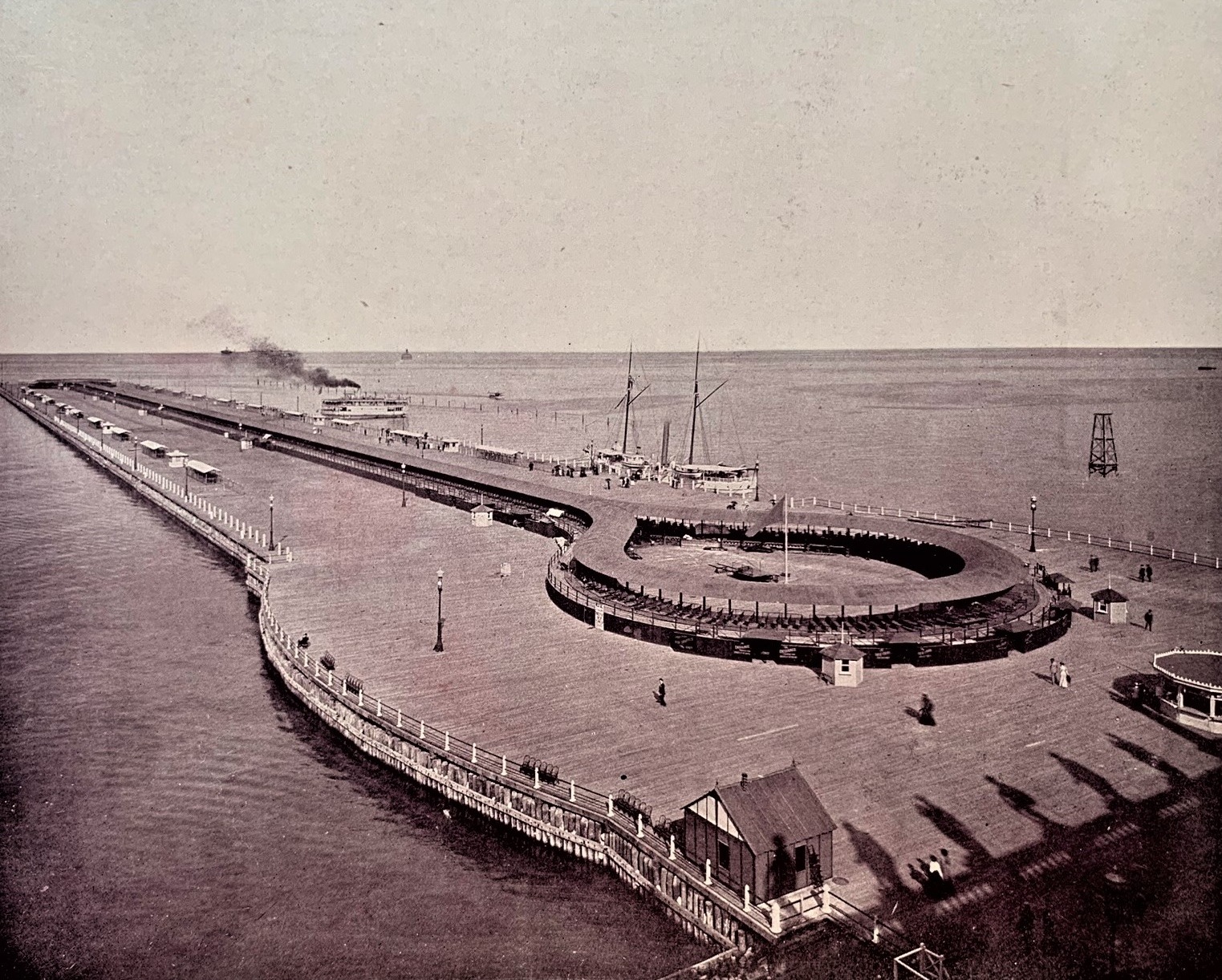
The first moving sidewalk appeared at the 1893 World’s Columbian Exposition in Chicago. The half-mile-long sidewalk connected the ferry terminal with the exhibition complex.
In 1903, a six-mile underground moving sidewalk system was proposed in New York that would have connected Lower Manhattan and Brooklyn via the Williamsburg Bridge. The tunnel, up to 9 meters wide, would have accommodated three parallel platforms at speeds of 3, 6, and 9 mph. The fastest would have had seating. The tunnel was to be illuminated and heated in winter. But the project lost out to the underground subway. Still, engineers took an important step: they moved Speer’s idea underground and under cover.
Why Moving Walkways Lost to Automobiles in the 20th Century
By the 1920s, more than half of the U.S. population was concentrated in cities. Street congestion was intensifying, and engineers kept returning to the idea of moving sidewalks. In 1919, there were even plans to connect New York’s Grand Central Terminal to Times Square with an underground moving walkway. In 1930, Detroit traffic inspector Herman Taylor built a tabletop model of a system that could reach 25 mph through gradual belt acceleration.
Westinghouse, which had built the electric motors for the Paris sidewalk, remained the main commercial enthusiast. In 1932, Popular Science published plans for underground and elevated moving sidewalks in glass tunnels between buildings. Proposals came from transportation departments, engineers, and city planners — and died in committees.
The reasons were the same for decades:
- Cost. City-wide moving sidewalk systems required enormous investments comparable to subway construction.
- Safety. Pedestrians stepping onto a continuously moving platform — a legal nightmare.
- Weather. Exposed machinery and passengers in rain and snow — an engineering headache.
- Automobiles. From the early 20th century, cars won the battle for the streets, and highways won government budgets.
The last point proved decisive. Urban planning doctrine for generations pushed pedestrians to the margins — literally. Where moving sidewalks could have appeared, asphalt for cars was laid instead. And today, more and more cities are trying to rethink this model, because car-free cities have long ceased to seem like fantasy.
Why Moving Sidewalks Took Hold in Airports
The breakthrough came when engineers stopped dreaming about redesigning entire cities and asked a more modest question: how do you move people along one specific corridor? In 1954, Goodyear installed the first commercial moving sidewalk at a railroad station in Jersey City. The “Speedwalk” was a rubber belt 84 meters long that ascended an inclined corridor passengers had nicknamed “Heart Attack Alley” because of its steep slope. Speed — just 1.5 mph. No parallel tracks, no chairs, no smoking lounges. Just gentle assistance on one difficult stretch. And it worked.
In 1958, the first airport moving walkway — the Trav-O-Lator — opened at Dallas Love Field airport. That’s exactly where the name “travelator” comes from — a horizontal or inclined moving walkway without steps, also known as a “travellator” or “passenger conveyor.” The design was popular, but its belt was notoriously known for catching clothing and shoes. In 1960, a two-year-old girl died in such an incident.
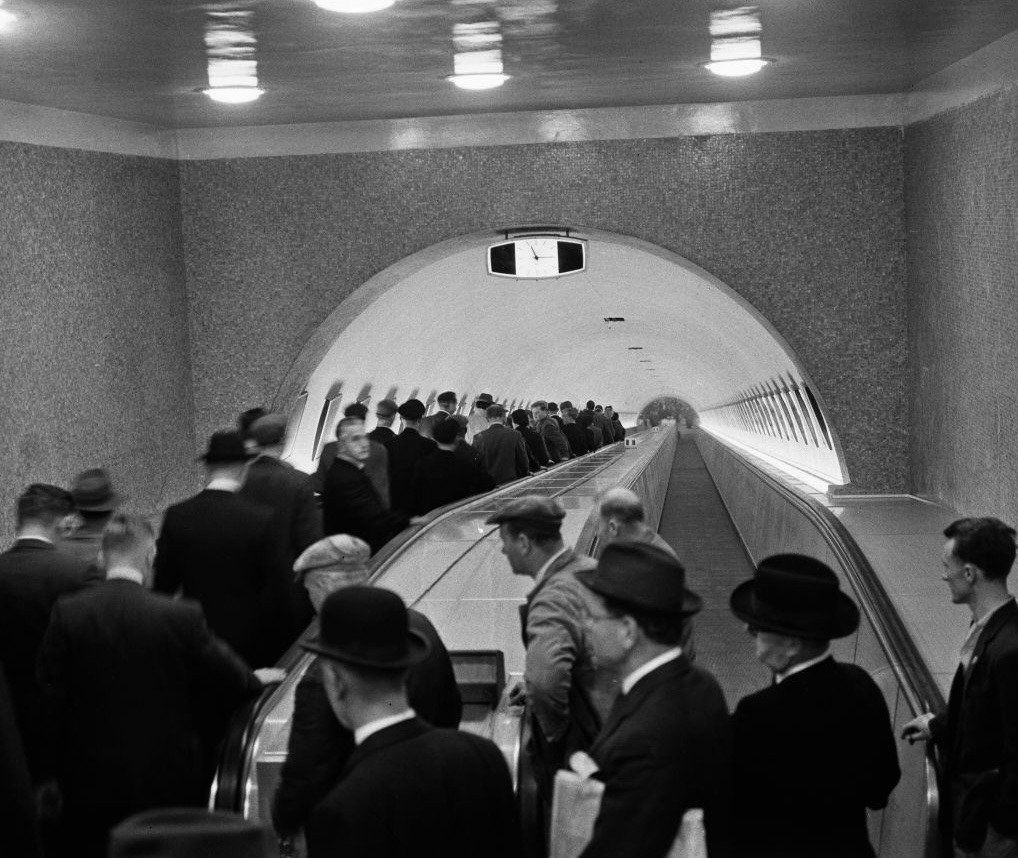
On October 8, 1960, passengers use the newly installed Trav-O-Lator moving sidewalk at Bank station on the London Underground.
Despite the tragedy, airports proved to be the ideal environment for moving sidewalks: enclosed spaces, long corridors between specific points, and predictable passenger flow. In 1960, the “Astroways” travelator appeared at Los Angeles Airport, and at London’s Bank Underground station the first European Trav-O-Lator was installed — and it still operates today. The era of moving walkways — albeit in a limited format — had finally begun.
Interestingly, some airports today are actually removing travelators. Airports in Chicago, Las Vegas, Dallas, and Cincinnati have dismantled some walkways due to high maintenance costs and lack of space. Additionally, shops complain: passengers fly past storefronts without stopping.