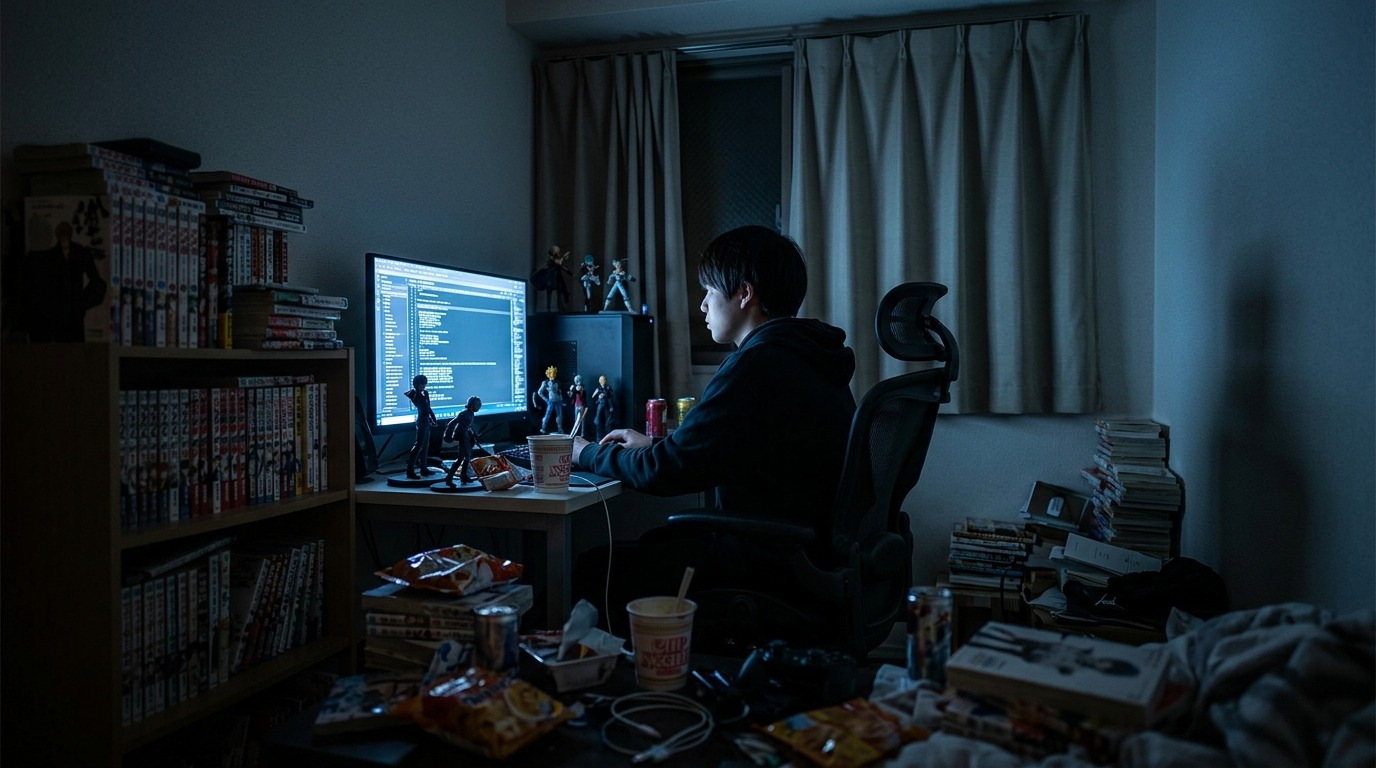
A typical hikikomori room: drawn curtains, screen glow, and complete isolation from the outside world
In Japan, nearly one and a half million people live in complete isolation from society — not leaving their rooms for months and years. For a long time, this was considered a purely Japanese problem linked to the pressure of a rigid culture. But fresh scientific data suggests that hikikomori is not an exotic phenomenon but a global trend that has only intensified after the pandemic.
What is hikikomori syndrome
The word hikikomori literally translates from Japanese as “pulling inward” or “reclusion.” The term appeared in the late 1990s thanks to Japanese psychiatrist Tamaki Saitō, who described people who completely isolate themselves from social life — locking themselves in their homes, often in a single room, refusing work, education, and live communication. The key criterion is that such isolation lasts at least six months, but in practice it often involves years and even decades.
A typical hikikomori reverses their daily routine: sleeping during the day and staying awake at night. Waking hours are spent in front of a screen — games, the internet, television. Basic daily habits like hygiene or cleaning are often abandoned. This is not simply introversion or laziness; it is a radical withdrawal from the social world.
IMPORTANT: hikikomori is not a psychiatric diagnosis; it does not appear in the international disease classifications DSM-5 or ICD-11. Psychiatrist Saitō emphasized that hikikomori symptoms do not fit neatly into any single disorder — neither depression, nor anxiety disorder, nor schizophrenia. It is more of a behavioral syndrome at the intersection of personal vulnerabilities and societal pressure.
How many hikikomori are in Japan
When Saitō first described the phenomenon, he estimated the number of recluses at approximately one million people. Since then, the figure has not decreased but grown. The latest major survey by the Japanese Cabinet Office (2022) showed that approximately 1.46 million people aged 15 to 64 live in a state of hikikomori — slightly more than 2% of the working-age population.
Initially, the problem was associated with young men, but reality turned out to be broader. Recent studies have shown a growing number of hikikomori among women — in the 40–64 age group, women made up 52.3% in a 2023 survey. The phenomenon is also aging along with its participants: more than half of older hikikomori had been in isolation for longer than five years, and 6.4% — for over thirty years.
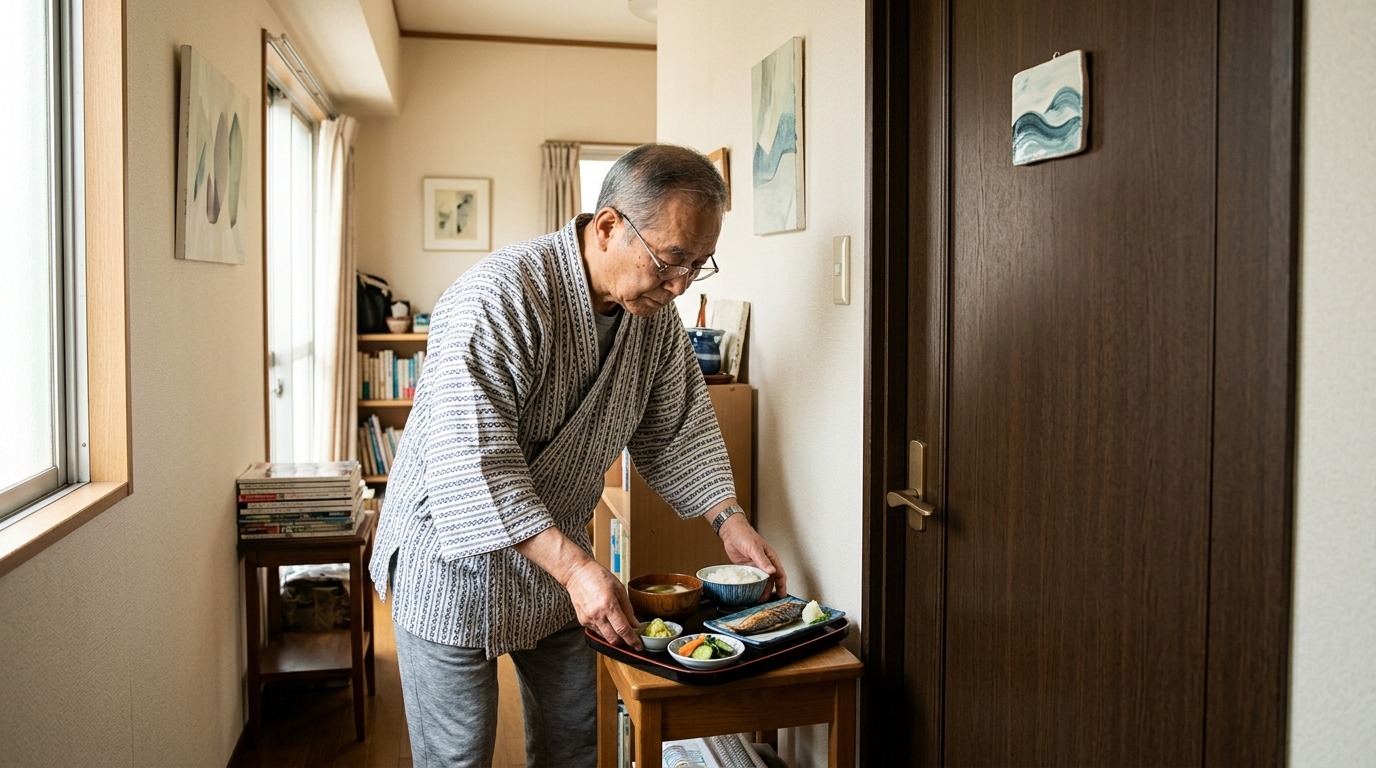
An elderly parent leaves food at a closed door — the everyday reality of families with hikikomori
Why people don’t leave their homes
There is no simple explanation, and that is precisely what makes hikikomori such a complex phenomenon. The causes are a combination of personal psychological vulnerabilities and environmental pressure.
In Japan, several key factors are often identified:
- Extreme pressure in education and work — failing a university entrance exam, school bullying, or public humiliation at the workplace can destroy self-esteem to the point where withdrawal from the world becomes a psychological defense;
- The culture of sekentei — reputation and social image carry enormous weight in Japanese society. When a person fails to meet expectations, shame spreads to the entire family. Paradoxically, it is precisely because of shame that families often hide their hikikomori child instead of seeking help;
- The concept of amae — in Japanese culture, a certain dependence of adult children on their parents is accepted. Living together is the norm. This support system, for all its merits, can unintentionally facilitate prolonged reclusion by removing the financial necessity to leave home.
But reducing everything to Japanese culture alone is a mistake. Competitive education, fear of failure, social pressure, and economic instability exist worldwide. That is precisely why hikikomori turned out not to be a uniquely Japanese phenomenon.
Hikikomori beyond Japan
For a long time, scientists debated: is hikikomori a Japanese cultural syndrome or a universal human reaction to certain conditions? The data increasingly points to the second option.
In 2011, a study was conducted in which psychiatrists from Australia, Bangladesh, India, Iran, Japan, South Korea, Taiwan, Thailand, and the USA were asked whether they had encountered patients with symptoms resembling hikikomori. Similar patterns were found in all surveyed countries, particularly pronounced in urban areas. No statistically significant differences between countries were found.
Cases of hikikomori have been documented in France, Brazil, China, Canada, Italy, India, South Korea, and the USA. Today, researchers view hikikomori as something that transcends individual cultures and diagnoses.
Prevalence estimates range from 1.1% to 6.7% of the population — serious figures for any country. This means that millions of people worldwide may be living in a state of deep social isolation, and we simply are not accustomed to calling it by one name.
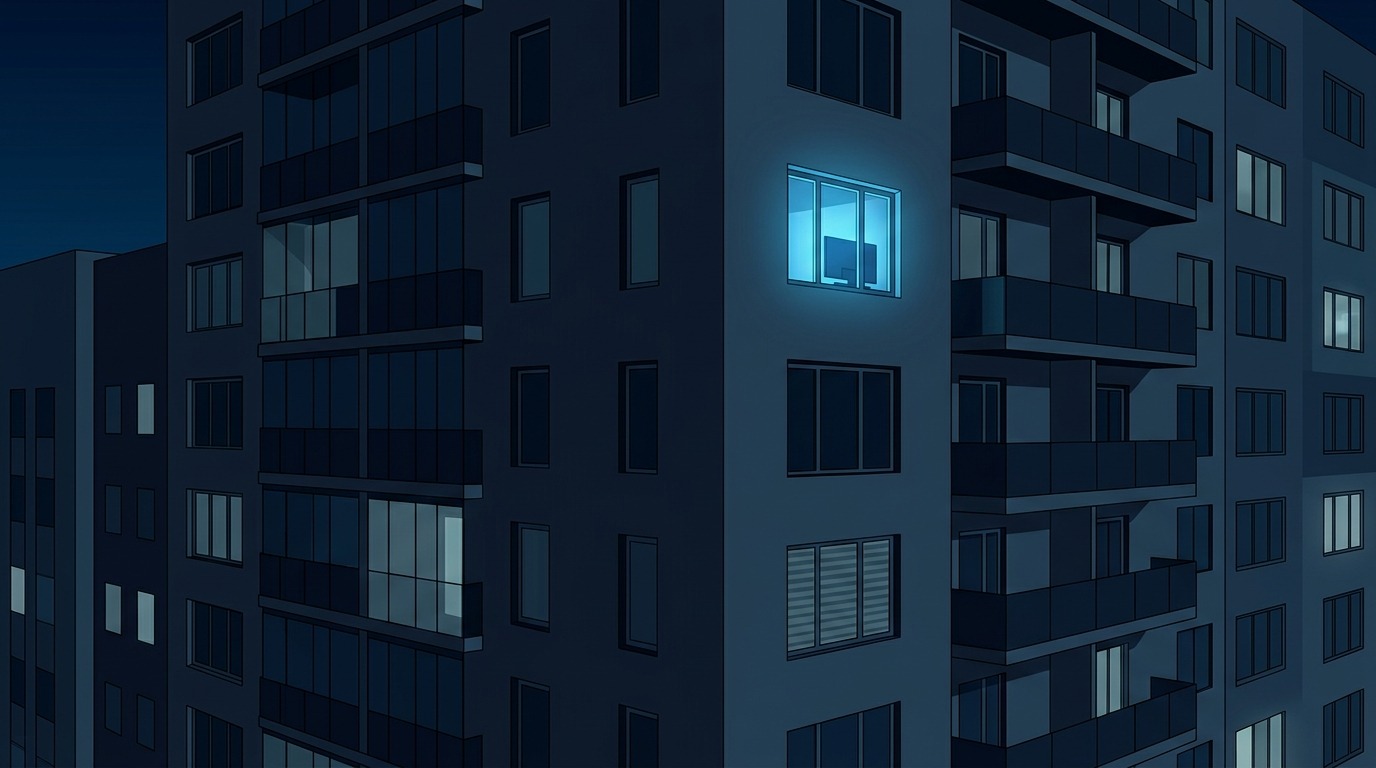
The lonely glow of a screen in a nighttime metropolis — a scene familiar far beyond Japan
How the COVID-19 pandemic intensified social reclusion
The lockdowns of 2020–2022 became a kind of global experiment in forced isolation. And for some people, the exit from it never happened.
An Italian study tracked the behavior of more than 7,500 adolescents before and after the pandemic (surveys in 2019 and 2022). The researchers identified three profiles: “Social Butterflies,” “Friendship-Oriented,” and “Lone Wolves.” The number of adolescents in the last group — those who never meet friends outside of school — doubled after the pandemic.
Researchers from Italy’s National Research Council (CNR) emphasized that this is not a temporary teenage whim but a chronic behavioral change. This does not mean all these adolescents became hikikomori in the strict sense of the word. But the trajectory is alarming: the habit of isolation becomes entrenched, and the longer a person lives outside social connections, the harder it is to return.
In the Japanese survey, more than a fifth of hikikomori named COVID-19 as a significant factor in their reclusion. The pandemic also increased screen time and internet usage — habits associated with hikikomori syndrome.
What will happen to hikikomori in the digital age
Even without the pandemic, the modern world creates ideal conditions for voluntary isolation. Remote work, food delivery, online entertainment, the rising cost of going out — all of this reduces the need to physically be present in the social world. The barrier to reclusion has never been this low.
This does not mean technology is to blame. But it makes isolation comfortable, and therefore easily reproducible. A person can exist within four walls for years, receiving the bare minimum needed for survival through apps, and formally need nothing.
Treating hikikomori requires enormous patience and a comprehensive approach. Since the recluse almost never seeks help themselves, work usually begins with the family. Reintegration is a slow process: from an open door to the room, to sharing a meal with the family, and then to short walks outside, initially during nighttime hours when few people are around.
There are no simple solutions here. Hikikomori is not a disease that can be cured with a pill, nor laziness that can be fixed with a motivational speech. It is a complex response to a complex world — and understanding it means better understanding how the pressure that society exerts on each of us works.
The phenomenon that was born in Japan turned out to be a mirror in which the whole world is now looking. Not because the Japanese were “strange,” but because they were the first to encounter the conditions that are becoming the global norm today. Research on hikikomori outside Japan is only beginning, and its results will be important for understanding how to help people who quietly disappear from society — regardless of country and culture.