The oldest Bronze Age meteoritic iron artifact found in southwestern China.
In southwestern China, archaeologists have discovered a 3,000-year-old weapon made of iron that fell to Earth from space. The artifact, resembling an axe, was extracted from a ritual pit of the ancient Sanxingdui culture — one of the most enigmatic civilizations of the Bronze Age. It is the oldest and largest meteoritic iron artifact found in southwestern China, and it overturns our understanding of how ancient people worked with metal that literally fell from the sky.
What Is Sanxingdui: A Mysterious Civilization of Ancient China
Sanxingdui is located in Guanghan, Sichuan Province, and was included in the list of “Ten Greatest Archaeological Discoveries in China” in 2021. It dates from 2800 to 600 BCE and belongs to the Shang era (1600–1046 BCE). This city was the largest Shang-period settlement in southern China and demonstrated advanced urban planning: artisan quarters, palace zones, and sacrificial pits.
Sanxingdui is famous primarily for its bronze masks — enormous, eerie, with bulging eyes and elongated ears. This culture left behind neither writing nor human remains and apparently existed for only about 350 years before vanishing without a trace. From eight so-called sacrificial pits, archaeologists have recovered more than 17,000 artifacts, including bronze, jade, gold, ivory, and silk remnants.
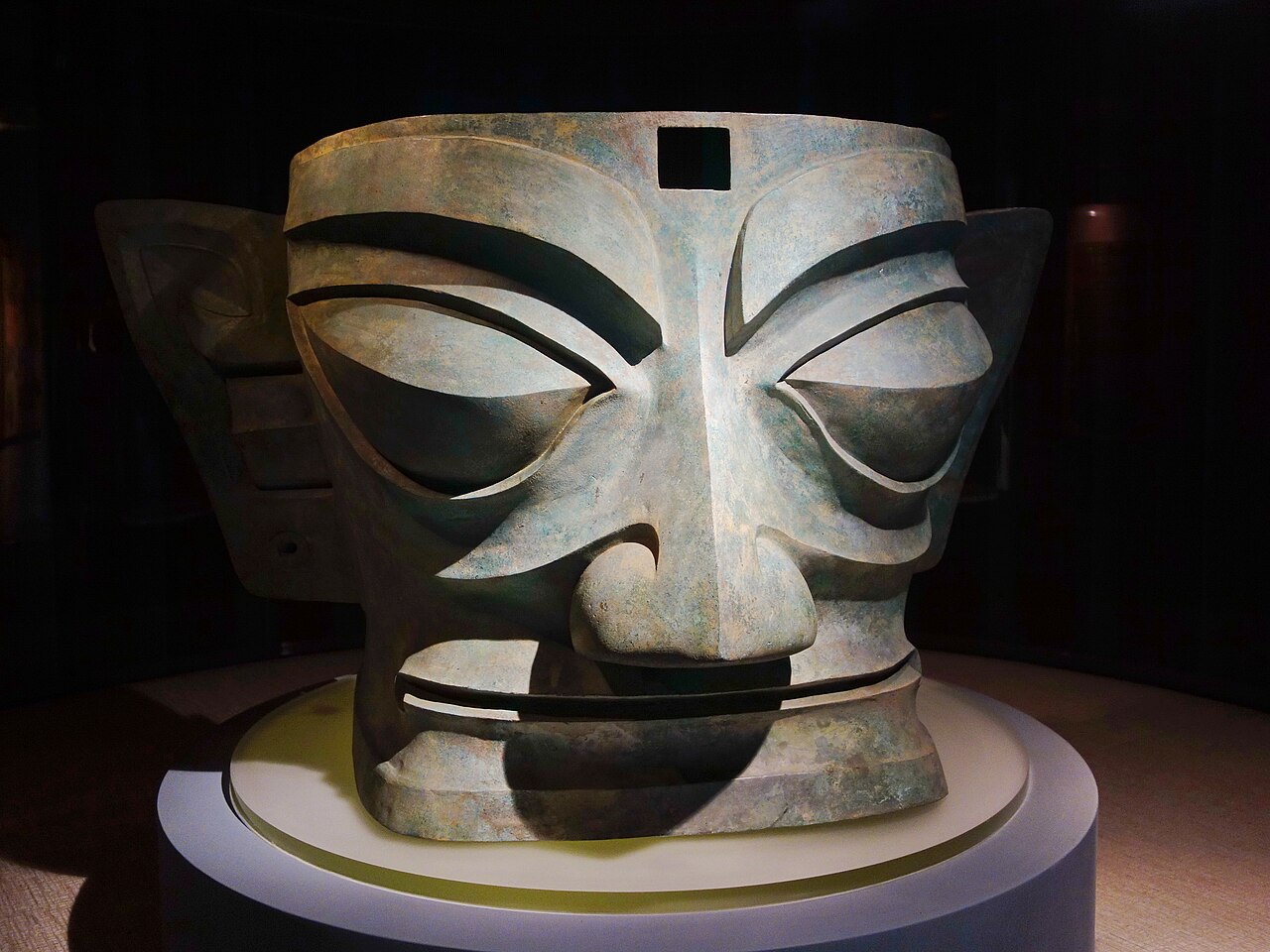
Sanxingdui bronze mask. Image source: en.wikipedia.org
But among thousands of ritual objects made of bronze and jade, one find turned out to be completely unique — it was made of iron. And not just any iron.
How the Meteoritic Iron Axe Was Found at Sanxingdui
The unusual iron artifact (code K7QW-TIE-1) was extracted from Pit No. 7. It was found vertically driven into the lower part of the eastern wall and has an elongated shape resembling an axe or weapon. Its length is about 20 centimeters, and its width ranges from 5 to 8 centimeters.
The artifact was in poor condition, so researchers carefully extracted it together with a piece of the pit wall and delivered the entire block to the laboratory for analysis. During preliminary cleaning, three small fragments separated from the main body, allowing scientists to conduct initial tests without damaging the artifact itself.
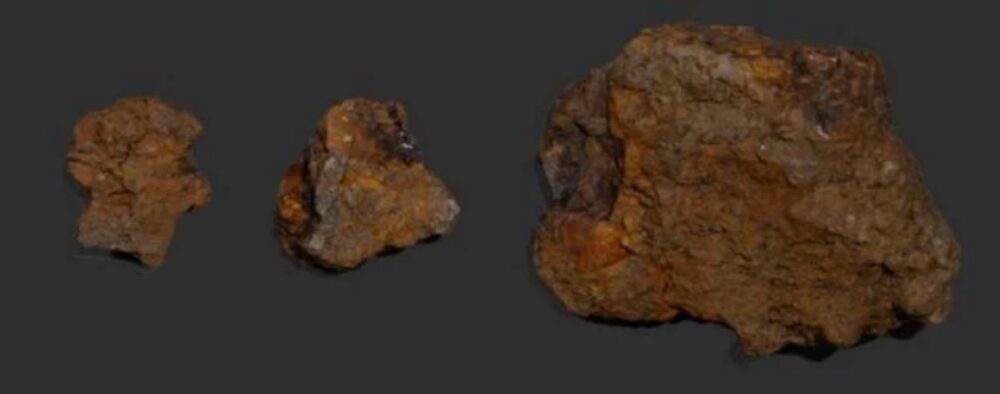
Three fragments that broke off from the partially destroyed artifact. Image source: sciencealert.com
Dating of surrounding artifacts places the find in the Shang dynasty — a period long before the advent of iron smelting in China. However, X-ray fluorescence analysis showed that the object consists of at least 90% iron and 7.41% nickel, with the rest being trace elements.
It was the high nickel content that became the key clue. In most iron meteorites, nickel content ranges from 5 to 35%, whereas in terrestrial iron obtained by smelting before the 19th century, it never exceeded 4%. Nickel and iron diffuse at very different rates, and obtaining such a homogeneous alloy with high nickel content would have been impossible using any smelting technologies available in the late Shang era. The conclusion is unambiguous: the metal for this axe arrived from space.
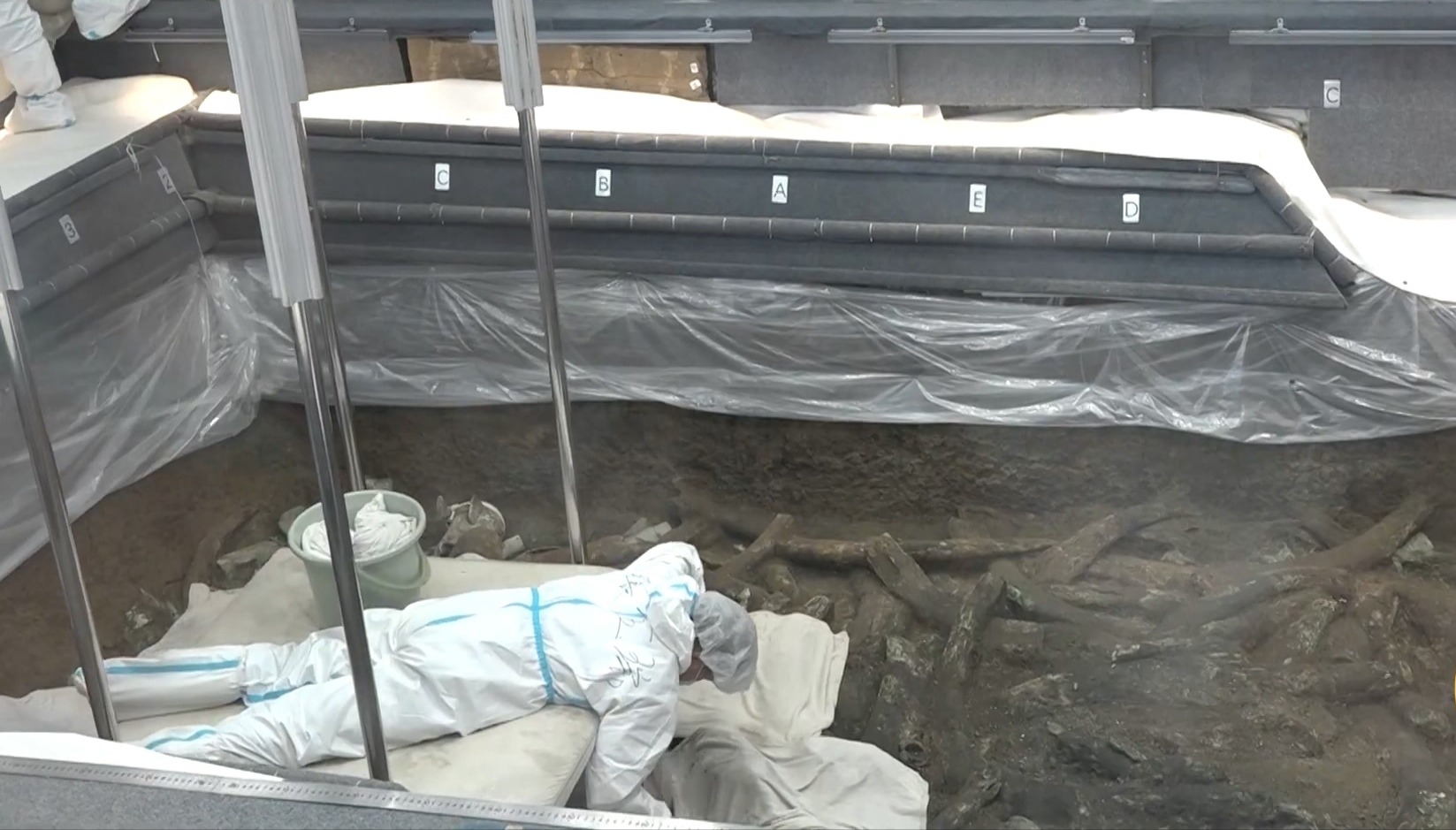
An archaeologist working at the excavation site, Sanxingdui, 2022. Image source: en.wikipedia.org
Why Ancient People Made Weapons from Meteoritic Iron
To understand why this find is so important, one must recall the context of the era. Bronze was the primary metal for tools, weapons, and ornaments in the Bronze Age. This alloy was strong and accessible: it was produced by melting copper and adding tin.
The earliest smelted cast iron artifacts in China date only to the 8th century BCE — meaning iron smelting technology appeared several centuries after the described axe. Before that point, iron could only be obtained one way — by finding it in the form of a meteorite.
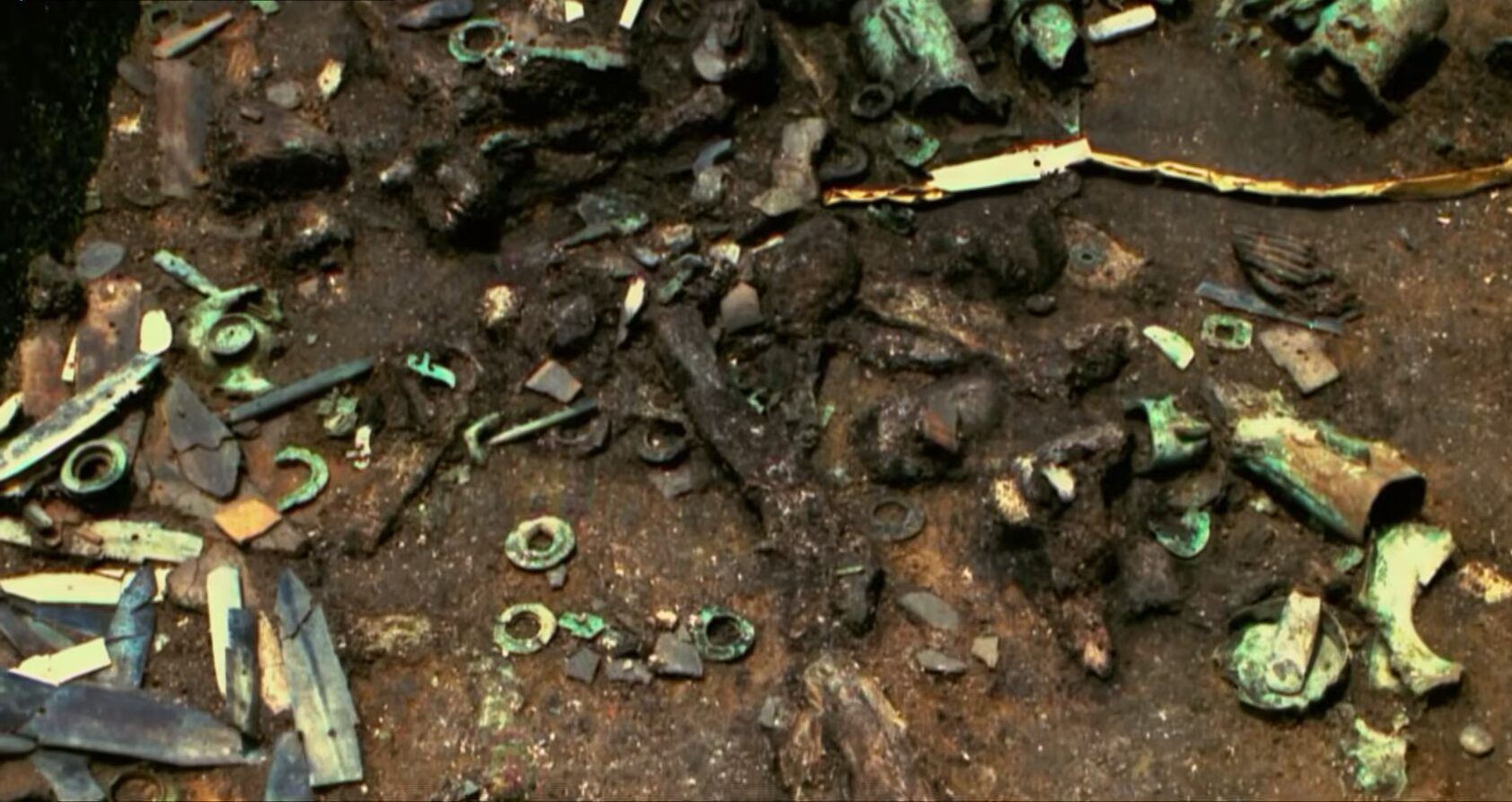
The context and composition of artifacts from Xinjiang and Sanxingdui point to a different type of metallurgical practice compared to the Central Plains. Screenshot from a video about artifacts and excavations. Source: sciencealert.com
And people took advantage of this. During the time of Tutankhamun (around 1323 BCE), iron objects were used exclusively for ritual, artistic, and ceremonial purposes. Iron was then valued at ten times the price of gold. The famous dagger from Tutankhamun’s tomb has an iron and nickel content that precisely matches the composition and uniformity of meteorites. In ancient Egypt, iron was literally called “metal from the sky.”
Meteoritic iron was widely used in the ancient world, although only 13 such artifacts are known in China, and most were found in the northern regions. The find from Sanxingdui is the first of its kind in the southwest of the country.
How the Sanxingdui Meteoritic Artifact Differs from Other Finds
Iron from space has been found in other parts of China, but the artifact from Sanxingdui is surprising for several reasons.
- It is the largest meteoritic iron artifact found in China, with the highest nickel content among known specimens.
- Unlike finds from the Central Plains of China, where meteoritic iron was usually combined with bronze, the Sanxingdui artifact is made entirely of iron.
- The object is completely monometallic and has no decorative elements — which is unusual for the ritually rich Sanxingdui culture.
Of all known meteoritic artifacts in China, only two are monometallic — the find from Sanxingdui and a knife from the Narensu necropolis in Xinjiang, dating to approximately 3000 BCE. All other specimens are bimetallic bronze-iron objects. This suggests that in southwestern China there existed a fundamentally different metallurgical tradition — independent from the practices of the Central Plains.