Blood Moon on March 3: why you shouldn’t miss this eclipse and where it will be visible.
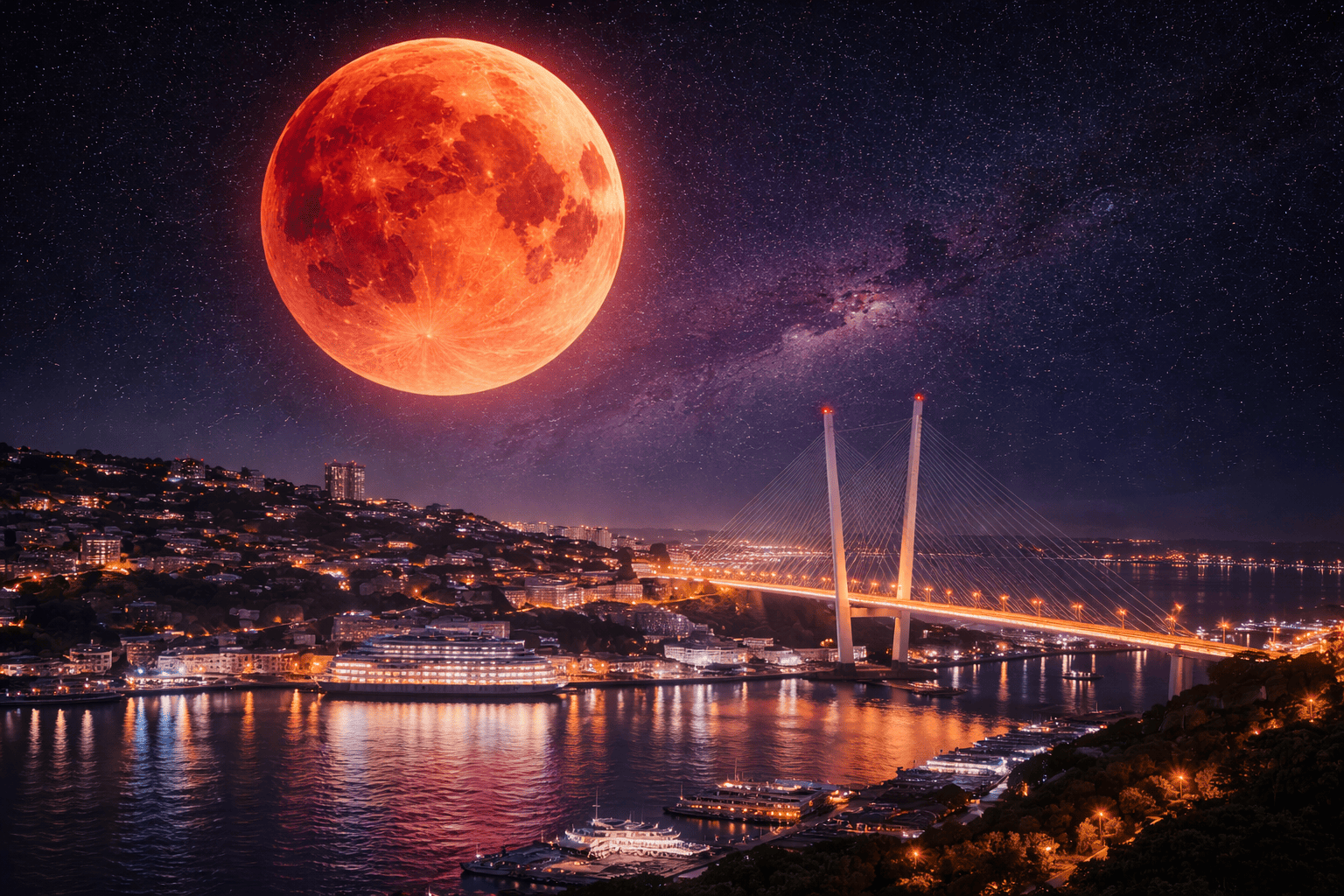
On March 3, 2026, the only total lunar eclipse of the year will occur. For nearly an hour, the Moon will be fully immersed in Earth’s shadow and turn copper-red — a phenomenon known as the Blood Moon. The next such opportunity won’t come until late 2028, making this event truly rare. The eclipse will coincide with the March full moon, known as the “Worm Moon.” It sounds ominous, but in reality it’s a beautiful and completely safe astronomical spectacle.
What Time Does the Total Lunar Eclipse on March 3, 2026 Begin
The total phase of the eclipse will last 58 minutes and 19 seconds — from 11:04 to 12:03 UTC (14:04–15:03 Moscow time). The eclipse maximum will occur at 11:33 UTC (14:33 MSK).
The entire event — from the beginning of the penumbral phase to its end — will stretch over 5 hours and 39 minutes. The partial phase will begin at 09:50 UTC (12:50 MSK), and from that moment it will be noticeable how Earth’s shadow “bites” into the edge of the lunar disk.
An interesting detail: the peak of the full moon will occur at 11:38 UTC — just five minutes after the eclipse maximum. At that moment, the Moon will be at its fullest and reddest simultaneously.
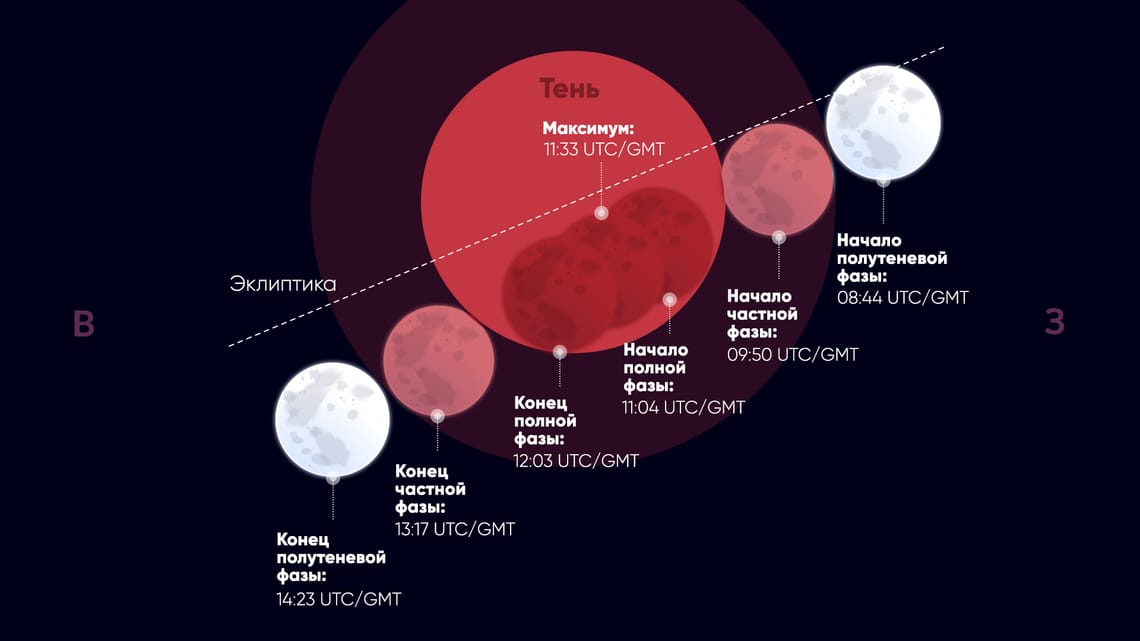
Phases of the total lunar eclipse on March 3, 2026. Image source: starwalk.space
Where Will the Lunar Eclipse on March 3, 2026 Be Visible
The best conditions will be where the Moon is high above the horizon during the total phase. The total eclipse will be visible:
- In East Asia (Japan, Korea, China, the Russian Far East)
- In Australia and New Zealand
- Over the Pacific Ocean
- In North and Central America
- In the western part of South America
In some regions of East Asia, the Moon will rise already darkened, while in the eastern part of North America, part of the total phase will occur low on the horizon.
In Europe, Africa, and most of the Middle East, the eclipse will not be visible — the Moon will be below the horizon at that time.
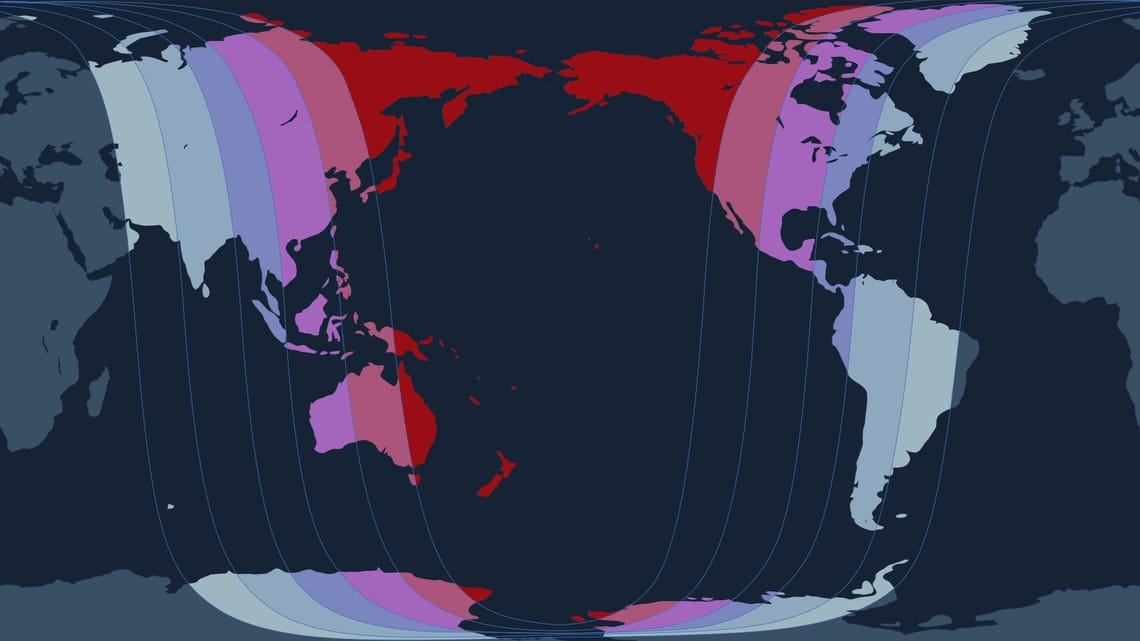
Visibility map of the lunar eclipse on March 3, 2026: red — the eclipse is visible from start to finish, pink and purple — the total or maximum phase is visible low on the horizon, light blue — only the partial or penumbral phases are visible; dark, uncolored areas — the eclipse will not be visible at all. Image source: starwalk.space
As for the visibility of the eclipse specifically in Russia, the picture is as follows:
The best conditions are in the Far East. In Vladivostok, Kamchatka, and the Khabarovsk Territory, the eclipse will be visible almost in its entirety, and the red Moon will rise sufficiently high above the horizon.
In Eastern Siberia (Yakutia, Irkutsk Oblast, Krasnoyarsk Territory) the Moon will rise already during the eclipse. It will be possible to see the total phase, but the earliest stages will be missed.
In Western Siberia and the Urals, the situation is more complicated: the Moon will appear above the horizon closer to the end of the total phase or already during the partial eclipse. The red Moon may be spotted low on the horizon, but the observation window will be short.
In the European part of Russia (Moscow, Saint Petersburg, the Volga region, the south of the country) the total eclipse will not be visible. In most regions, the Moon will be below the horizon during the total phase, so observers will only be able to see the later partial stages — and only under favorable conditions.
In other words, the farther east you are, the higher your chance of seeing the Blood Moon in full.
Why the Moon Turns Red During an Eclipse
During a total eclipse, Earth is positioned between the Sun and the Moon. Direct sunlight is blocked, but some rays pass through Earth’s atmosphere. Blue light is scattered more strongly, while red light is scattered less, so predominantly red hues reach the Moon. In essence, the Moon is illuminated by all of Earth’s sunsets and sunrises simultaneously.
How to Observe the Total Lunar Eclipse on March 3, 2026
No special protection is needed — unlike solar eclipses, you can watch with the naked eye. Binoculars or a small telescope will help you see the shadow boundary more clearly.
- Choose a location with an open horizon
- Check the weather forecast in advance
- Start observing 30 minutes before the total phase
- Use binoculars for a more detailed view
If the sky turns out to be cloudy or you are in Europe, online streaming remains an option. But don’t worry — this year still has plenty of important astronomical events ahead, so don’t miss them!