A restaurant runs on fine-tuned mechanisms: the pace of the register during the morning rush, adherence to recipe cards in the hot kitchen, and honest inventory at the end of the day. The moment one of these springs loosens, the familiar arithmetic kicks in: remakes “eat up” minute after minute, a “generous spoonful” hits the cost price, and accounting produces three versions of yesterday’s revenue. Restaurant automation software isn’t needed for fancy diagrams — it’s needed to link these springs into one manageable loop.
When “very tasty” too often clashes with “very unprofitable”
In essence, it’s operational logic that captures an event where it happens and immediately turns it into an action: a check becomes a task in the kitchen, preparation becomes a write-off according to the recipe card, dispatch becomes an updated stock balance, and the day becomes a report that not only the accountant but also the manager can understand. This is exactly how restaurant business software stops being an “option” and becomes an essential part of modern operations: it pulls the work of the dining area, kitchen, warehouse, and delivery out of the shadows, provides manageable speed, and removes guesswork from decisions.
Look at the typical pain points — and you’ll recognize your own. Errors in order and inventory tracking, difficulties working with large data sets, lack of transparency in staff operations, slow service, “archaeological” reporting that arrives when it’s already too late to change anything. iiko software addresses them across the entire line: it automates key processes, centralizes order and inventory tracking in real time, and delivers management analytics “here and now.” It’s not just the office that wins: at the counter there are fewer reasons for “sorry, we’ll redo it,” in the kitchen — less improvisation, in the warehouse — fewer “magical” shortages.
What the system does when it’s truly “in action”
Let’s start with the front. A restaurant information system should accept orders in a single loop — dine-in, pre-orders, delivery, aggregators — without manual rewriting and double entry. With iiko, this works as a unified stream: every table, every item, every modifier is captured in an event that both the register and the kitchen “understand.” As a result, the check doesn’t wait for the printer but is instantly broken down into tasks by stations; priorities are set by pickup and delivery deadlines, and “promised by the minute” stops diverging from the actual handoff time. The manager sees this pulse not through gossip but in data available during the same shift.
Next — warehouse and recipes. All food service automation programs rely on recipe cards and batches: write-offs happen “at the moment of preparation,” expiration dates live in the system, and supplier orders are generated based on actual consumption. This eliminates two chronic sources of losses — “generous spoonfuls” and “just-in-case stockpiles” — and brings food cost back into a reasonable range. Crucially, all this arithmetic doesn’t burden the shift: the interface consolidates routine into quick actions, and reports remain readable for people whose job isn’t in Excel.
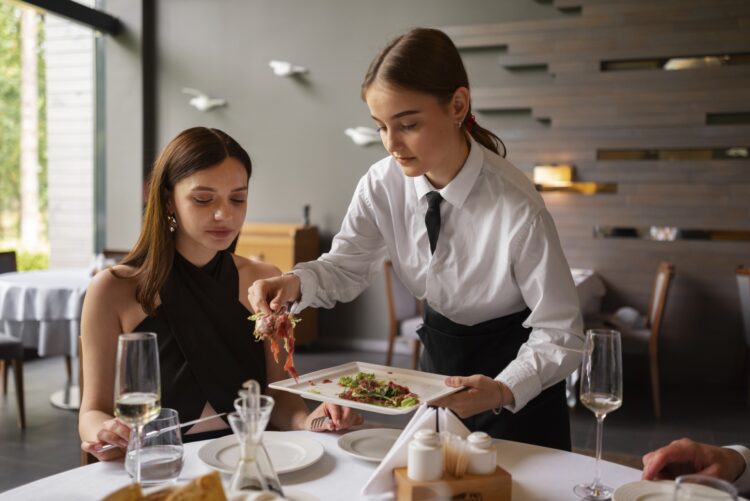
A restaurant always needs a human. Image: checkoffice.ru
The third layer — money and decisions. The point of instant analytics isn’t beautiful graphs. It answers down-to-earth questions: why does the “payment → handoff” speed drop on Fridays after 7 PM, what the “free filter coffee with a second dessert” promo actually does to margins, where remakes originate, and what’s happening with inventory in sensitive categories. iiko shows this “live” — you disable a harmful promotion, reschedule a delivery, move popular modifiers to the first screen, adjust the schedule. Decisions are made today, when you can still turn the wheel.
The fourth layer — people and discipline. In proper software, staff control isn’t about “cameras and yelling” — it’s about task distribution, roles and permissions, procedure checks, and transparent discount rules. This reduces quality variation between shifts and closes the main source of conflicts “dining area  kitchen warehouse” — different interpretations of the same events. Combined with CRM and delivery, you get a single loop: statuses are synchronized, the guest sees an honest readiness time, marketing stops being “10% off for everyone” and becomes targeted.
Down-to-earth stories instead of fanfare. A bistro at a food court linked “table → register → kitchen” into a single stream and reprioritized for pickup: the queue collapsed without a second register, the average “payment → handoff” time dropped by dozens of seconds, and evening complaints disappeared. A pizza chain standardized recipe cards and batch tracking: “sudden” cheese shortages vanished, and the planned food cost stopped getting derailed by a “creative approach.” Both cases are about the same thing: software doesn’t decorate processes — it gives them the discipline and speed that show up at the register and in the report.
How to choose and implement so the effect arrives this very Friday
Starting with a “feature catalog” is almost guaranteed to get your priorities wrong. Start with a map of your day. Where exactly are seconds being lost: in searching for items, in dictating modifiers through the noise, in the “bottleneck” at the handoff counter? Where are grams leaking: remakes, reassemblies, “generous” portions? Where do decisions sink: reports “when there’s time,” “just-in-case” inventory, promos that eat margins? The configuration is built around this map: unified order acceptance and routing, integration with the register and warehouse, recipe cards and auto-write-offs, real-time stock levels, role and task control, “today” analytics, integration with delivery and CRM. This isn’t “everything at once” — it’s the backbone without which everything else is just noise.
Next — a short pilot and four “before/after” anchors: median “payment → handoff” time, the share of remakes, cost stability of bestsellers, and batch and expiration discipline in expensive categories. The pilot isn’t about “falling in love with the interface” — it’s about economics: if the curves don’t move, the settings are off — reconfigure the POS presets, adjust kitchen priorities, enable “lightning” inventory checks. Good software scales without cracking: once the foundation is flying at one location, add delivery, loyalty, expanded analytics — and don’t forget training, which in iiko relies on an intuitive interface rather than week-long mentoring sessions.
Finally — the criterion of the right choice. A restaurant automation program is invisible to the team and obvious to the guest. The bar doesn’t argue with the dining area over the queue, the kitchen doesn’t clash with the register over modifiers, and the warehouse doesn’t dispute the report over “missing” batches. The owner sees not a “pretty summary” but levers that change the course of the day: disable a promotion, reassign staff, reschedule a delivery, unpack a batch ahead of schedule. If this sounds like the picture you want, here’s the most practical next step: request a consultation or iiko demo, ask them to show the “order → preparation → write-off → report” chain using your dishes, and then launch an honest pilot. The brief directly leads to this — because only then does software turn from a promise into money on your P&L.