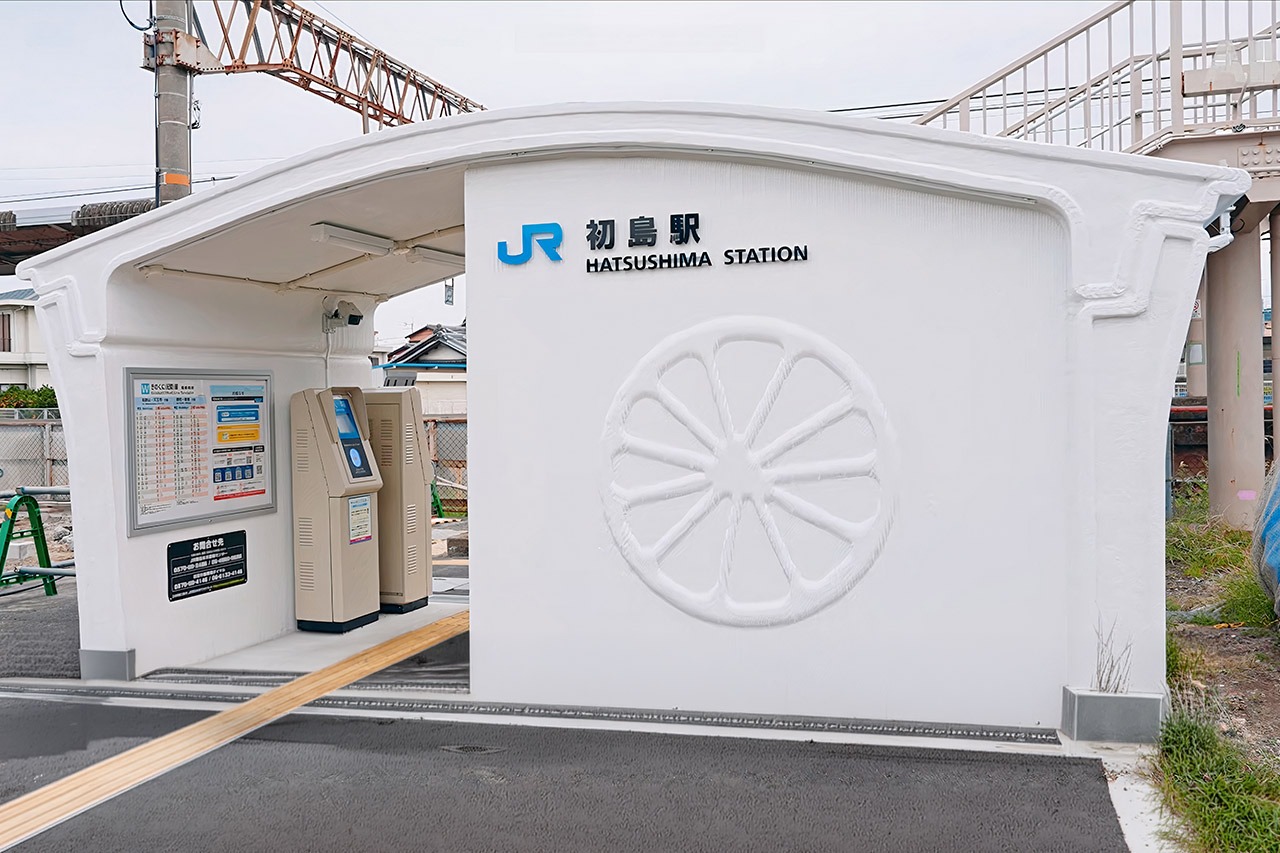
Japan’s first 3D-printed railway station Hatsushima
In the Japanese city of Arida, the world’s first railway station made from 3D-printed elements has been built. The structure was assembled in a single night — in the gap between the last evening and first morning train. Service on the line was not interrupted for a single minute. This project is a collaboration between Serendix, railway operator JR West, and Swiss robotics manufacturer ABB. And this is no longer an isolated experiment: a two-story 3D-printed house you can live in has already been built in Japan.
How a Station Was Built Overnight Using 3D Printing
Typically, construction or renovation of railway facilities is a lengthy process. According to Serendix estimates, a station of similar size made from conventional reinforced concrete would take one to two months to build. During that entire time, train service has to be restricted, platforms closed off, and noise and dust tolerated. For small rural stations — of which there are thousands in Japan — this is especially inconvenient: budgets are modest, and passengers have no alternative. It’s no surprise that construction 3D printers capable of drastically accelerating such work are attracting increasing attention.
Hatsushima Station was created from four elements 3D-printed at a factory, then assembled on site. According to Serendix, assembling the four modules on location took about two hours. Metal rods were inserted into mounting holes and secured with adhesive. The full work cycle — including demolition of the old structure, foundation preparation, and installation of the new building — fit within a six-hour window between the last and first train.
The ABB robot played a key role during the factory printing stage: the industrial manipulator applied the building mixture layer by layer with high precision. This made it possible to create parts with complex shapes that would have required expensive formwork in traditional concrete construction.
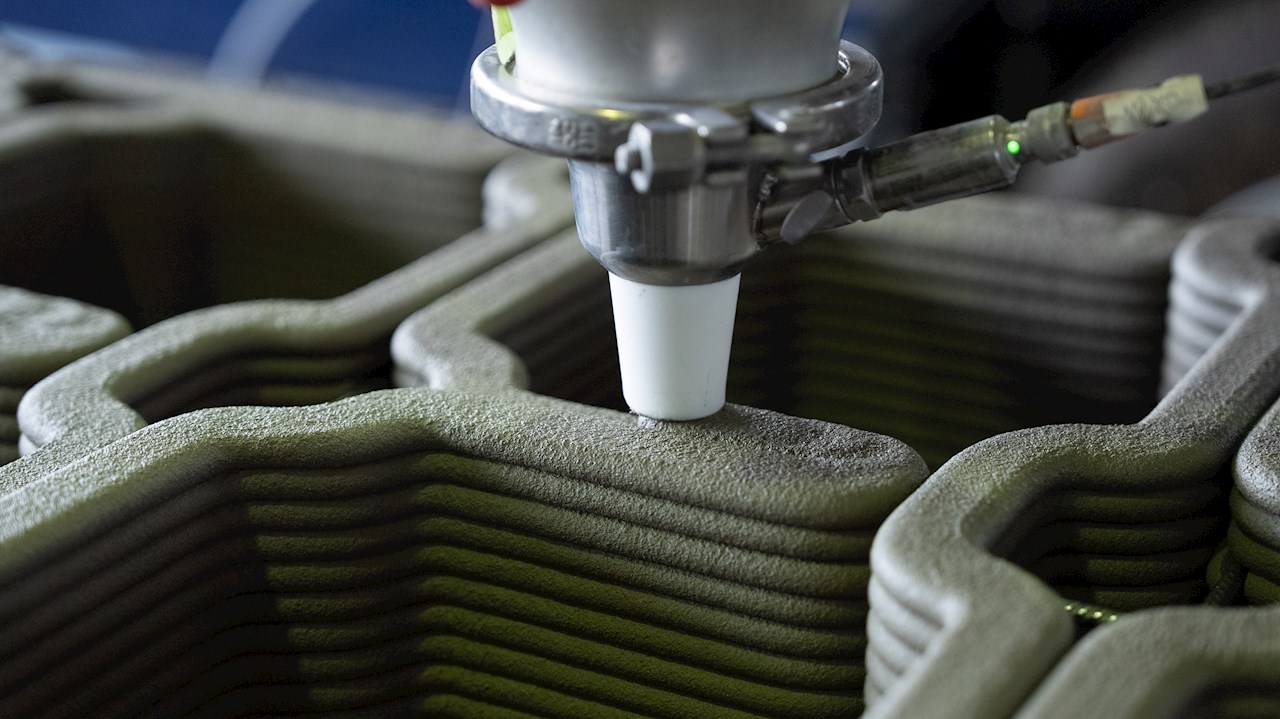
The printing process for the station took about a week
How the 3D-Printed Hatsushima Station in Japan Is Designed
The project was carried out for Hatsushima Station on the Kisei Line in the city of Arida, Wakayama Prefecture, in collaboration with JR West and the architectural firm Neuob. The new building replaced a wooden structure from 1948 — the old station had deteriorated after nearly 80 years of operation on the sea coast.
The pavilion features an arched roof and measures 6.3 meters wide, 2.1 meters deep, and 2.6 meters tall. In terms of area, that’s about 10 square meters — small but a fully functional station with a canopy and waiting area. The walls feature mandarins and cutlassfish — symbols of the Arida region — rendered as 3D relief, which would have been extremely expensive with conventional concrete construction.
An interesting detail: the elements were printed vertically rather than horizontally, as is typical. After printing, they were rotated 90 degrees. This reduces the visibility of rain streaks on the facade and simplifies building maintenance.
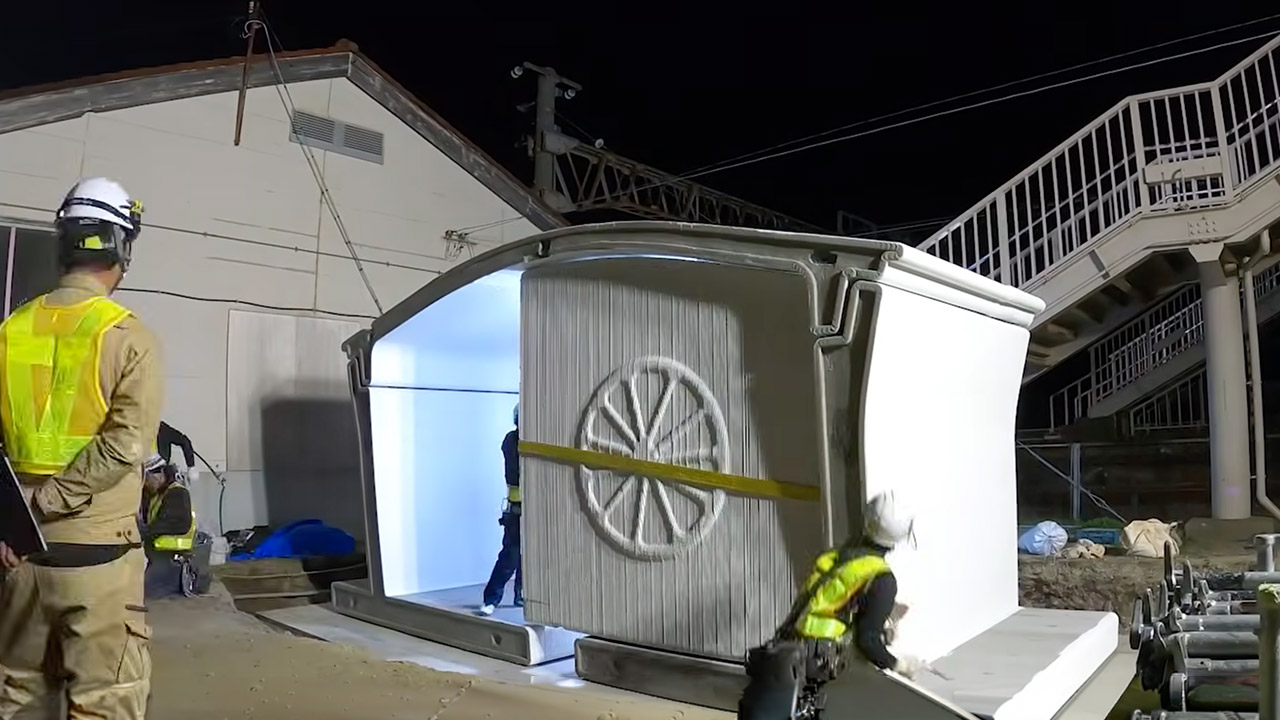
Nighttime assembly of the station. The decorative element you see on the building is a mandarin (one of the symbols of the Arida region).
According to JR West, the building has seismic resistance comparable to reinforced concrete houses — a critically important quality for Japan. The structure consists of four blocks printed from construction mortar and reinforced with poured concrete.
Why 3D-Printing Buildings Is Cheaper and Faster Than Conventional Construction
The main advantage is the absence of formwork. In traditional concrete construction, every wall requires a mold into which the mixture is poured. If the wall is straight, it’s relatively simple. But add an arch, a curve, or decorative relief, and the cost of formwork skyrockets. In molding, any shape more complex than a rectangle requires non-standard frames and additional supports, while 3D printing allows the creation of complex shapes without extra costs.
According to The Japan Times, the construction cost of Hatsushima Station was approximately half the price of a comparable structure made from conventional reinforced concrete. And the actual assembly time turned out to be even less than the initial estimate of six hours — under three hours.
The workflow looks like this: elements are printed at the Serendix factory, undergo additional processing (reinforcement, concrete filling), then are delivered to the site and installed. In the case of Hatsushima, the modules were even transported by rail — logical, considering the station sits right on the tracks.
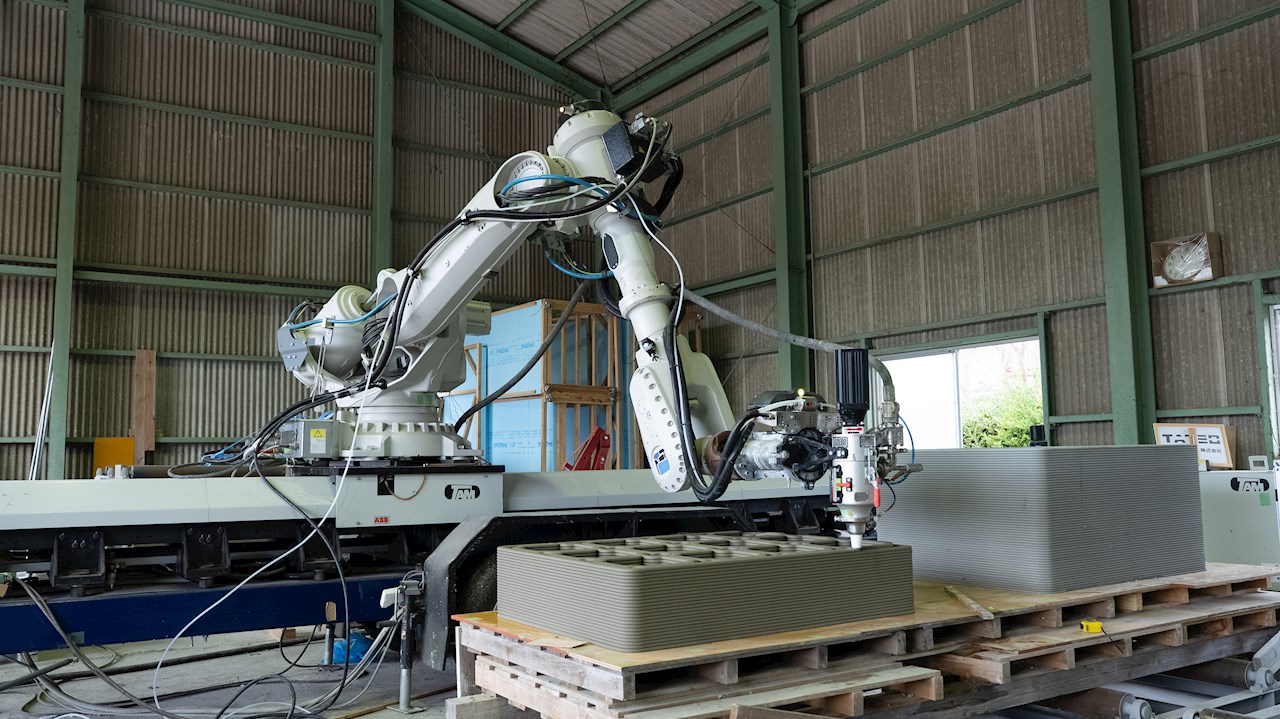
ABB IRB 6700 robot used in construction
Japan Is Building Stations with 3D Printing — Why?
Japan is facing a shrinking workforce due to an aging population. The construction industry is hit especially hard: the average age of workers is rising, and young people are in no hurry to join construction sites. At the same time, material costs and labor wages are increasing.
JR West — one of Japan’s largest operators — has numerous small stations on rural lines, many of which were built in the mid-20th century and need replacement. Traditional renovation is slow, expensive, and requires a crew of skilled workers. 3D printing solves several problems at once: fewer people are needed, construction is faster, and costs are lower.
JR West chose Hatsushima specifically because of its coastal location — this will allow them to assess how the building withstands salty sea air. The company also plans to evaluate construction and maintenance costs to determine whether the technology is worth scaling to other stations.
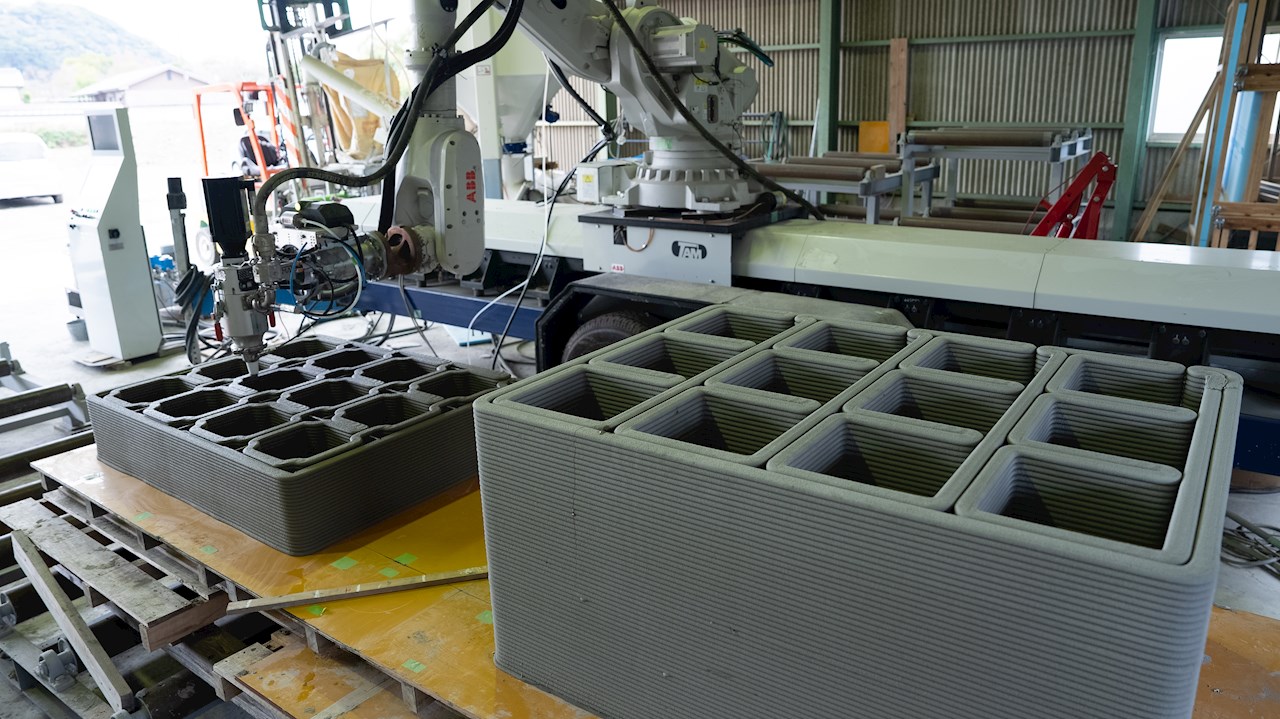
ABB robot at work
Where 3D Printing Is Being Used in Construction Around the World
Hatsushima Station is not Serendix’s first major project. In 2022, the company built its first 3D-printed house, Sphere — a spherical reinforced concrete building of less than 10 sq. m, assembled in under 24 hours, costing approximately 3 million yen (about $25,500). Later came the Fujitsubo model — a single-story house of 50 sq. m priced at 5.5 million yen (about $37,700), printed in 44 and a half hours.
In 2024, Serendix acquired three new construction 3D printers, bringing the total to eight, with plans to increase to twelve by the end of 2025. Among them are gantry printers for large objects up to 100 sq. m and robotic arm printers for detailed printing.
ABB, for its part, has long been working with 3D printing in construction. In Germany, the ABB IRB 6700 industrial robot was used to print a new Red Cross building — the first non-residential 3D-printed building in the country. ABB’s software supports various additive manufacturing processes, including welding, granule printing, and concrete printing.
Hatsushima Station is a first step in exploring the possibilities of 3D printing for railway infrastructure. JR West and Serendix intend to analyze costs and maintenance requirements to decide whether the technology is suitable for wider deployment.