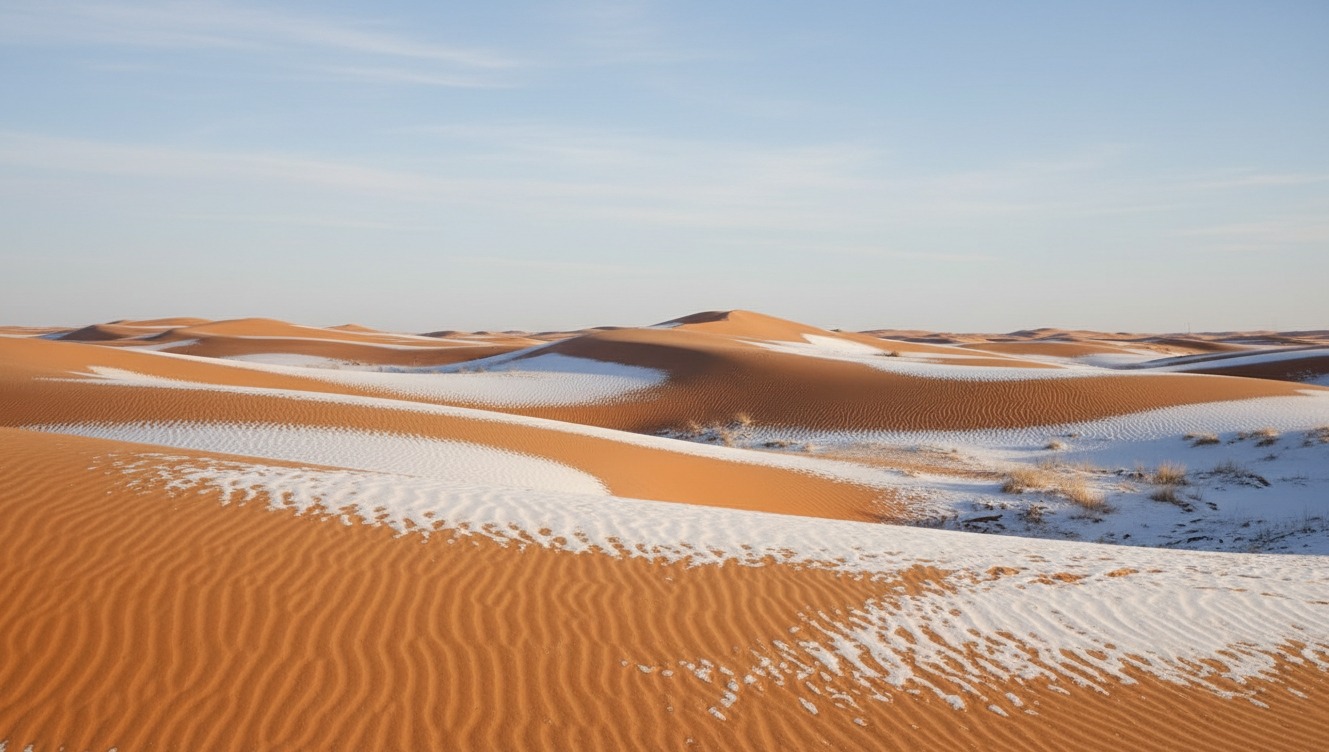
Snow on the Sahara dunes — a sight that can still surprise even seasoned meteorologists
When we think of the Sahara, images of scorching orange dunes, blazing sun, and hot wind come to mind. Water here is worth its weight in gold, and snow is out of the question. But nature once again showed that it plays by its own rules. In March 2026, it snowed in the Sahara, and here’s what we know about this amazing phenomenon.
Why It Snowed in the Sahara
According to news.ru, the Sahara surprised the world with a rare natural phenomenon: the familiar orange dunes were covered with a layer of snow. In the Algerian city of Ain Sefra, the air temperature dropped below zero, which was enough for snowfall. The city is located at an altitude of about 1,000 meters above sea level and is surrounded by the Atlas Mountains, earning it the poetic nickname “gateway to the desert.”
It is precisely the unique geographical position of Ain Sefra at the foot of the Atlas Mountains that contributes to sharp temperature fluctuations. In winter, rising air above the mountain range cools and condenses, moisture freezes and falls as snow. If the precipitation lands on sand that hasn’t yet warmed up, people witness an almost impossible sight — they see snow in the desert.
FOR COMPARISON: in summer, temperatures in the Sahara often exceed +50 degrees Celsius, and the sand heats up to +80 degrees. And yet on that very same sand — snow. The contrast is, to put it mildly, impressive.
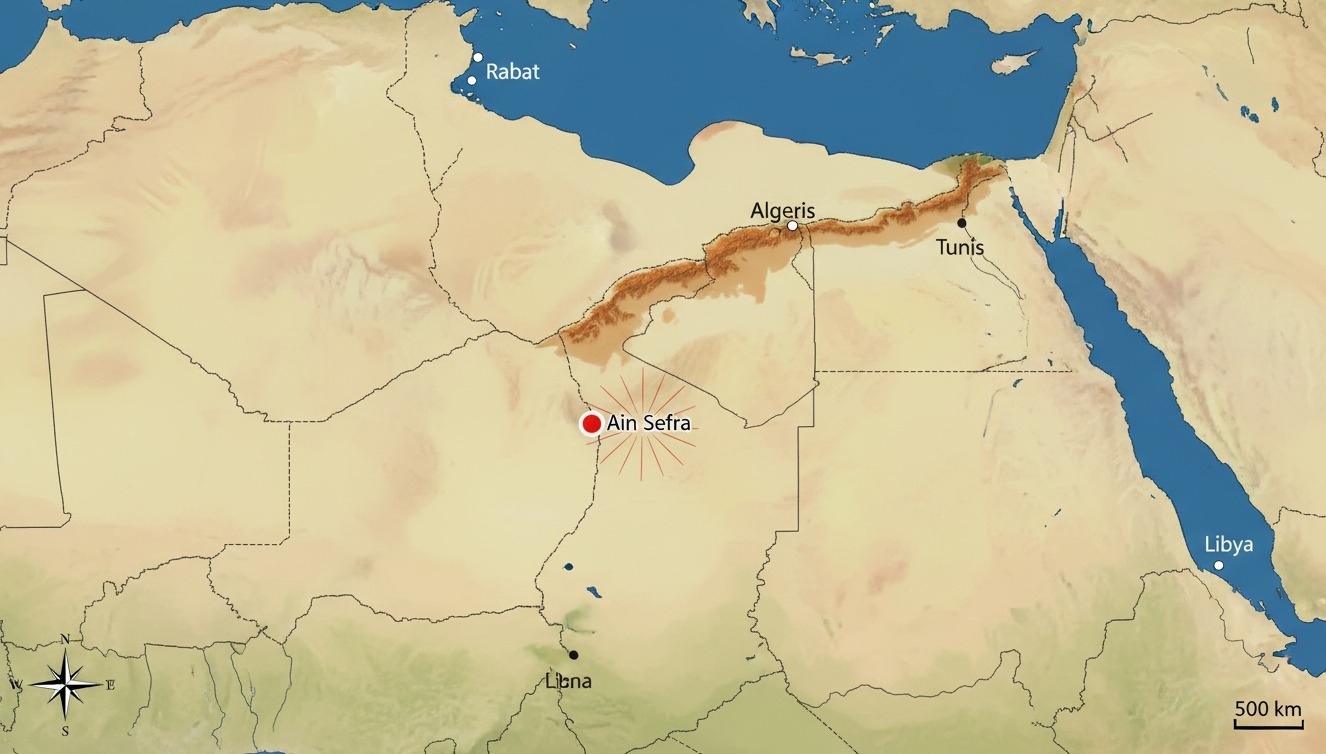
Ain Sefra — a small city that regularly makes world news thanks to seemingly impossible snow
Why Snow in the Sahara Is Becoming More Frequent
You’d think snow in the desert would be a one-time thing — happening once every half century and then forgotten. But no. According to observations, the recent snowfall in Ain Sefra was already the seventh occurrence in the last 40 years. Snow was first recorded here on February 18, 1979 — it lasted just half an hour. Then there were episodes in 2016, 2018, 2021, and 2022. And now — again.
But there’s a nuance: in the last decade, such anomalies at the “gateway to the desert” have been occurring significantly more often. While nearly 37 years passed from 1979 to 2016 without a single snowflake, in recent years snowfalls have been happening almost every other year. The head of Russia’s Hydrometeorological Center, Roman Vilfand, stated several years ago that the increasing frequency of snowfalls in the Sahara is the same sign of global warming as abnormally warm winters in Russia. It’s not about one specific episode, but about the fact that the range of weather events is increasing.
Why Snow in the Sahara Melts Quickly
Despite the excitement of local residents and photographers rushing to capture the white dunes, the snow cover in the Sahara proved short-lived. The layer of snow was thin, and accompanying rain accelerated the melting. Simply put, in desert conditions, snow doesn’t have time to linger: during the day the sand heats up, clouds dissipate, and no trace of the winter fairy tale remains.
In fact, this is typical for snowfalls in Ain Sefra. In 2016, when snow fell for the first time in 37 years, it lasted only about a day before melting. Sometimes the melting snow mixes with sand and takes on an unusual orange hue — resulting in something between winter and a Martian landscape.
The area of the Sahara is 8.6 million square kilometers — roughly half of Russia or an entire Brazil. And across this entire gigantic expanse, snow falls only in a tiny area near the Atlas Mountains. This clearly shows how localized and fragile such a phenomenon is.
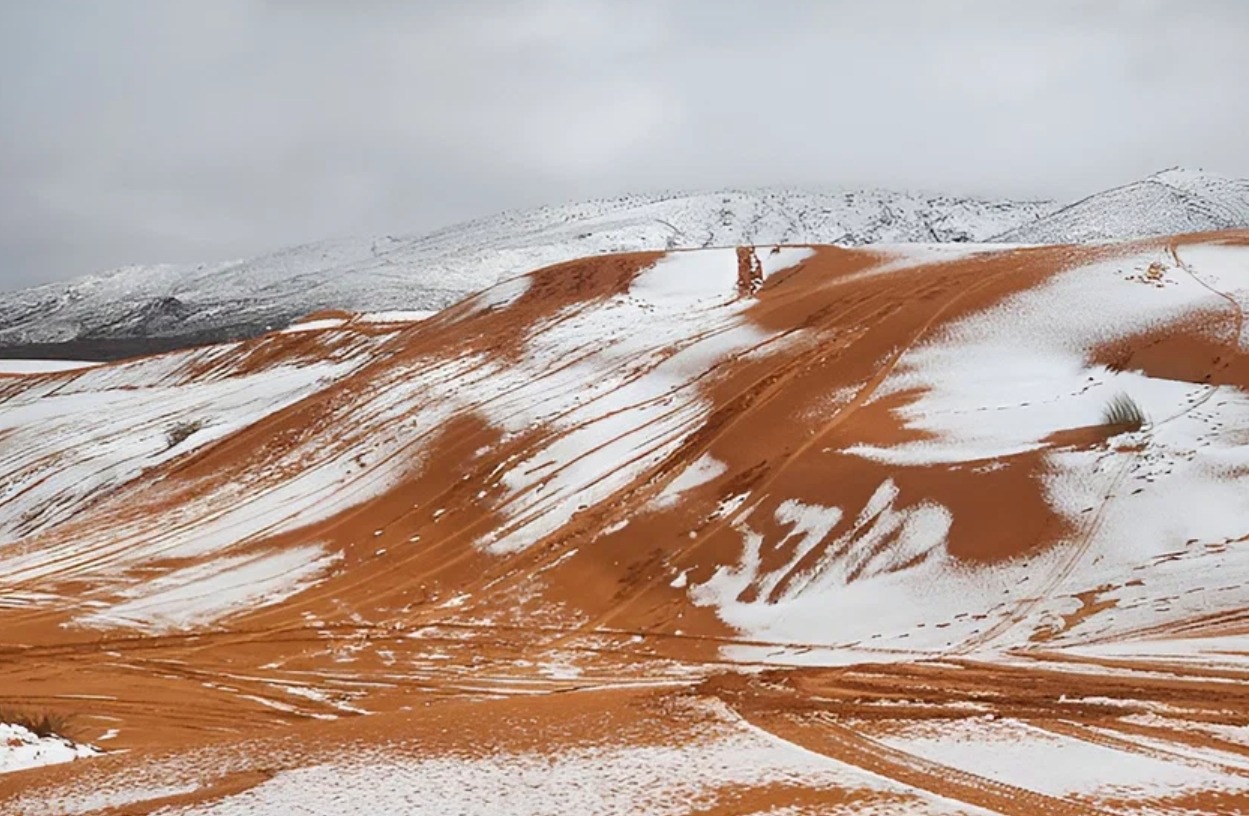
Snow in the Sahara melts quickly, so people don’t have time to enjoy it. Image source: dailymail.co.uk
Why It Snows in Deserts
It sounds paradoxical: global warming causes snow in the hottest place on the planet? But scientists explain it simply. Warming doesn’t mean it gets warmer everywhere. It means the climate system becomes more unstable. Cold air masses from the Atlantic and the Mediterranean Sea increasingly penetrate into the northern Sahara in winter, colliding with the mountain barrier of the Atlas. The result — precipitation where it shouldn’t exist.
By the way, the Sahara isn’t the only place where the desert delivers climate surprises. Recently, abnormally intense blooming was recorded in America’s Death Valley — it was called the most powerful and spectacular in the last 10 years. Normally barren desert lands were covered with a carpet of pink, yellow, and purple plants. The reason is the same: a record amount of precipitation in a region usually known for its drought.
In other words, deserts around the world are beginning to behave unpredictably. And this is not cause for excitement — it’s a signal that the planet’s climate system is changing faster than we’re used to thinking.