The debate about the properties of reboiled water continues, so it’s time to get to the bottom of it
If you’ve ever heard from a grandmother, a coworker, or a blogger that reboiling water practically turns it into poison, you’re not alone. This myth is incredibly persistent: it gets repeated in kitchens, group chats, and even in some “science” communities. And the arguments sound frightening: heavy water, salt buildup, chlorine compounds. Let’s examine this question from different angles and try to reach a clear conclusion.
The Harm of Reboiling Water
The first and most popular argument for the harmfulness of reboiled water is that with each boiling, some ordinary H₂O molecules evaporate. As a result, the water becomes “heavy” — containing the hydrogen isotope deuterium instead of regular hydrogen. This means the concentration of deuterium water increases with each boiling. That sounds alarming because in large doses, heavy water is indeed toxic to living organisms.
The second argument involves mineral salts. When water boils off, the calcium, magnesium, and other salts dissolved in it don’t go anywhere. The volume of water decreases while the amount of salts stays the same — meaning their concentration increases. And suddenly you’re drinking “brine.”
The third fear is related to chlorine. Tap water is chlorinated, and when heated, chlorine can react with organic impurities, forming potentially harmful chlororganic compounds — for example, trihalomethanes. Reboiling, according to this logic, only makes the process worse.
Each of these arguments is based on real chemical phenomena. But the devil, as usual, is in the scale.
What Is Heavy Water
Deuterium (heavy) water does indeed exist, and it is slightly less volatile than regular water. But here’s the thing: in natural water, the proportion of molecules containing deuterium is approximately 0.015%. That’s 150 parts per million.
To noticeably increase this concentration through boiling, you would need to reboil the water not tens or hundreds of times, but essentially evaporate it almost entirely and repeat this process many times over. Sofya Eliashevich, head of the laboratory for the study and correction of eating behavior at the National Medical Research Center for Therapy and Preventive Medicine of the Russian Ministry of Health, directly stated in a conversation with Gazeta.ru: the proportion of heavy water is so small that there is no reason to speak of any health effects.
Simply put, your kettle is not an industrial deuterium enrichment facility. Even if you boil the same water every day for a year, the concentration of heavy water will remain negligible.
Limescale and Salts from Reboiling
The story with mineral salts is a bit more interesting. Indeed, during boiling, some water evaporates, and salts formally become more concentrated. Plus, calcium and magnesium precipitate out as sediment — that same limescale on the walls of the kettle.
But it’s important to understand two things here. First, limescale consists of salts that have already left the solution. They remain on the walls, not in your cup. Second, even if the salt concentration in the water increases slightly, we’re talking about minuscule amounts. Dr. Eliashevich emphasized that limescale in the kettle has no effect on health.
For comparison, bottled mineral water that we drink without concern contains far more dissolved salts than tap water after several rounds of boiling.
Is There Any Danger from Chlorine in Water
The chlorine question deserves a separate discussion because it most frequently comes up in “horror stories” about tap water. The logic goes: chlorine + organic matter + heat = dangerous compounds.
However, as Eliashevich explained, modern water treatment systems remove organic impurities from water before chlorination. This is a fundamental point: if there is almost no organic matter in the water, chlorine simply has nothing to react with to form those chlororganic compounds. Moreover, during the first boiling, most of the dissolved chlorine evaporates — it’s a gas, and when heated, it leaves the water.
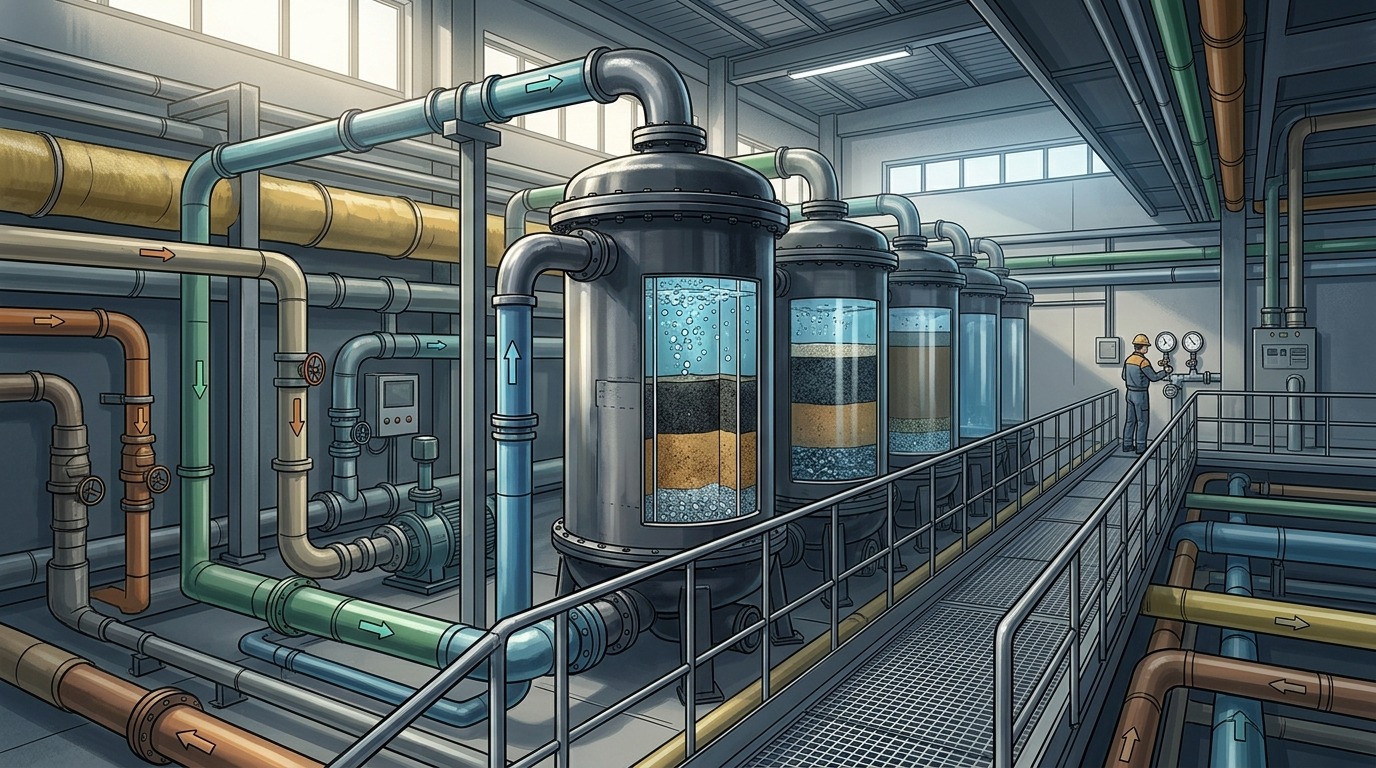
Water treatment plant with filtration systems
Is Reboiling Water Safe According to Science
So, the three main arguments supporting the myth fall apart upon closer examination:
- Heavy water — its concentration is negligible and doesn’t change in any meaningful way even with multiple boilings;
- Mineral salts — their concentration increases insignificantly, and some of them end up as limescale that settles on the walls;
- Chlorine compounds — chlorine evaporates during the very first boiling, and there is too little organic matter in treated tap water for dangerous reactions.
Reboiling water in a kettle is safe — at least in terms of the threats typically used to scare people. A doctor from the National Medical Research Center for Therapy of the Ministry of Health directly called these concerns a myth unsupported by facts.
But there is a nuance that is genuinely worth considering. Physician and parasitologist Eduard Bartuli noted that tap water itself may contain iron ions and other heavy metals — and simple boiling (whether the first or fifth time) doesn’t remove them. If the water quality in your region is questionable, it makes more sense to use a filter than to worry about the number of boilings.
So you can safely pour the water back in and press the kettle button a second time. The real health risks are not associated with reboiling but with the original quality of the water, and that is truly worth monitoring.