The foldable iPhone Duo appears to be no faster than the iPhone 18 Pro Max. A Geekbench 7 result, found by MacRumors ahead of pre-orders, shows the Duo scoring 3,986 in single-core and 11,067 in multi-core tests. The iPhone 18 Pro Max scores 4,005 and 11,370. Both phones use the same A20 Pro chip and 12 GB of RAM. In the US, the Duo starts at $1,999, which is $700 more than the iPhone 18 Pro Max. Based on this benchmark, none of that premium buys extra speed. The source author, who argues against buying the Duo, says the extra money mainly pays for the folding design.
What you need to know
- Geekbench 7 lists the iPhone Duo (identifier iPhone19,4) with an A20 Pro chip and 12 GB of RAM, the same as the iPhone 18 Pro Max.
- The Duo scored 3,986 single-core and 11,067 multi-core, versus 4,005 and 11,370 for the iPhone 18 Pro Max.
- US pricing starts at $1,999 for the Duo and $1,299 for the iPhone 18 Pro Max.
- Apple charges $999 to replace the Duo’s inner display without AppleCare+, or $99 with it.
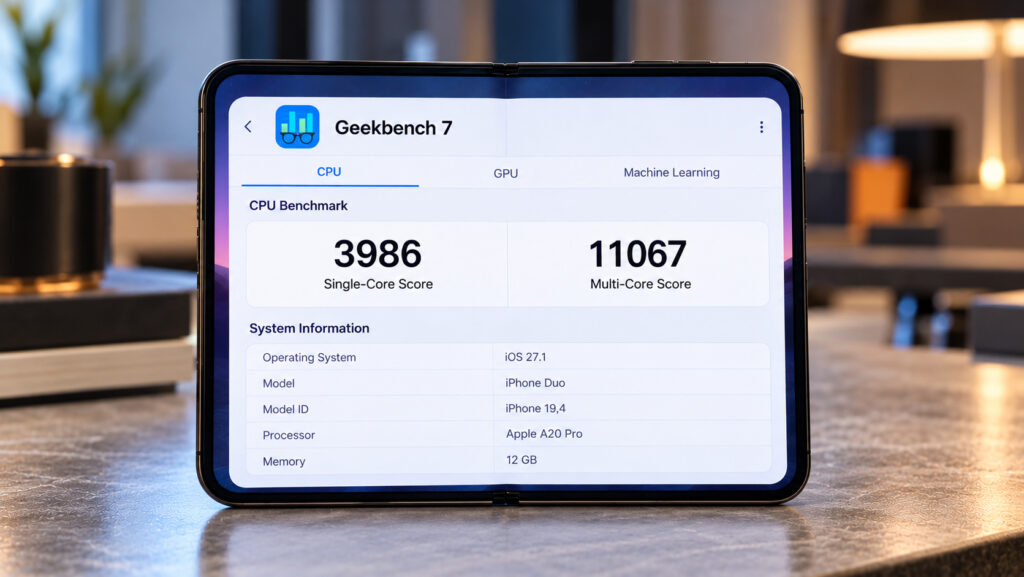
The iPhone Duo unfolded, with a Geekbench 7 result on screen
What Geekbench measures and how to read the scores
Geekbench is a free app that measures a smartphone’s processor speed. It gives each phone the same set of tasks, such as processing a photo, compressing a file, and recognizing text, and it times how long they take. Results are given in points, and the rule is simple: the higher the score, the faster the phone. The source had already compared the iPhone 18 Pro Max with the iPhone 17 Pro Max in the same version of Geekbench, so it had numbers to set the Duo against.
Geekbench reports two scores:
- Single-core shows how quickly the phone handles a single action, such as opening an app, scrolling a feed, or loading a web page. This is the speed you feel in everyday use.
- Multi-core covers heavy workloads that push the processor to its limit, such as exporting a long video or processing a batch of photos.
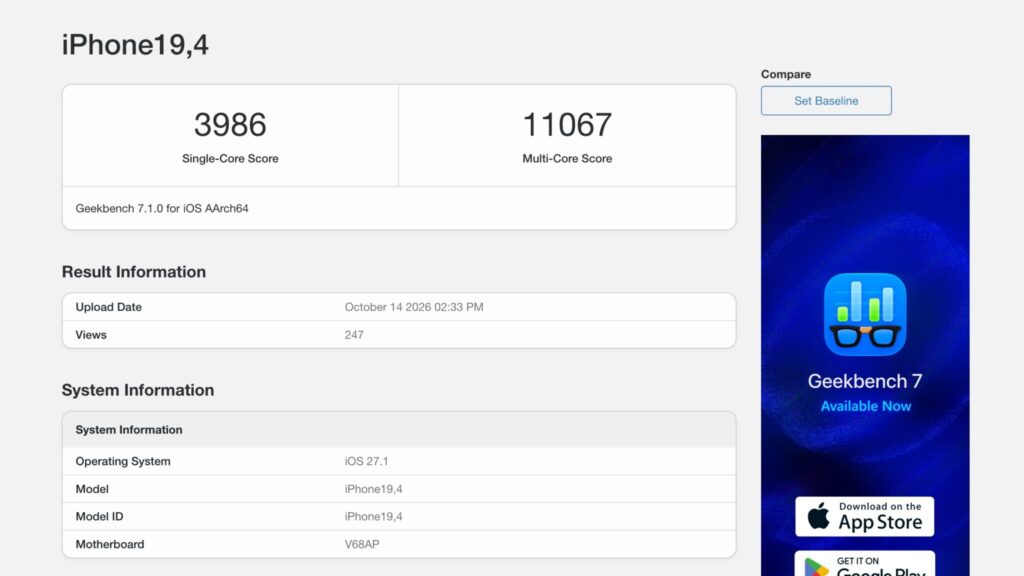
Screenshot of the iPhone19,4 result page in Geekbench 7
Every Geekbench run is uploaded to Geekbench’s public database, which is where MacRumors found the Duo’s result. The listing is labeled iPhone19,4. According to the source, this is the internal identifier Apple uses for the Duo. The phone has an A20 Pro processor and 12 GB of RAM, the same configuration as the iPhone 18 Pro Max. The source notes that 12 GB gives iOS plenty of headroom.
The foldable is not faster than the iPhone 18 Pro Max
The source put the Duo in a table alongside the iPhone 18 Pro Max, which has the same processor, and last year’s iPhone 17 Pro Max. This shows how far Apple has moved in a year.
| Geekbench 7 | iPhone Duo | iPhone 18 Pro Max | iPhone 17 Pro Max |
|---|---|---|---|
| Single-core (single actions) | 3,986 | 4,005 | 3,207 |
| Multi-core (heavy workloads) | 11,067 | 11,370 | 8,975 |
Put simply, the Duo and the iPhone 18 Pro Max are practically identical in speed. You would not notice the gap in normal use. Scores for the same iPhone also vary slightly from one run to the next. Both new phones, however, outperform the iPhone 17 Pro Max by roughly a quarter.
On this evidence, buyers should not expect extra performance from the foldable. It performs like this year’s standard flagship. One limitation applies: this is a single benchmark listing published before the phone’s release.
Why the source author sees this as a reason to skip the Duo
The source author’s argument is straightforward. Someone spending nearly $2,000 on a phone might expect the most powerful iPhone in the lineup, not just the most expensive one. Instead, the Duo matches the noticeably cheaper iPhone 18 Pro and iPhone 18 Pro Max, because all three use the same A20 Pro chip.
In the US, the iPhone 18 Pro Max starts at $1,299 and the Duo starts at $1,999. That is a $700 difference, and the benchmark suggests none of it goes toward speed. In the author’s view, buyers are paying only for the ability to fold the phone.
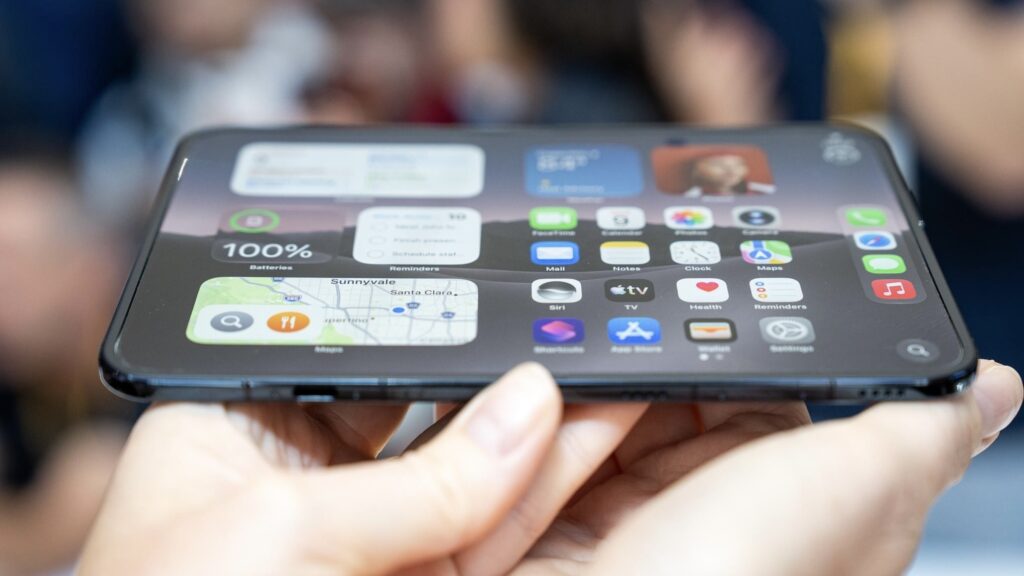
The iPhone Duo unfolded
Sustained performance and cooling remain open questions
The source raises a further concern: under long workloads, the Duo could end up slower than the iPhone 18 Pro Max. A Geekbench run lasts only a couple of minutes, which is not long enough for the phone to heat up. During half an hour of gaming, or while recording video in hot weather, a processor warms up. At that point, any smartphone reduces its performance to avoid overheating.
Unfolded, the Duo is just 5.2 mm thick. The source suggests its thin halves may struggle to dissipate heat compared with the single-piece body of the iPhone 18 Pro Max. MacRumors also cautions that the Duo’s real-world speed may differ because of its cooling and its two displays. The source author expects any difference to be for the worse and calls this the Duo’s biggest drawback. This remains a prediction, not a measured result.
Graphics performance was not tested this time. For gaming, the only figure so far comes from Apple, which says the A20 Pro’s graphics are up to 40% faster than those of last year’s A19 Pro.
Repair costs, the crease, and other drawbacks
Speed is not the Duo’s only issue. According to the source, Apple has published repair pricing for the Duo. Replacing the inner display without AppleCare+ costs $999, about half the price of the phone. With AppleCare+, the same repair costs $99.
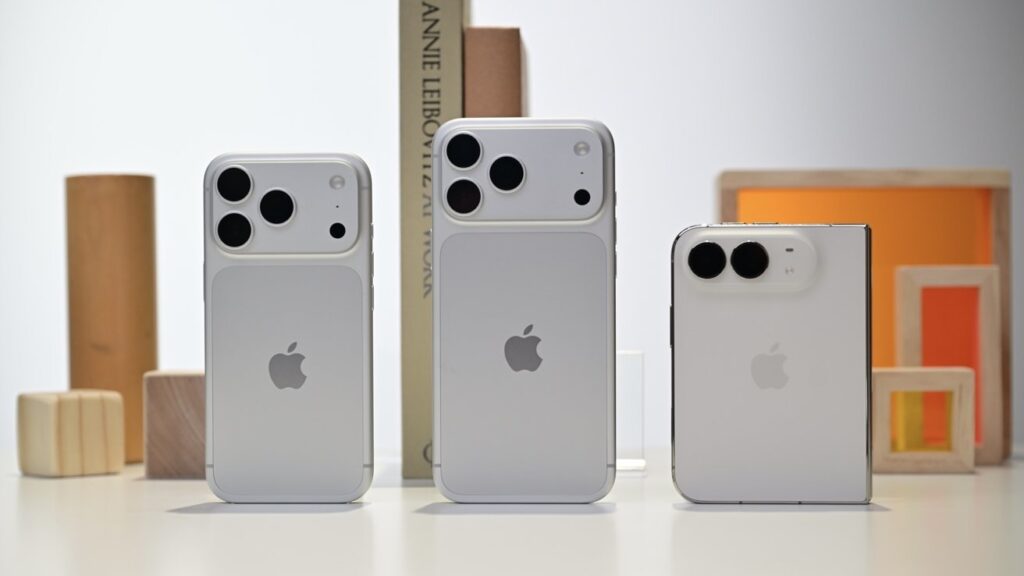
The iPhone Duo next to the iPhone 18 Pro and iPhone 18 Pro Max
The second question is the crease down the middle of the large display. Apple says a matte coating almost hides it. According to early impressions from journalists cited by the source, the crease is indeed invisible when you look at the screen head-on. At an angle, it shows through about as much as it does on Samsung’s foldables. No one, Apple included, yet knows how the display will look after a year of use.
Other drawbacks have been known since the phone’s unveiling:
- It weighs 254 grams, making it the heaviest iPhone ever.
- It is 11.3 mm thick when folded, noticeably thicker than the iPhone 18 Pro Max.
- It has no optical zoom camera. The rear has only a 48 MP main camera and a 48 MP ultrawide camera.
The source author says the missing zoom camera is the biggest disappointment. At this price, the author wants to be able to shoot a concert or a child’s school performance from a distance without losing quality, and the Duo cannot do that.
Who the Duo may still suit
The source acknowledges that the foldable iPhone has an audience. Some people constantly work with documents, spreadsheets, and email on the go, watch video while commuting, or want their phone to replace an iPad as well. For them, a 7.6-inch display that fits in a pocket may be worth it. They would still get the same speed as the most expensive conventional iPhone.
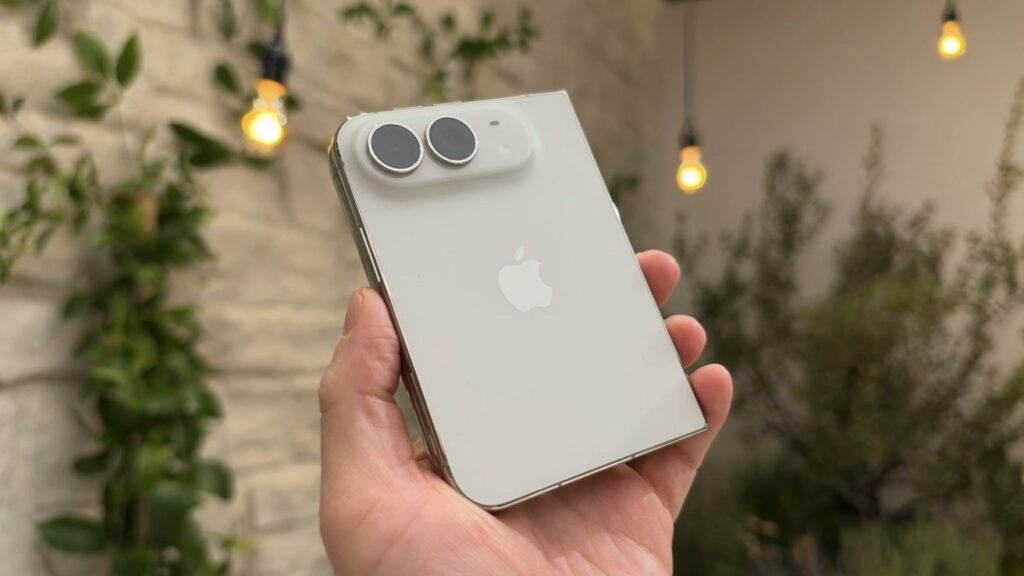
The iPhone Duo folded
For buyers who simply want a fast iPhone with a good camera, the source recommends the iPhone 18 Pro Max. It offers the same speed, an optical zoom camera, and cheaper repairs. According to the source, Duo pre-orders open on October 16 and sales begin on October 23. Given the repair prices, the source suggests that anyone who buys a Duo should use a case that covers the hinge.
The source author’s verdict is that they will not buy a Duo. On the numbers, the author describes it as an iPhone 18 Pro Max that folds, will heat up under load, and costs $700 more. For that premium, the author expects more than a second screen.