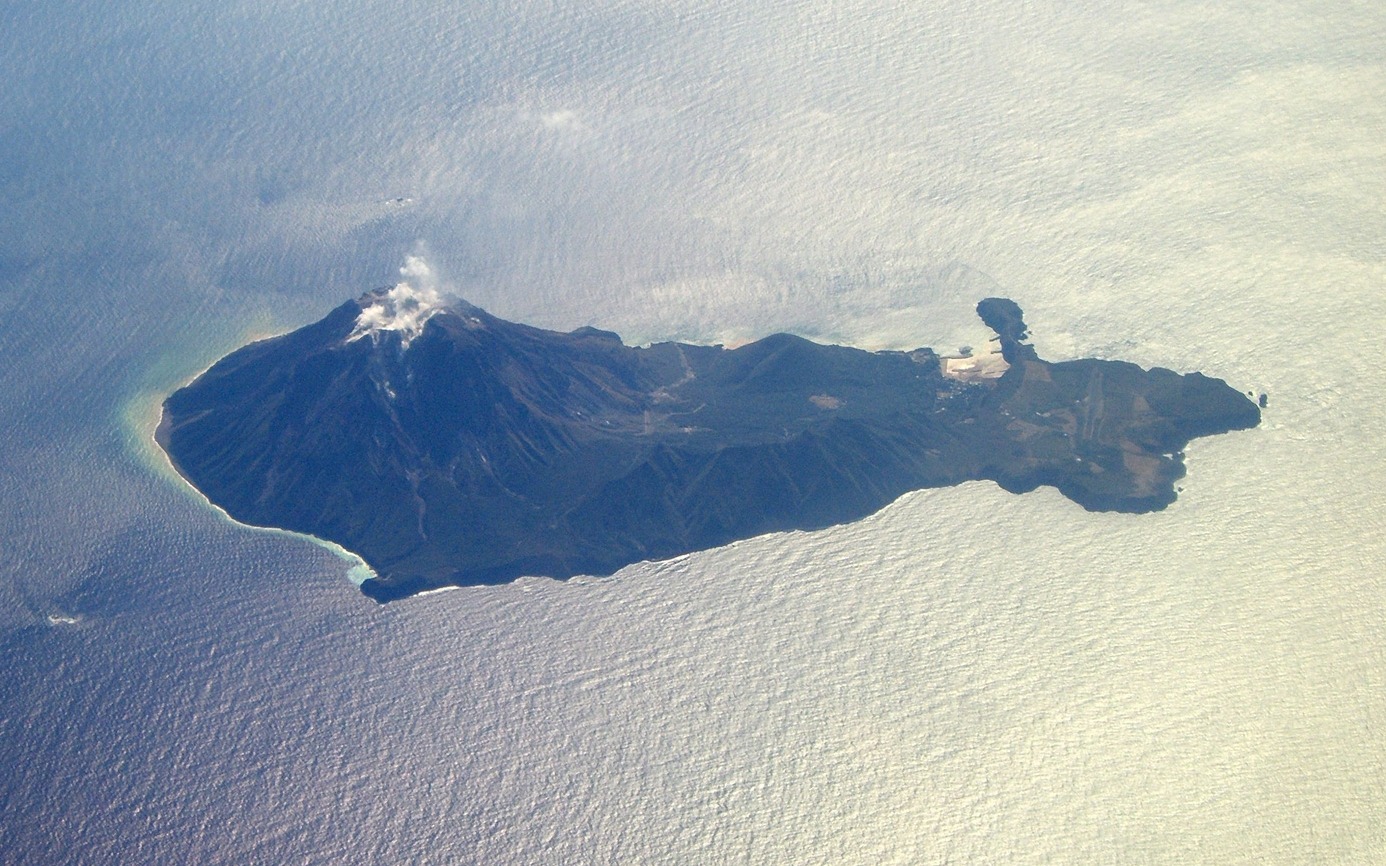
Iwo Jima island was formed as a result of one of the eruptions of the Kikai volcanic system. Image source: wikipedia.org
The Kikai Caldera off the coast of Japan, the site of the most powerful eruption in the modern era, is once again accumulating magma. Moreover, this is not leftover old melt but an entirely new batch rising from the depths. A team of Japanese geophysicists has for the first time mapped the underground reservoir in detail and proposed a model that explains how the world’s most dangerous volcanoes — including Yellowstone and Toba — “recharge.”
What Happened 7,300 Years Ago at the Kikai Caldera
About 7,300 years ago, an underwater volcano near the Japanese island of Kyushu produced what volcanologists call the Kikai-Akahoya eruption. It was one of the largest eruptions of the Holocene, the current geological epoch, receiving a Volcanic Explosivity Index (VEI) of 7, placing it alongside the eruptions of Santorini, Crater Lake, and Tambora.
To put the scale in perspective: the volcano ejected approximately 160 cubic kilometers of rock in dense-rock equivalent — 32 times more than the 1991 Pinatubo eruption. Pyroclastic flows covered an area within a radius of up to 150 km from the epicenter, and ash fell across most of Japan and the southern Korean Peninsula. After such an explosion, the ground collapsed, forming a massive depression — a caldera roughly 20 by 17 km in size, most of which ended up underwater.
The eruption dealt a serious blow to the Jōmon culture — the hunter-gatherers who inhabited the Japanese islands at the time. Pyroclastic flows destroyed forests, buried rivers under layers of ash, and some islands, such as Tanegashima, remained uninhabited for centuries because the ecosystem recovered extremely slowly.
Why Volcanic Calderas Are More Dangerous Than Ordinary Volcanoes
A caldera is not just a mountain with a crater. It is a giant funnel that forms when a volcano ejects so much magma that the Earth’s surface literally collapses into the emptied chamber. The most well-known examples of such structures are Yellowstone in the USA, Toba in Indonesia, and the very same Kikai Caldera in Japan.
Scientists have learned to more or less monitor ordinary volcanoes: small earthquakes, surface swelling, changes in gases — all these are signals of an impending eruption. With calderas, everything is more complicated: magma volumes are enormous, timescales are measured in millennia, and the internal “plumbing” is intricately complex. Although science knows that such systems can erupt again, the processes leading to a new explosion are still poorly understood.
This is precisely why the Japanese scientists’ discovery is so important — it allows us for the first time to see what is happening inside a caldera system thousands of years after a super-eruption.
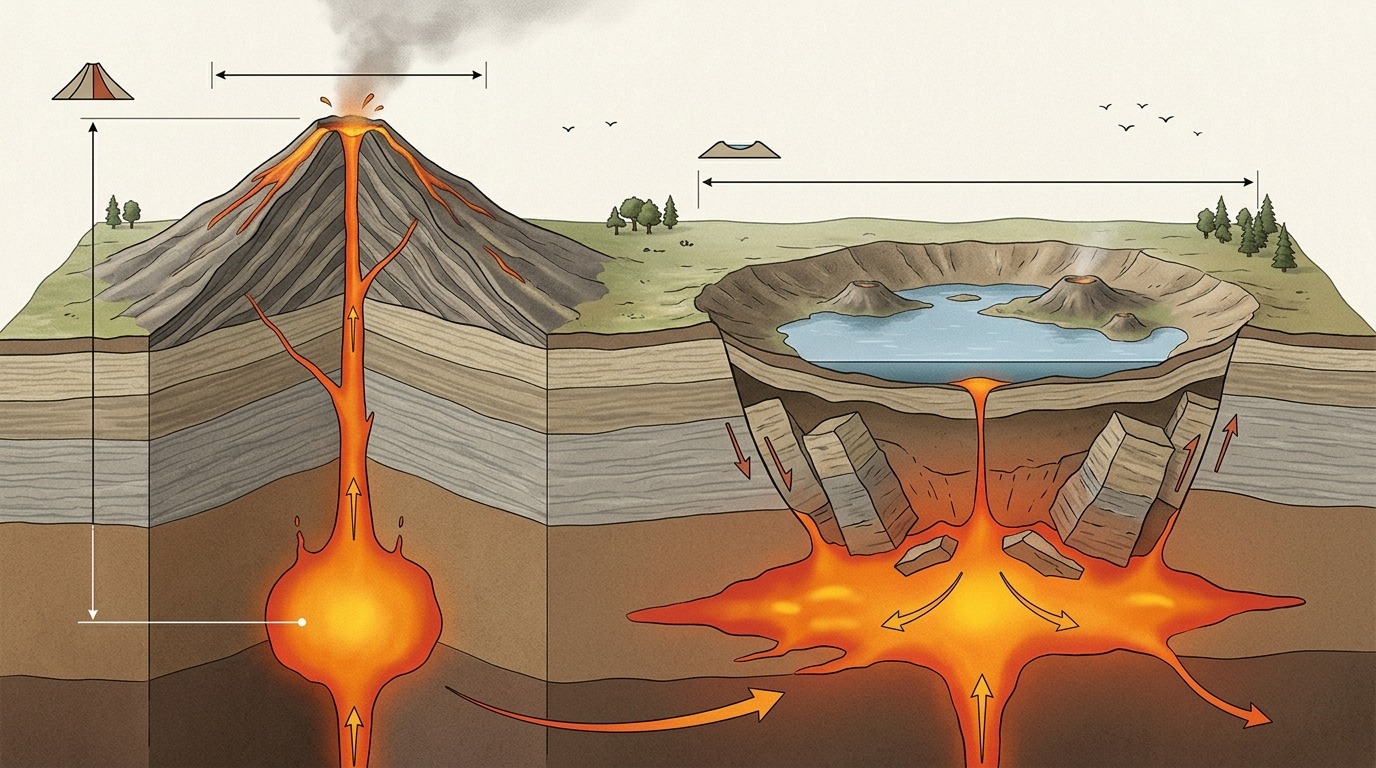
A caldera differs from an ordinary volcano: it is a wide, shallow depression above an enormous magmatic reservoir
How Scientists Peered Inside an Underwater Volcano
Paradoxically, the fact that the Kikai Caldera is underwater turned out to be not an obstacle but an advantage. As geophysicist Nobukazu Seama of Kobe University explains, the underwater location allows for systematic large-scale surveys.
The team, in collaboration with the Japan Agency for Marine-Earth Science and Technology (JAMSTEC), deployed 39 ocean-bottom seismometers and used air guns along a 175-kilometer profile. The working principle resembles a medical ultrasound, only on the scale of the Earth’s crust: air guns create sound pulses, and seismometers on the seafloor “listen” to how these waves pass through rock. Where molten magma is present, the waves slow down — and this deceleration can be precisely measured.
The results revealed a low-velocity anomaly directly beneath the caldera at depths ranging from 2.5 to 6 km — this is the magmatic reservoir. In two-dimensional cross-section, it resembles a trapezoid in shape, and its width is no less than that of the inner caldera. The melt fraction in the reservoir is estimated at 3–6%, but could reach 10%.
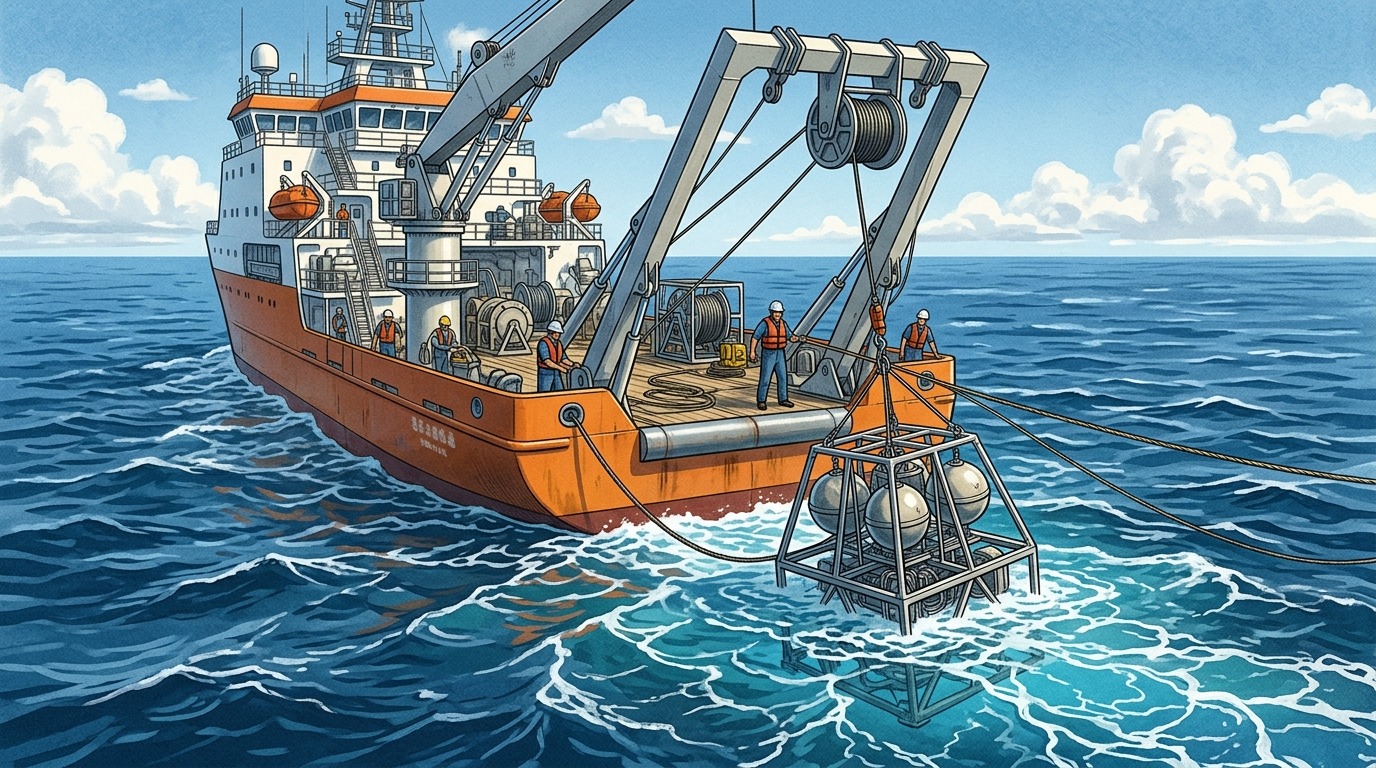
Scientists deployed ocean-bottom seismometers from a research vessel to “scan” the caldera’s interior
Why the Magma in the Kikai Caldera Turned Out to Be “Fresh”
The most intriguing finding of the study: the magma in the reservoir is not remnants of that ancient eruption but new melt arriving from the depths of the Earth.
How did the scientists establish this? Two arguments were at play. First, a new lava dome has been forming in the center of the caldera over the past 3,900 years — a visible sign of ongoing volcanic activity. Second, chemical analysis showed that the composition of this dome’s materials differs from what was ejected during the eruption 7,300 years ago.
If the magma were old, its chemistry would match the ancient samples. But it is different — meaning the reservoir is being replenished from below. This means that giant caldera reservoirs do not disappear after a super-eruption. The structure persists as a long-lived magma “storage zone,” even if its contents are completely renewed over time.
Imagine a pool that was once completely drained. Thousands of years later, water began flowing into it again — but from a different source. The pool is the same; the water is new. This is roughly how the Kikai magmatic reservoir behaves.
What Magma Accumulation Means for Eruption Forecasting
Based on the Kikai data, scientists proposed a universal model of “magma re-injection” — it describes how caldera reservoirs replenish after major eruptions. The presence of large shallow magmatic reservoirs beneath other famous calderas — Yellowstone and Toba — suggests they may be undergoing a similar cycle of depletion and replenishment.
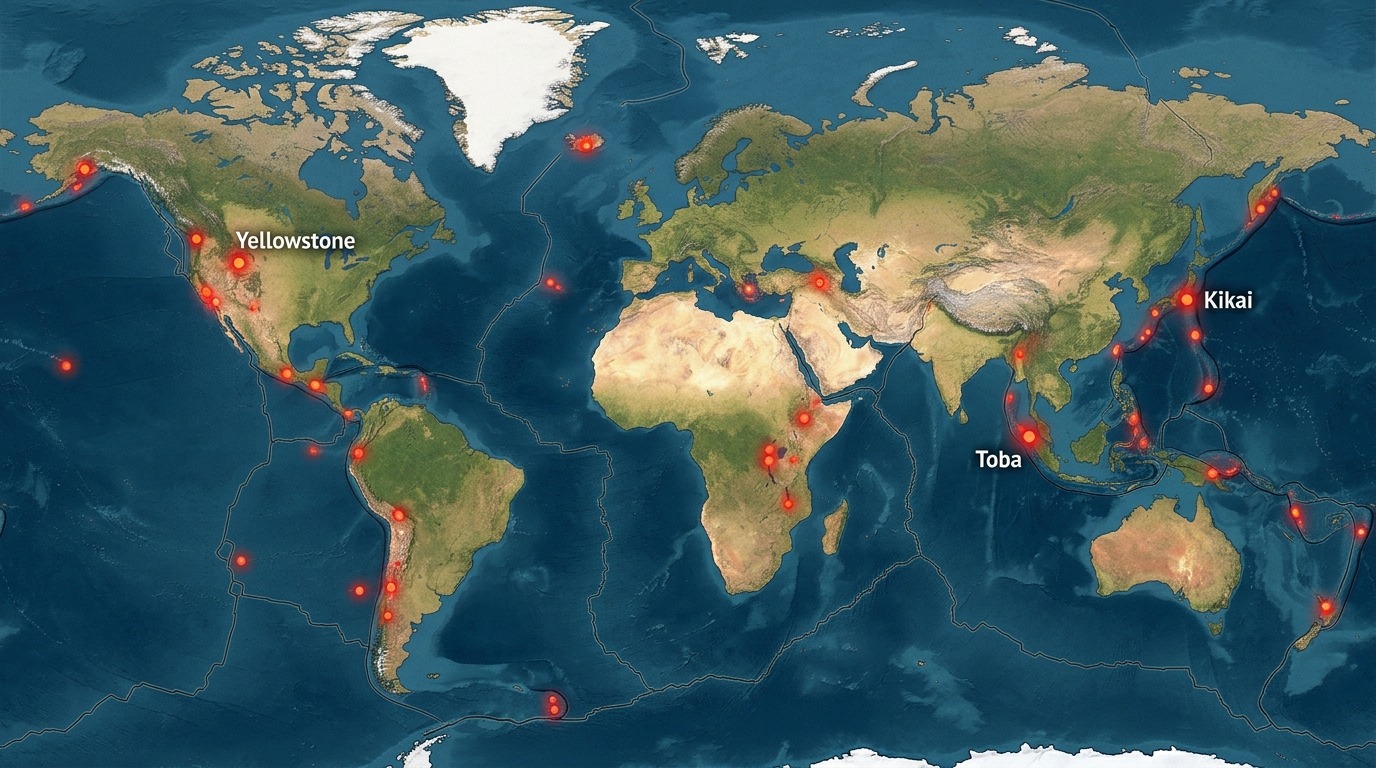
The world’s largest caldera volcanoes: Yellowstone, Toba, and Kikai — all of them may undergo a similar magma replenishment cycle
Important: this research does not mean that a Kikai eruption is imminent. But it gives scientists a significantly clearer picture of how these massive magmatic systems recover over millennia. The timescales here are measured in thousands of years, and the value of this work lies not in immediate alarm but in improving the long-term physics of forecasting.
Given that the region around Kikai is densely populated today, understanding the “recharging” mechanism of supervolcanoes is not a matter of abstract curiosity but of practical safety. Even a relatively modest eruption in such a zone could be far more devastating than the catastrophe of 7,300 years ago, simply because there are incomparably more people living nearby now.