Venous blood in a test tube is dark red, not blue at all
Blood in the human body is always red — both in arteries and in veins. But if you look at your wrist or the crook of your elbow, you’ll see distinctly blue or greenish lines under the skin. Many people have believed since childhood that “blue blood” flows through veins, turning red upon contact with air. In reality, the truth is far more interesting. It all comes down to the physics of light, the structure of skin, and even how our brain processes color.
Why Blood Is Red
In short — it’s red. Always. But with nuances. The red color of our blood is determined by hemoglobin — a complex protein found inside erythrocytes (red blood cells). Each hemoglobin molecule contains four iron atoms, and it is iron, interacting with oxygen, that gives blood its characteristic red hue.
Arterial blood, saturated with oxygen, has a bright scarlet color. Venous blood, which has already delivered oxygen to tissues and carries carbon dioxide back, becomes dark red, almost maroon. But it is never blue or light blue. Anyone who has had blood drawn from a vein can confirm this — the test tube contains a dark red liquid, not a blue one.
The difference in shades is explained by the fact that oxygenated hemoglobin absorbs blue-green spectrum waves and reflects red-orange ones, while deoxygenated hemoglobin absorbs more red waves, making the blood appear darker.
Why Our Veins Look Blue
The answer to the main question lies not in the blood, but in how light passes through the skin. In 1996, a group of scientists led by Alwin Kienle published a detailed study in the journal Applied Optics titled “Why do veins appear blue?”. Using a CCD camera and computer modeling, they showed that the color of blood vessels is determined by four factors:
- how skin scatters and absorbs light of different wavelengths;
- the level of blood oxygen saturation;
- the diameter and depth of the vessel;
- the peculiarities of color perception by our brain.
The mechanism works as follows. When white light hits the skin, it splits into waves of different lengths. Red rays (long-wavelength) penetrate deep, 5–10 mm into the tissue, reaching the veins. But there, hemoglobin absorbs them. Blue rays (short-wavelength) behave differently: they barely penetrate the skin and are reflected back. As a result, our eyes receive more reflected blue light from the area where veins run, and the brain “draws” blue lines for us.
In other words, the skin acts as a kind of light filter that lets red light pass inward (where it is absorbed) and returns blue light outward. If the skin were transparent, veins would look red.
Why Veins Look Blue but Capillaries Don’t
Not all blood vessels look blue. The depth of the vessel is the key factor. If a blood vessel is very close to the surface (less than 0.5 mm), it absorbs almost all blue light and reflects a lot of red — which is why the skin above it looks pinkish. This is exactly why fingertips are pink: tiny capillaries are located right at the surface.
But most visible veins lie at a depth of 0.5 mm or more. At this depth, red light has time to be absorbed, and the ratio of reflected blue to red light is approximately 2:3. It would seem that there’s still more red — so why do we see blue? This is where our brain comes in.
It’s all about relative color perception. The surrounding skin reflects quite a lot of red light, and against this warm background, the area above the vein appears contrastingly cool — bluish — to our brain. This is similar to a well-known optical illusion: if you place a purple object next to a red one, the purple will appear blue. Our brain constantly adjusts colors based on contrast with the surroundings.
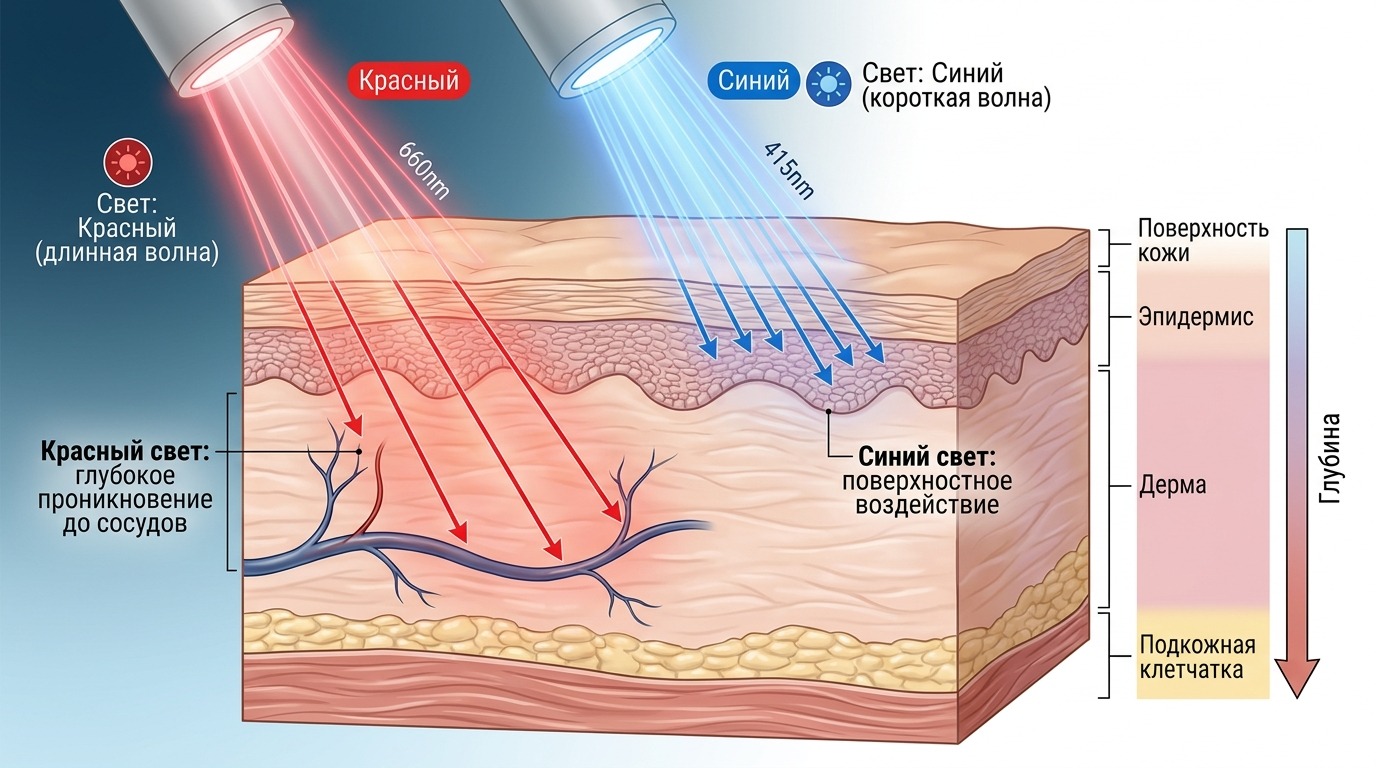
Diagram showing red and blue light penetration through skin layers to a vein
Why Veins Are More Visible on Pale Skin
The color of veins under the skin also depends on the skin tone itself. In people with light skin, veins often appear blue or bluish because pale skin transmits more light and makes the contrast more noticeable. In people with darker or olive skin, the same veins may look greenish or even be invisible because the skin absorbs more light of all wavelengths, and the “blue effect” weakens.
There’s a simple experiment that clearly demonstrates this. If you shine a red flashlight on your hand, veins will show up as dark stripes — red light penetrates deep and is absorbed by hemoglobin. But if you shine blue light — the veins virtually disappear because blue light reflects off the skin without reaching the vessels. Doctors actually use this principle: special devices illuminate the hand with red or infrared light to locate a vein for injection.

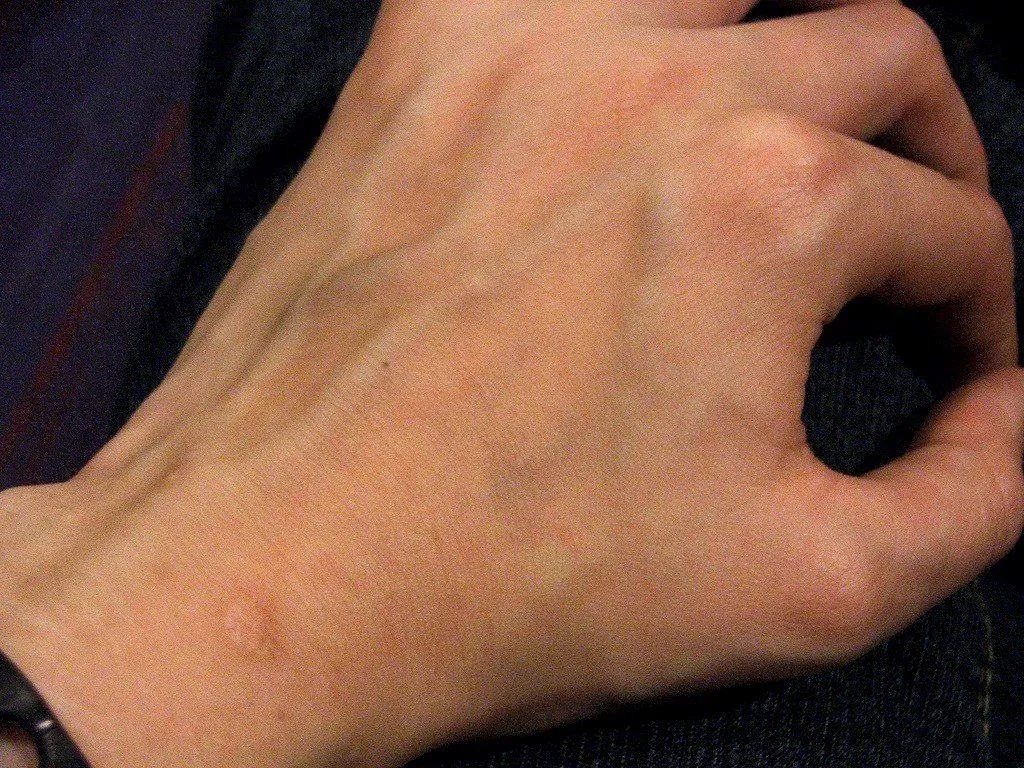
Veins on the wrist appear blue-green due to how light passes through the skin
How Veins Are Depicted in Illustrations
Another source of confusion is medical illustrations. In anatomical diagrams, arteries are traditionally drawn in red and veins in blue. This is a convenient convention that helps quickly distinguish between the two types of vessels. But many people take this at face value and believe that blood in veins is actually blue.
In practice, arteries are invisible through the skin not because they are “red,” but because they are located deeper, have thicker walls, and have a smaller diameter than superficial veins. Light simply doesn’t reach them in sufficient quantity. Even arteries that run relatively close to the surface (for example, the radial artery on the wrist where we feel the pulse) remain invisible to the eye.
Where Did the Expression “Blue Blood” Come From
Since we’ve figured out the optics, it’s worth recalling the famous expression. The idiom “blue blood” originated in medieval Spain. Light-skinned Castilian aristocrats took pride in the fact that bluish veins were clearly visible through their pale skin — this was considered proof that there were no dark-skinned Moors in their lineage.
Peasants who worked in the sun were tanned, and their veins were not visible. Noble ladies, who hid from the sun under parasols and hats, kept their skin white and their veins noticeable. Thus “blue veins” became a symbol of noble birth, and the expression eventually spread throughout Europe.
Of course, the blood of aristocrats was no different from the blood of commoners. But now you know that even this cultural myth has a very concrete optical basis — veins are simply more visible through lighter skin.

The pale skin of aristocrats made bluish veins especially noticeable
Can Blood Actually Be Blue?
In humans — no. But in the animal kingdom — yes. Octopuses, squids, spiders, and scorpions truly have blue blood. Instead of hemoglobin with iron, they use a different protein — hemocyanin, which contains copper. When copper binds with oxygen, the blood takes on a blue-green hue.
There are other variations as well: lizards from New Guinea have green blood due to high levels of the pigment biliverdin, and some Antarctic fish have completely colorless blood. The diversity of solutions nature has found for oxygen transport is truly impressive.
So, the blue color of veins is not a property of blood but the result of a complex interaction between light, skin, and the brain. The blood in your veins right now is dark red, and no layer of skin changes that — it merely makes you see it differently. Next time you notice blue lines on your hand, remember: what you’re looking at is not the color of blood, but a little show performed by optics and neuroscience right on your skin.