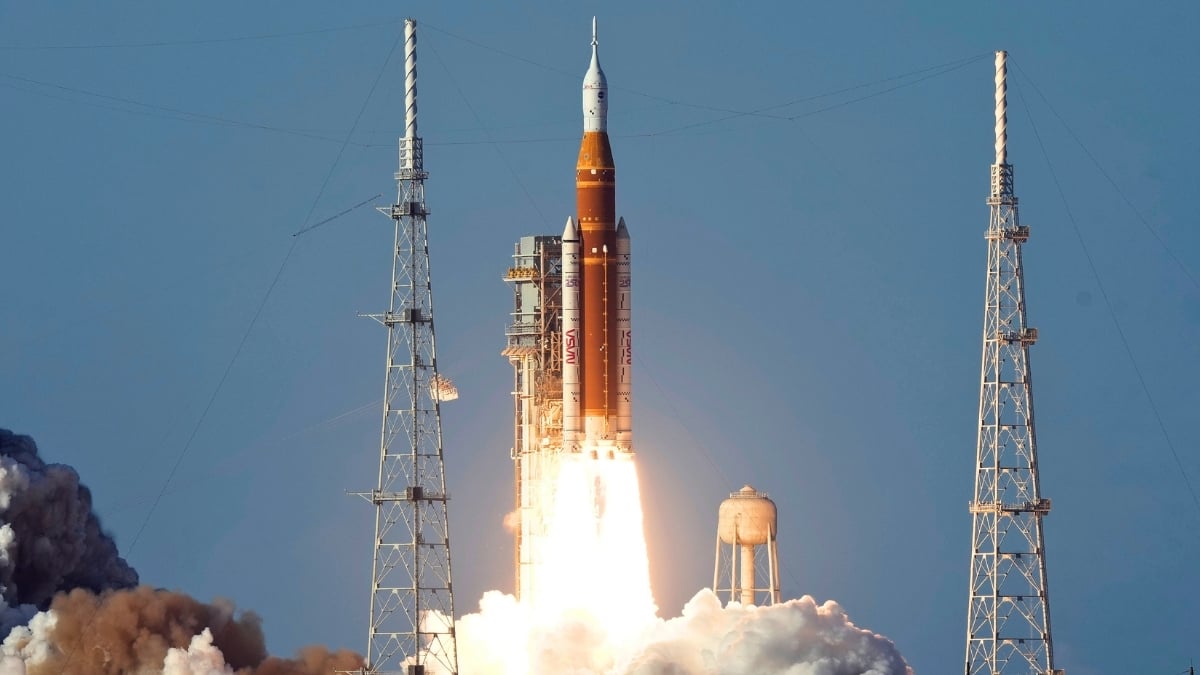
SLS rocket launches from Kennedy Space Center at sunset
For the first time in over half a century, humans are flying to the Moon. On the evening of April 1, 2026, a Space Launch System (SLS) rocket carrying the Orion spacecraft and four astronauts launched from Kennedy Space Center in Florida. The Artemis 2 mission is not a lunar landing, but it is still important and will go down in history: the crew will break the record for the farthest distance from Earth, and among the team members are the first woman, the first Black person, and the first non-American to fly to the Moon.
Flight to the Moon in 2026
The last time humans flew to the Moon was in December 1972 — it was Apollo 17, during which a flag was planted on the lunar surface. That was 53 years ago. Artemis 2 is a lunar flyby mission as part of the Artemis program. It is the second flight of the SLS rocket, the first crewed flight of the Orion spacecraft, and the first crewed mission beyond low Earth orbit since Apollo 17 in 1972.
Artemis 2 builds on the success of the uncrewed Artemis 1 mission conducted in 2022, and is intended to demonstrate a wide range of capabilities needed for deep space travel. This is the first crewed flight aboard the SLS rocket and Orion spacecraft. The spacecraft will not land on the lunar surface — the crew will fly around the Moon without stopping and without entering lunar orbit, then head back to Earth for splashdown in the Pacific Ocean.
The main goal is to test how Orion performs in real conditions: life support systems, navigation, and communications. Essentially, this is a dress rehearsal before a future lunar landing.
Who Is Flying to the Moon on Artemis 2
The crew consists of four: Commander Reid Wiseman, Pilot Victor Glover, Mission Specialist Christina Koch from NASA, and Mission Specialist Jeremy Hansen from the Canadian Space Agency.
This crew is a record in itself. Glover will become the first Black person, Koch — the first woman, and Hansen — the first non-U.S. citizen to fly beyond low Earth orbit and to the vicinity of the Moon.
The three NASA astronauts are experienced space travelers. Wiseman, a former Navy pilot who became an astronaut in 2009, already spent six months on the International Space Station in 2014.
Before launch, the astronauts spoke words that echo the Apollo tradition: “We fly for our families. We fly for our teammates. We fly for all of humanity.”
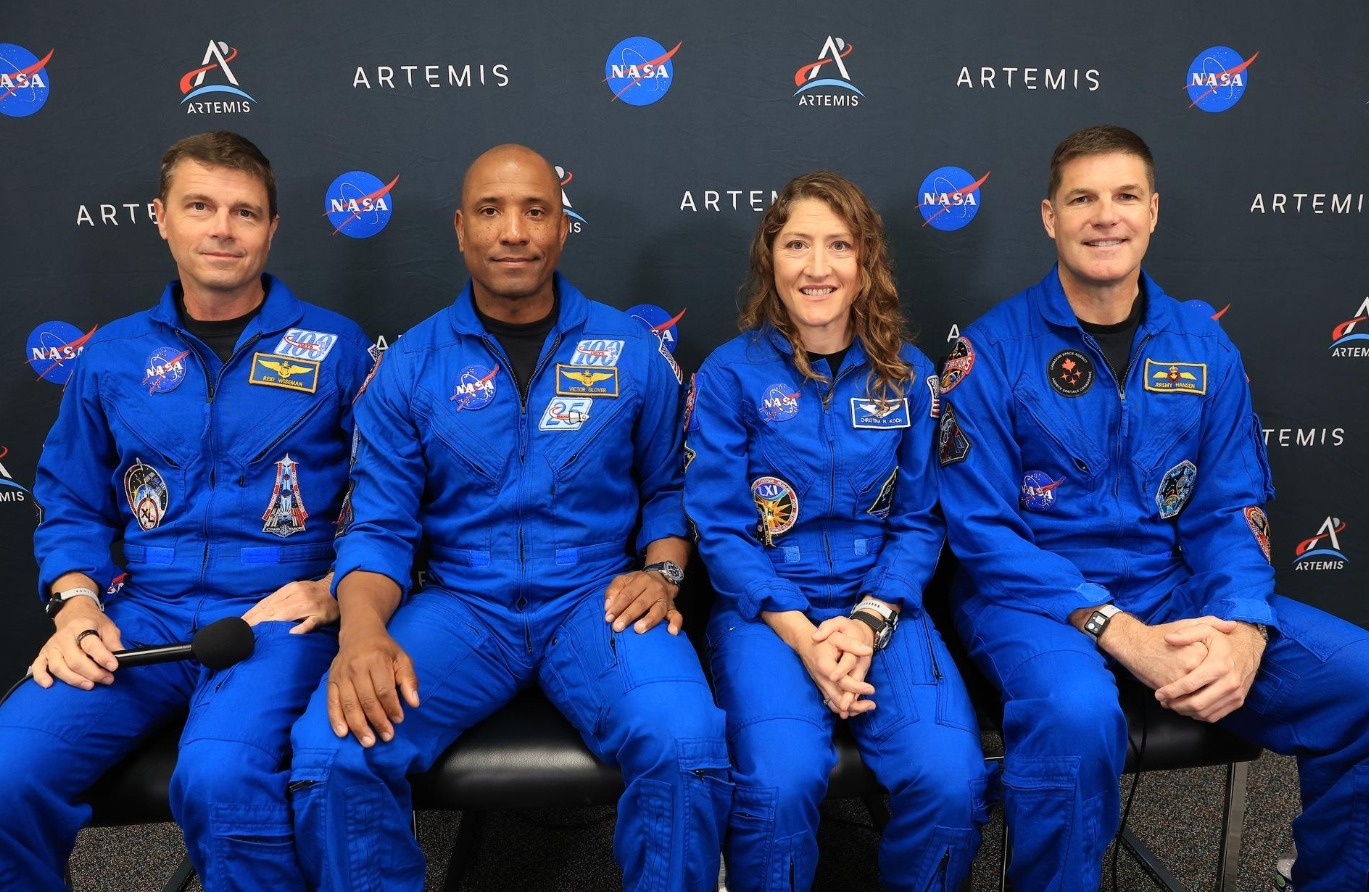
Artemis 2 crew before launch. Image source: nasa.gov
How the Crewed Moon Launch Went
The SLS rocket with the Orion spacecraft and four astronauts on board launched from Pad 39B at Kennedy Space Center on April 1 at 6:35 PM Eastern Time (April 2 at 1:35 AM Moscow time).
The two solid rocket boosters ignited first, providing more than 75% of the thrust needed to lift off the launch pad. Their power combined with four RS-25 engines at full thrust generated an incredible 8.8 million pounds (approximately 3,990 metric tons) of force at liftoff. To put the scale in perspective: the team loaded more than 700,000 gallons (2.6 million liters) of fuel into the 32-story rocket — roughly the volume of four Olympic swimming pools.
The launch went cleanly. To NASA’s relief, there were no significant hydrogen leaks — this was especially important since fuel problems had led to months of delays.
Pilot Victor Glover manually controlled the Orion capsule for the first time in history, conducting a test flight lasting more than an hour. After that, the crew began checking onboard systems in Earth orbit — they need to verify that life support, communications, and navigation are functioning normally before heading to the Moon.
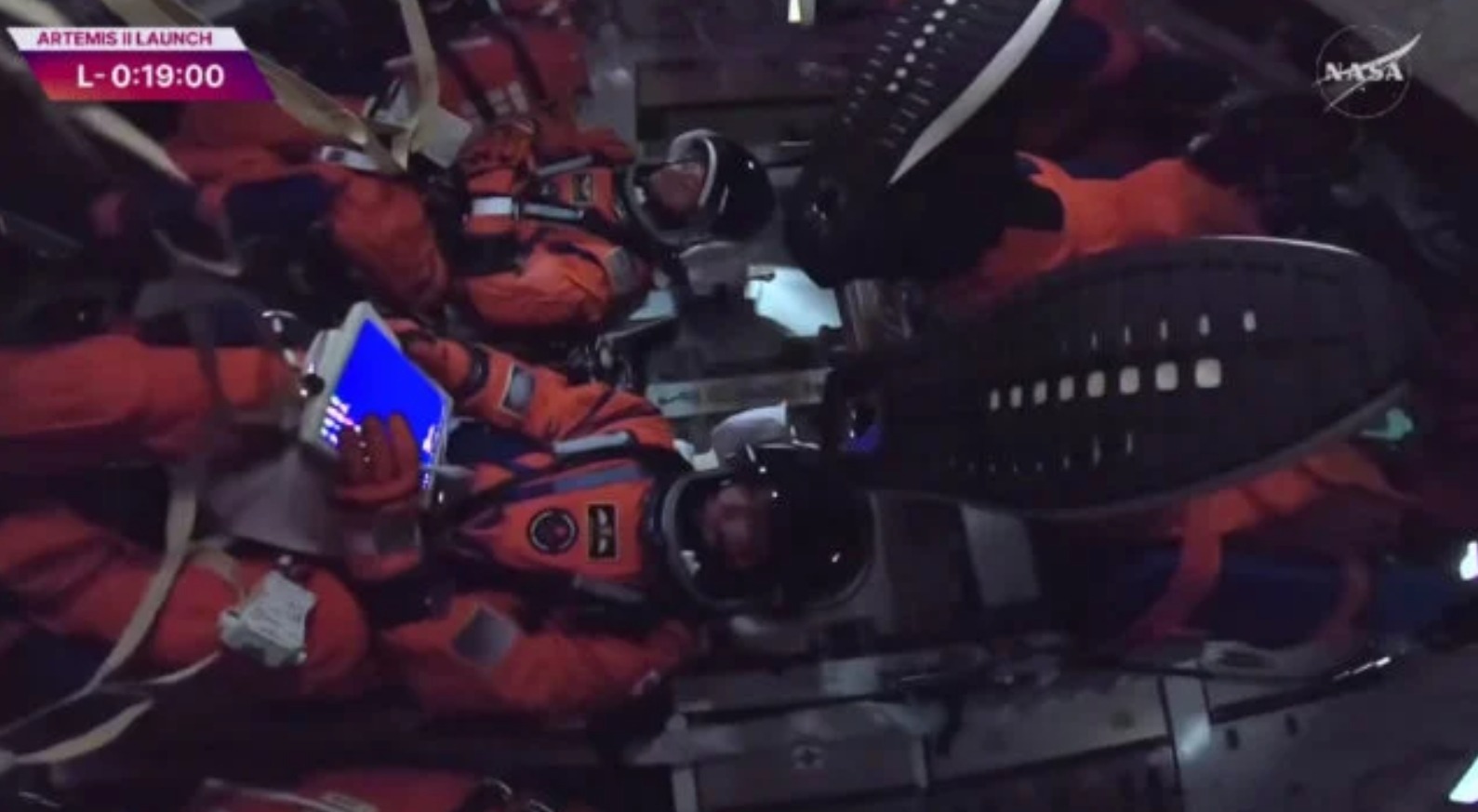
Crew inside the spacecraft. Image source: Science Alert
Record for Farthest Distance from Earth
The current record for the farthest distance a human has traveled from Earth belongs to the Apollo 13 crew. In 1970, during an emergency lunar flyby, their spacecraft reached a distance of 400,171 kilometers from Earth. Ironically, the record was set not by design but due to an accident — the crew had to loop around the Moon on a “free return trajectory” to get home.
The Artemis 2 crew is expected to surpass this record: the spacecraft will fly approximately 7,600 km beyond the Moon, and the atmospheric reentry speed upon return will be about 40,000 km/h — also a record for a crewed flight.
The astronauts will spend roughly one day in Earth orbit to confirm all systems are working, then fire the main engine and head toward the Moon. The journey will take three to four days, and the spacecraft will pass approximately 8,000 km beyond the lunar surface — farther than the ill-fated Apollo 13. The lunar flyby is expected on April 6.
Why the Artemis 2 Mission Was Delayed
The road to launch was not easy. The launch window was originally scheduled for early February 2026, but a winter storm in North America delayed preparations. After a practice countdown rehearsal on February 2, NASA announced a postponement to March due to a liquid hydrogen leak.
A second rehearsal on February 19 went successfully, but on February 21 a helium flow issue was discovered, forcing the rocket to be rolled back to the Vehicle Assembly Building and pushing the launch to at least April.
Such delays are standard practice for super-heavy rockets. The Artemis program in general can hardly be called fast-tracked: the schedule shifted due to investigations into problems with Orion’s life support system and unexpected heat shield damage discovered after Artemis 1’s return. Crew safety remained the top priority, and NASA did not rush.
When Will Humans Land on the Moon
Artemis 2 is the second step in a multi-phase program. Here is the full plan:
- Artemis 1 (2022) — uncrewed lunar flyby, testing the rocket and spacecraft.
- Artemis 2 (April 2026) — first crewed lunar flyby in 53 years. Currently underway.
- Artemis 3 (mid-2027) — crew will enter low Earth orbit for docking tests with one or two commercial lunar landing modules (Starship HLS from SpaceX and Blue Moon from Blue Origin), as well as testing of the new AxEMU spacesuit.
- Artemis 4 (early 2028) — first landing of American astronauts on the Moon since Apollo 17. Astronauts will transfer to a landing module, descend to the surface, conduct at least two surface excursions, and return to orbit to rejoin Orion.
The Artemis 3 mission was originally planned as a landing mission, but in 2026 the landing was moved to Artemis 4. After that, NASA intends to conduct lunar landings annually. The long-term goal is a permanent lunar base and preparation for missions to Mars.
All of this depends on the success of the current mission. If Orion proves its reliability in deep space with living humans rather than mannequins, the program will get the green light for the next phases. If problems arise, NASA is prepared to make adjustments to Artemis 3, scheduled for mid-2027.
The Artemis 2 mission is a stress test of the entire technological chain that, over the coming years, should return humans to the lunar surface. The last time humanity stood on the Moon was in 1972. Now four astronauts are flying there to pave the way for those who, in 2028, if all goes according to plan, will leave fresh footprints on the lunar soil for the first time in half a century.