
The biological computer doesn’t play Doom perfectly, but at a very good level. Image source: popsci.com
When id Software released Doom in 1993, no one could have imagined that one day this shooter would be played not by a gamer’s fingers, but by living human brain cells. Yet that’s exactly what happened. Australian startup Cortical Labs created a bioprocessor in which real neurons are grown on a microchip and learned to complete levels of the iconic game.
What Is a Biological Computer
Cortical Labs is a Melbourne-based company that has been working on so-called neurochips for several years. The idea sounds simple: instead of silicon transistors, use living neurons grown from human stem cells. In practice, of course, everything is much more complex.
The neurons are placed on a microelectrode array (MEA) — a special substrate that simultaneously reads the electrical activity of the cells and can stimulate them. In essence, the chip “communicates” with the neurons in their language — through electrical impulses. The result is a hybrid of living and digital systems, which the company named DishBrain.
The chip contains approximately 800,000 living neurons. For comparison, the brain of an ordinary fruit fly has about 100,000. So in terms of the number of nerve cells, DishBrain is already more complex than an insect’s brain, but of course immeasurably simpler than the human brain with its 86 billion neurons. Nevertheless, even this was enough for the system to begin learning.
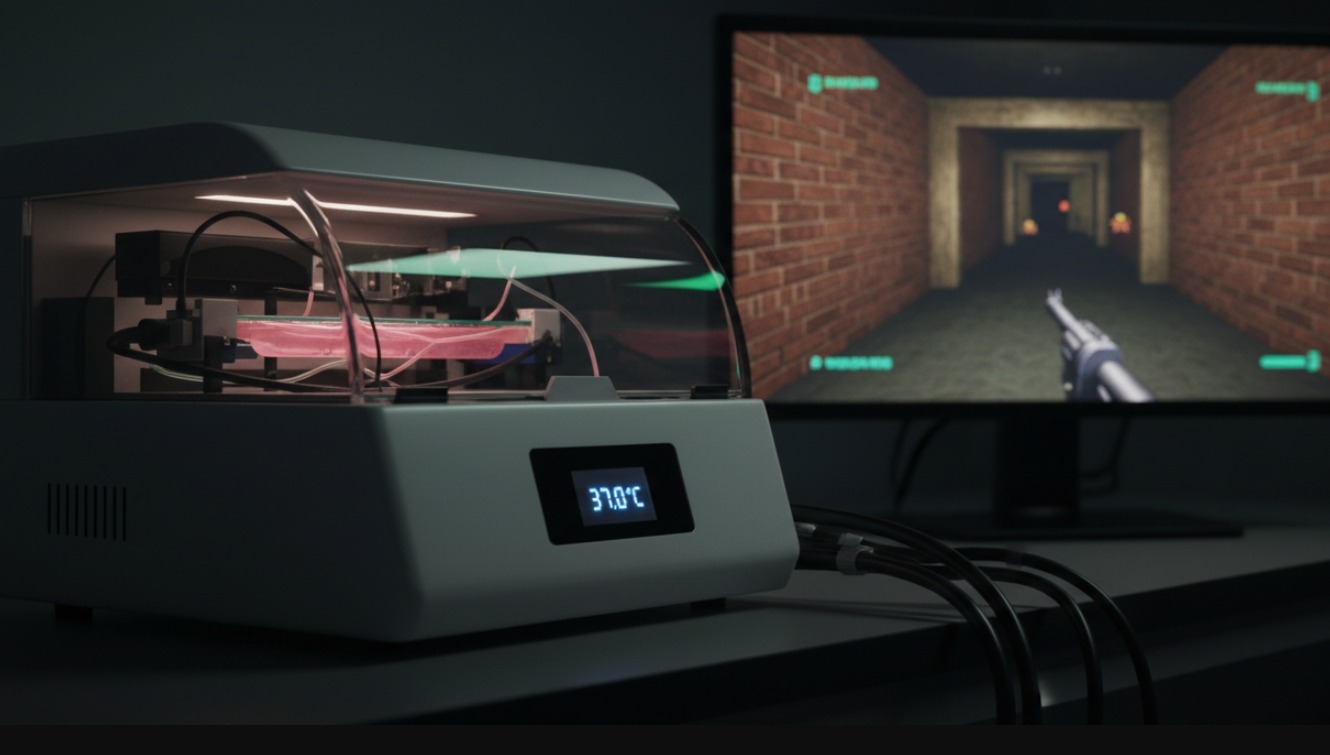
Brain cells in an incubator capable of playing Doom. Image source: bing.com
How Living Neurons Learned to Play Doom
Back in 2022, the Cortical Labs team demonstrated that DishBrain could play Pong — the simplest arcade game involving bouncing a ball. The neurons received information about the ball’s position through electrical signals and “responded” with impulses to control the paddle. The system learned based on the principle of predictability: when the neurons acted correctly, the environment became orderly, and when they made mistakes, it became chaotic. The cells “preferred” order and gradually improved their performance.
But Pong is two dimensions and one paddle. Doom is a completely different story. Three-dimensional space, enemies, walls, turns, shooting. And yet the researchers went further. The neurochip was connected to a simplified version of Doom where the objective was to navigate through a level and collect resources. Information from the game screen was converted into patterns of electrical stimulation, and the neurons’ response activity was interpreted as commands: forward, backward, left, right, shoot.
It turns out the neurons adapted to the task in approximately a few minutes — significantly faster than many artificial intelligence algorithms learn similar tasks. This doesn’t mean the bioprocessor “understands” the game the way a human does. But it reacts, corrects its behavior, and demonstrates a basic form of learning. And that is already impressive.
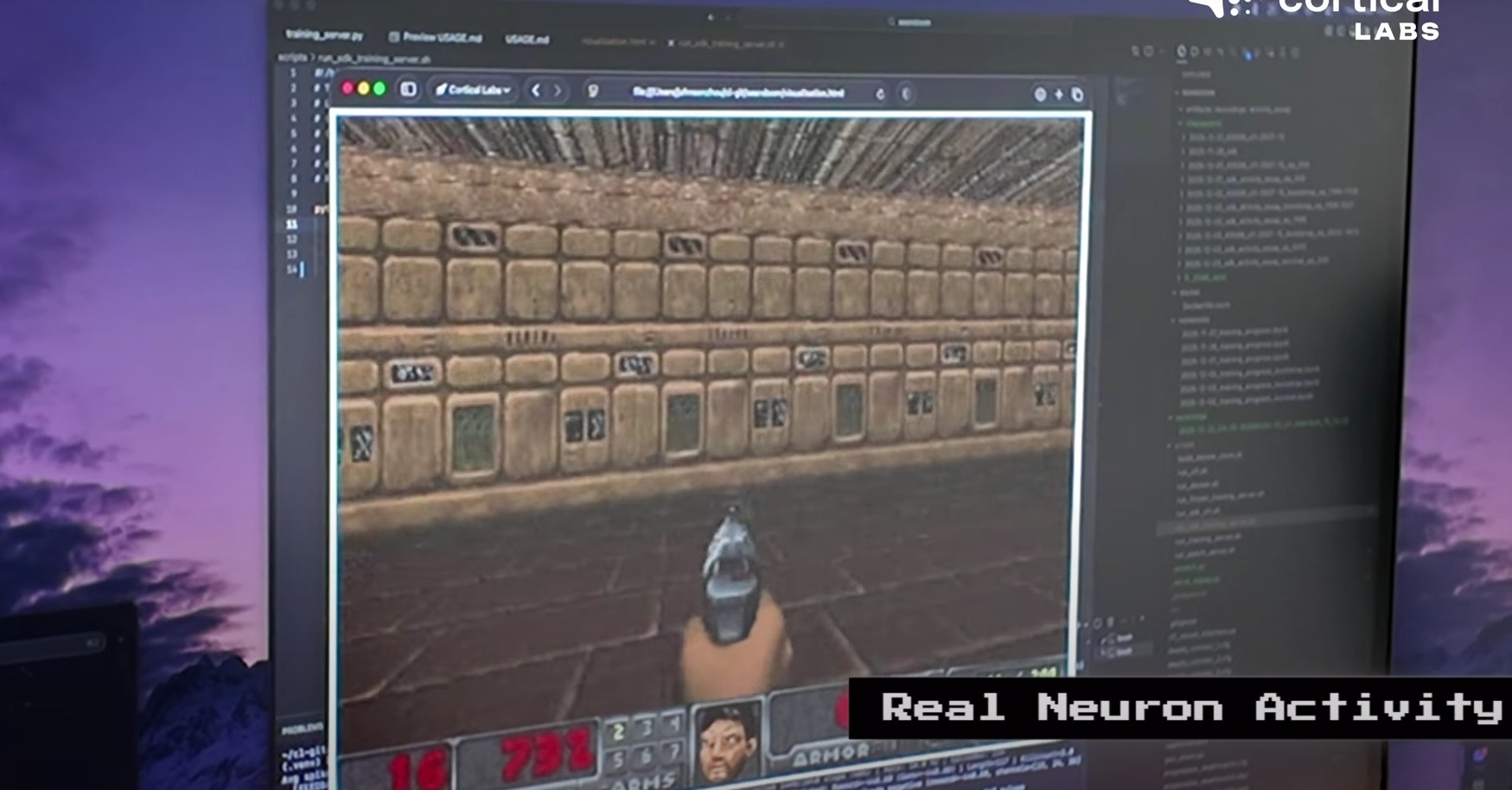
Brain cells controlled a simplified version of Doom
Why Do We Need a Biological Processor
One might ask, why grow neurons on a chip when silicon processors are getting more powerful every year? The thing is, biological neurons have one fundamental advantage — energy efficiency.
The human brain consumes about 20 watts of energy — roughly equivalent to a dim light bulb. Yet it performs tasks that require megawatts of electricity from supercomputers. Modern AI models like GPT-4 consume colossal resources during training: a single query to ChatGPT uses 10 times more energy than a Google search query. Data centers around the world already consume more electricity than entire countries.

Training ChatGPT requires colossal resources
Simply put, silicon AI “costs” the planet dearly. But biological neurons process information almost for free — in terms of energy. Cortical Labs believes that neurochips could one day become the foundation for a new type of artificial intelligence system that will learn faster, use less energy, and possibly solve problems that are currently beyond the capabilities of conventional computers.
But there’s a catch. Living neurons require a nutrient medium, specific temperature, and constant maintenance. For now, DishBrain is a laboratory setup, not a portable gadget. However, the company has already attracted more than $10 million in investments and is actively working on scaling the technology.
What Does a Neuron-Based Computer Feel
When it comes to living brain cells in laboratory conditions, the question inevitably arises: do these neurons feel anything? Do they suffer when they “lose” in Doom?
Scientists at Cortical Labs emphasize that 800,000 neurons on a chip are not a brain, nor even a resemblance of one. They have no structure, no consciousness, no capacity for experience. It’s more of a biological analog of a neural network than a thinking being. But the more complex such systems become, the more pressing this question will be.
As for the regulatory side, the company operates within existing bioethical legislation. The neurons are obtained from commercially available stem cell lines — the same ones used in thousands of medical studies worldwide. However, as the technology develops, new rules will be needed. If biochips become sufficiently complex, we will have to redefine the boundary between a tool and an organism.
What Awaits Biocomputers in the Future
Cortical Labs is not the only company in this field. The Swiss project FinalSpark is also working on bioprocessors, and major universities in Europe and the US are researching brain organoids — miniature three-dimensional structures made of neurons that could become the next step in the development of such systems.
In the coming years, Cortical Labs plans to increase the number of neurons on the chip and make the tasks the system can solve more complex. It’s not just about games — potential applications include robot control, medical data analysis, and modeling of biological processes. These are all tasks where the adaptability and energy efficiency of biological neurons could prove to be a decisive advantage.
The main takeaway from the Doom experiment is that living neurons on a chip are capable of learning in real time and interacting with complex digital environments. This is no longer just a curious experiment, but a foundation for an entirely new paradigm in computing. A future in which computers literally think is ceasing to be science fiction — and becoming an engineering challenge.