
Brain activity during sleep is much more intense than was long believed. Image source: popsci.com
The feeling of a great night’s sleep depends not only on the number of hours in bed — it is largely determined by how deep the sleep felt subjectively. A new study by Italian neuroscientists, published in the journal PLOS Biology, revealed something unexpected: vivid, immersive dreams don’t interfere with rest — on the contrary, they make the brain believe that sleep was deeper than it actually was, and provide more rest than previously thought. The results overturn the established understanding of deep sleep. In general, scientists still don’t fully understand why we dream, and this new research makes the question even more intriguing.
What is deep sleep and how was its function previously explained
For decades, scientists considered deep sleep to be something like a “standby mode” for the brain. Slow brain waves, minimal activity, no awareness of the outside world — the less the brain works, the deeper the sleep. This seemed logical and was supported by electroencephalography (EEG) data.
But at the same time, there was a paradox. The REM (Rapid Eye Movement) sleep phase is characterized by intense dreaming and brain activity similar to wakefulness. Nevertheless, people often describe REM sleep as deep and restorative. How can sleep feel deep precisely when the brain is most active?
This question became the starting point for the Italian research team led by neuroscientist Giulio Bernardi from the IMT School for Advanced Studies Lucca.
How dreams affect sleep quality: an EEG experiment
The team analyzed 196 overnight high-density EEG recordings (256 electrodes) from 44 healthy adults. Participants slept in a laboratory, and each spent four nights there. The researchers deliberately woke people from the N2 phase — the second stage of non-REM (NREM) sleep.
Why N2 specifically? This stage accounts for about half of all sleep time, is evenly distributed throughout the night, and shows a wide range in dream content and subjective perception of sleep depth. At the same time, N2 is formally considered light sleep — the brain has not yet transitioned to the deep slow-wave stage.
After each awakening, participants were asked to describe what they were experiencing in their sleep immediately before the alarm, and to rate two parameters: subjective sleep depth and level of drowsiness. In total, the scientists collected more than a thousand awakenings with detailed reports — a colossal volume of data for a study of this kind.
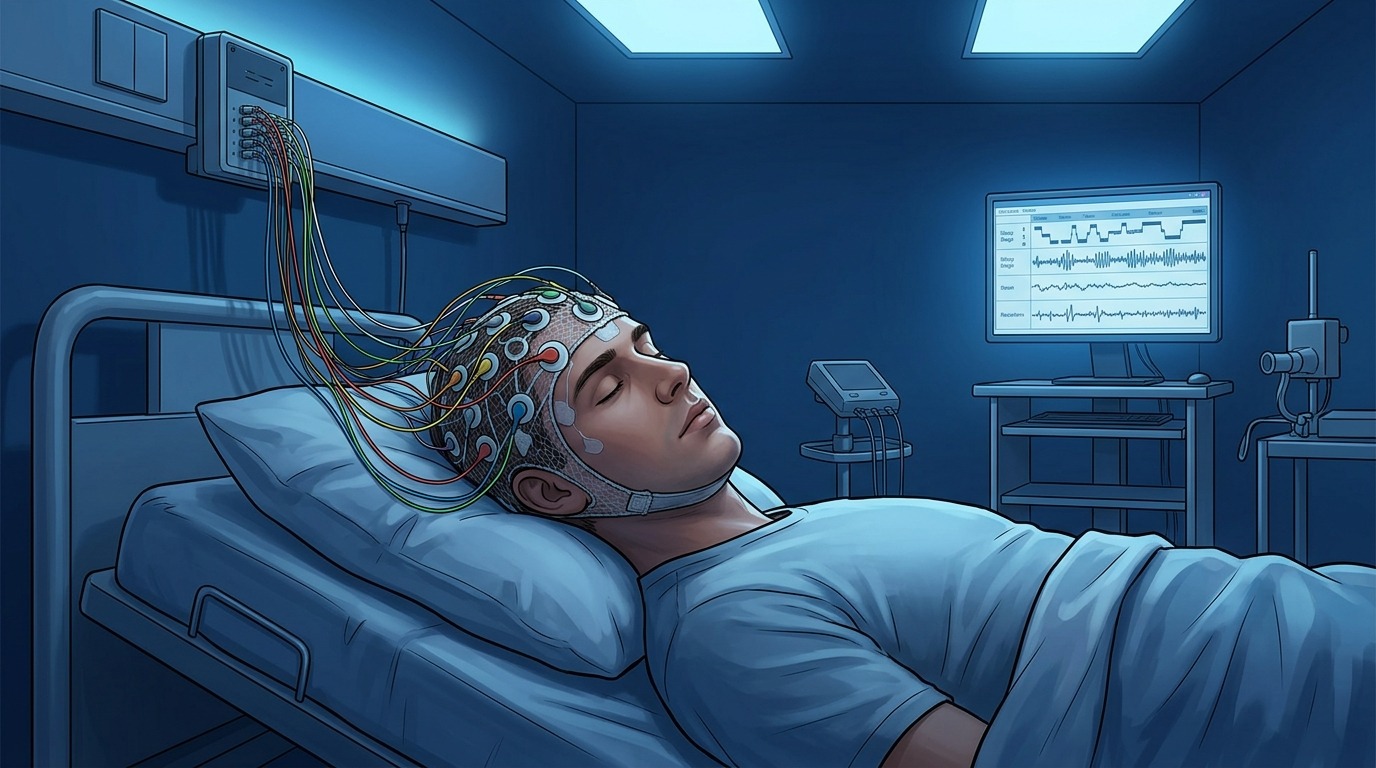
A study participant sleeping in a laboratory with EEG sensors.
Why vivid dreams make sleep feel deeper and how the brain reprocesses memories
The results were unexpected. Participants reported the deepest sleep in two cases: when they had no conscious experience at all (complete unconsciousness), and (here’s where it gets really interesting) after vivid, detailed, immersive dreams.
Fragmented, blurry sleep experiences — like a vague sense of being somewhere without understanding what was happening — produced the exact opposite result. These were associated with the most superficial sleep.
Simply put, not all brain activity during sleep interferes with the feeling of rest — what matters is the quality of the experience. A vivid, immersive dream with a plot, emotions, and details is perceived by the brain as deep sleep. While vague, murky “semi-consciousness” is perceived as shallow.
As Giulio Bernardi explains: “Dreams appear to be able to reshape how brain activity is interpreted by the sleeper: the more immersive the dream, the deeper the sleep feels.” There is evidence that at night the brain doesn’t simply rest but literally recalls the day’s events before deciding to save or discard them.
Why sleep feels deeper toward morning and what role dreams play
The study revealed yet another paradox. Throughout the night, physiological markers of so-called sleep pressure (the body’s internal need for rest) gradually decreased — this is normal: the longer you sleep, the less the body “needs” to continue sleeping. However, participants reported that their sleep, on the contrary, felt increasingly deeper as morning approached.

Schematic illustration of brain activity changes throughout the night.
This discrepancy between objective and subjective indicators precisely coincided with the increasing vividness and immersive nature of dreams. Toward morning, dreams became more vivid, emotional, and felt more detailed — and it was precisely this, according to the researchers, that maintained people’s feeling of deep sleep.
You can think of it as a kind of “inner cinema”: immersed in a vivid dream narrative, the brain essentially disconnects from the outside world. And it is this disconnection that creates the subjective feeling of deep, restorative rest, even though from a neurophysiological standpoint the brain is quite active at that moment.
Was Freud right: what are dreams for and do they really protect against awakening
The results echo one of Sigmund Freud’s most famous ideas. In “The Interpretation of Dreams” (1900), he formulated the hypothesis that dreams serve as “guardians of sleep” — they protect the sleeper from waking up by processing stimuli into the dream narrative rather than allowing them to wake us.
Much of Freud’s psychoanalytic theory of dreams — wishes, repression, hidden meaning — has long been challenged by experimental science. However, it is precisely the idea of sleep’s protective function that receives certain support in this study.
Vivid dreams may indeed help buffer fluctuations in brain activity and maintain the subjective feeling of deep sleep — even when individual brain regions are operating at full capacity.
However, it’s important to remember: the study does not prove that dreams literally “guard” sleep in the sense Freud intended. What we’re talking about is a correlation between dream vividness and the subjective perception of sleep depth, not a direct cause-and-effect mechanism. But what has been clear for a long time is that quality sleep can reduce anxiety overnight.
Why poor sleep may be linked to dreams and brain function
One of the most practically significant conclusions of the study concerns people who complain about poor sleep. Bernardi notes: if dreams really do help maintain the feeling of deep sleep, then disruptions in dreaming (for example, reduced vividness or frequency) may partially explain why some people feel unrested even after long sleep with objectively normal indicators by medical standards.
This is a situation familiar to many: the tracker on your wrist shows “excellent sleep,” but you wake up feeling drained. Or conversely — you seemingly slept little but felt energetic all day. The new research suggests that dream quality may be the missing piece in this equation.