Weight gain during menopause is one of the most common complaints among women over 40
Scientists have discovered a potential combination that could significantly increase the effectiveness of weight loss medications in older women. This conclusion was reached by researchers from the Mayo Clinic and Wayne University. However, this is still a retrospective observation — not a full-scale experiment, and the scientists directly state: it’s too early to claim that the combination “causes” enhanced weight loss. But the finding is quite intriguing.
Why It’s Hard to Lose Weight After 40 for Women: The Impact of Menopause
As menopause approaches, a woman’s body experiences a sharp decline in estrogen and progesterone levels — key sex hormones. These changes trigger a whole cascade of consequences: slowed metabolism, fat redistribution to the abdominal area, loss of muscle mass, and increased feelings of hunger. Simply put, the body begins to store fat more actively and expend energy less willingly.
As endocrinologists explain, during this period adipose tissue essentially takes over part of the ovaries’ function — it produces a small amount of estrogen, and the body “protects” fat reserves. Added to this are hot flashes, insomnia, chronic fatigue, and mood swings — all of which make regular exercise and healthy eating more difficult.
By various estimates, rapid weight gain is observed in approximately 60% of women during menopause. On average, weight increases by 2–3 kg during the first three years after menopause, and by 5–6 kg over eight years. This is not merely an aesthetic issue: abdominal fat is associated with visceral deposits that increase the risk of cardiovascular disease, type 2 diabetes, and certain types of cancer.
How Tirzepatide and Hormone Therapy Affect Weight Loss
Researchers from the Mayo Clinic decided to test whether menopausal hormone therapy (MHT) affects the effectiveness of tirzepatide — one of the most powerful obesity treatment drugs available today. Tirzepatide is a next-generation injectable drug (brand names Zepbound and Mounjaro) that simultaneously activates two receptors: GLP-1 and GIP. Essentially, it mimics the action of two gut hormones responsible for feelings of satiety and blood sugar regulation.
The scientists analyzed medical data from 120 postmenopausal women with obesity or excess weight who had been taking tirzepatide for at least 12 months. Of these, 40 were simultaneously using some form of hormone therapy (pills, patches, or creams with estrogen and/or progesterone), while 80 were not. The average age of the participants was about 56 years, and the observation period lasted an average of 18 months.
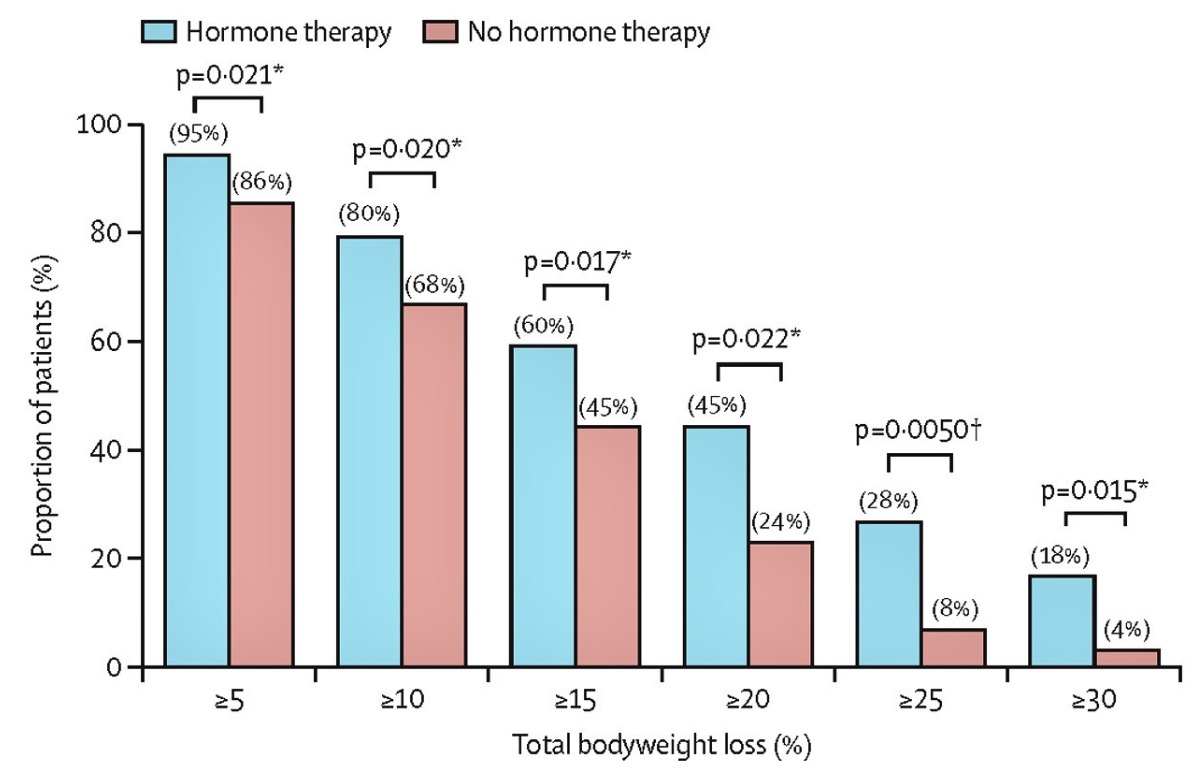
Proportion of women in each group achieving a certain percentage of total body weight loss at the time of last observation. (Castaneda et al., Lancet Obstet. Gynaecol. Women’s Health, 2026)
The result was quite impressive: women who received both tirzepatide and hormone therapy lost an average of 19.2% of their initial body weight, while participants on tirzepatide alone lost 14%. The 5.2 percentage point difference was statistically significant. Moreover, in the hormone therapy group, a noticeably larger proportion of women achieved a loss of 30% or more of their initial weight.
Postmenopausal women who simultaneously took the weight loss drug tirzepatide and menopausal hormone therapy lost 35% more weight than those who used tirzepatide alone.
Why Hormones Enhance the Effect of Weight Loss Drugs
The most intriguing question: why might hormone therapy enhance the effect of tirzepatide? The researchers honestly admit — they don’t have an exact answer yet. As the study’s first author, Regina Castaneda from the Mayo Clinic, said: “We don’t know why we’re seeing these improved weight loss outcomes.”
Nevertheless, the team has several hypotheses:
- Estrogen may enhance the GLP-1 system in the body. Preliminary experiments in rodents have shown that estrogen can enhance the appetite-suppressing effect of GLP-1 — the very hormone that tirzepatide mimics. If something similar occurs in humans, it would explain the synergy between the two drugs.
- The healthy behavior effect. It’s possible that women who are already taking hormone therapy are generally more attentive to their health, exercise more frequently, and watch their diet.
- Relief of menopause symptoms. Hormone therapy alleviates hot flashes, night sweats, and insomnia. When a woman sleeps better and feels more energetic, it’s easier for her to maintain a diet and physical activity. As study co-author endocrinologist Maria Daniela Hurtado Andrade explained: “Relief of menopause symptoms could have improved sleep and quality of life, making it easier to maintain diet and physical activity.”

Women who received the combination of two drugs lost noticeably more weight
It’s important to emphasize: the results of rodent experiments are contradictory, and the study itself was retrospective and observational. This means that the scientists analyzed already collected medical data rather than conducting an experiment with a control group. Therefore, it’s too early to treat this as a ready-made treatment plan.
Can Hormone Therapy Be Used for Weight Loss
Before rushing to a doctor to request dual therapy, it’s worth understanding the limitations of this study. First, the sample size was small — only 120 women, and the vast majority of them (94%) were white. This means the results may not be representative for women of other ethnic groups.
Second, the study did not differentiate between the type and dose of hormone therapy — all participants on MHT were analyzed as a single group. Third, this was not a randomized controlled trial (the gold standard of medical science) but rather an analysis of existing data.

Scientists plan to conduct a randomized clinical trial to confirm the results
However, these results are not isolated. Earlier, in 2024, some of the same researchers found a similar trend for another GLP-1 drug — semaglutide (the active ingredient in Ozempic): among postmenopausal women receiving semaglutide along with hormone therapy, more participants reached the threshold of 10% or more weight loss.
Who Would Benefit from the Drug Combination for Weight Loss
The research team has already announced the next step — a randomized controlled clinical trial. Its goal is not only to verify whether the combination of tirzepatide and hormone therapy truly works better, but also to determine whether the benefits extend beyond weight loss. In particular, the scientists want to assess the impact on cardiometabolic indicators: blood pressure, levels of