Brain rot content destroys the human brain, and now this has been proven on a large number of people
You’ve probably caught yourself thinking that “just one more video” on short-form platforms imperceptibly turns into an hour of mindless scrolling. Many chalk it up to laziness or weak willpower, but it turns out the issue is far more serious. A new large-scale analysis by American scientists involving nearly 100,000 people has for the first time proven that short videos literally destroy cognitive brain functions. And this is not a metaphor — it’s a measurable effect.
What Is Brain Rot
The term brain rot was recognized as Oxford Dictionary’s Word of the Year in 2024. At first, it sounded like an internet joke: supposedly, the endless stream of short clips makes people dumber. But the jokes ended when researchers from the American Psychological Association (APA) took on the matter.
Previous studies mostly examined only TikTok, which limited conclusions to a single platform. But today, short videos are everywhere — from YouTube to other social networks. This means the problem has long extended beyond one app. That’s why the authors of the new study, published in the journal American Psychologist, decided to cover the entire field.
They conducted a meta-analysis of 71 scientific papers with data from 98,299 participants — making it one of the largest studies on the impact of short video on the human brain. For comparison, most previous studies covered from a few hundred to a couple of thousand people. Here, the scale is entirely different, which means confidence in the results is much higher.

Typical brain rot content created using a neural network
How Short Videos Affect the Brain
The study results were, to put it mildly, discouraging. Scientists found a direct link between active consumption of short videos and a decline in two key cognitive functions: the ability to concentrate attention and control impulses.
Simply put, the more a person watches 15-60-second clips, the harder it becomes for them to maintain focus on a single task afterward. The brain literally gets used to a constant change of stimuli — something new, bright, and unexpected every few seconds. If after that you need to read a long text or focus on work, the brain sort of “rebels”: it’s bored and demands a new dose of quick dopamine.
But there’s a nuance. It’s not just about cognitive functions. The study also recorded a significant deterioration in mental health indicators: increased anxiety, a tendency toward depression, and an overall decline in subjective well-being. Moreover, these effects were observed in both teenagers and adults — short videos spare no one.
Why Brain Rot Content Is Dangerous for Children
One of the most important findings was that age plays a colossal role. The researchers specifically divided participants into age groups and discovered that teenagers and young people are significantly more vulnerable to the negative effects of short videos.
This actually makes sense from a neurobiology perspective. The prefrontal cortex — the brain region responsible for planning, self-control, and decision-making — doesn’t fully develop until age 25. Until that point, a teenager’s brain literally lacks sufficient “brakes” to resist the pull of recommendation algorithms. The algorithm selects content with surgical precision, and the immature brain cannot say “enough.”
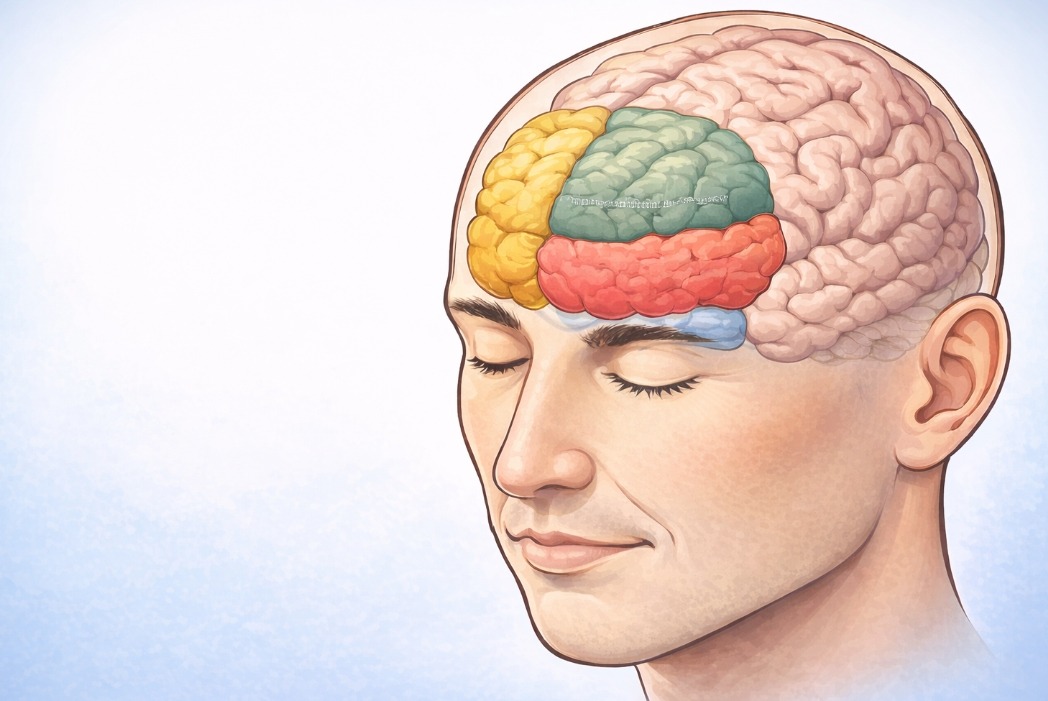
The prefrontal cortex of the brain
That said, adults aren’t safe either. Even participants over 25 showed decreased attention concentration and increased anxiety with high consumption of short videos. It’s just that the effect is many times stronger in teenagers. In other words, if the adult brain gets a figurative “cold” from endless scrolling, a teenager gets a full-blown “flu.”
The researchers emphasize that this isn’t about one or two videos a day destroying your life. The problem lies in systematic, hours-long consumption, when the short video feed becomes the primary way to fill any pause throughout the day.
How to Watch Short Videos Without Harm
All of this sounds rather grim, but there’s no need to panic and delete all apps from your phone. Scientists are not saying that short videos are absolute evil. They’re talking about dose and consumption patterns.
Here’s what researchers and neuropsychologists recommend:
- Set a timer. Most platforms allow you to limit time in the app. Even 30 minutes a day instead of two hours is already a significant step;
- Don’t scroll before bed. Blue screen light and dopamine stimulation before sleep worsen its quality, which amplifies all the negative effects;
- Alternate formats. If after a series of short clips you read an article or watch a long video, the brain gets training in sustaining attention;
- Practice mindful consumption. Try to notice the moment when scrolling stops bringing pleasure and becomes automatic. That is exactly where the harm begins.
The main thing to understand: the problem isn’t with the format itself, but with how algorithms exploit features of the human brain. Short video is perfectly designed so that you can’t stop. Knowing this is already half the solution.
This study is valuable because it moved the brain rot discussion from the realm of memes into the realm of evidence-based science for the first time. 98,000 participants and 71 studies — this isn’t one blogger’s opinion but a serious evidence base. And it says one thing: uncontrolled watching of short videos truly changes how the brain works. Not forever and not irreversibly, but enough to take it seriously — especially when it comes to children and teenagers.