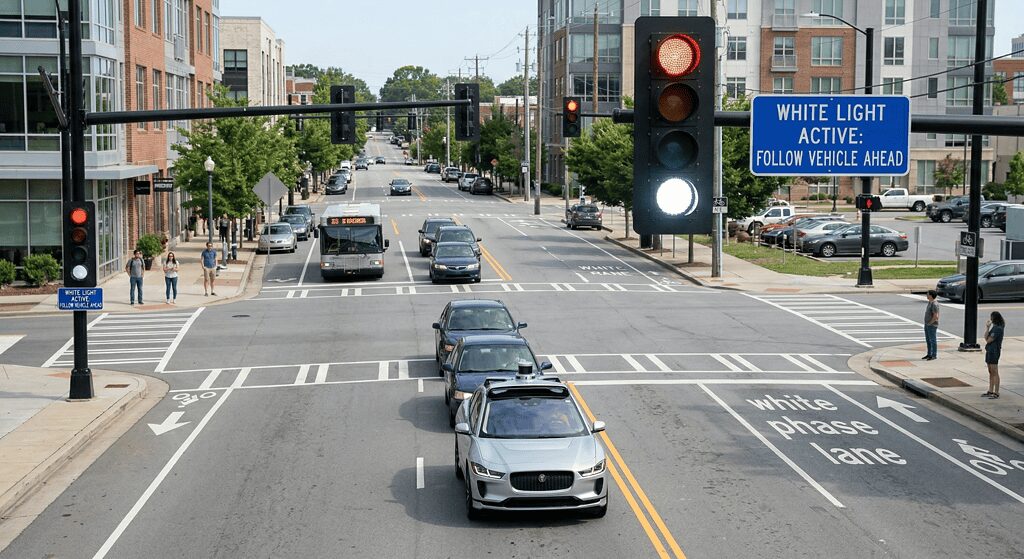
Intersection of the future: a white signal is added to the familiar red, yellow, and green traffic lights. Image source: zmescience.com
Red, yellow, green — this combination hasn’t changed for over a hundred years. But engineers at North Carolina State University believe it’s time to add a fourth color — a white traffic light signal. It is designed for intersections where there are enough self-driving cars for them to coordinate traffic on their own. Regular drivers only need to follow the car ahead when the white signal is on. It sounds like science fiction, but simulations show a reduction in intersection delays of up to 99%.
White Traffic Light Signal: How It Works for Self-Driving Cars
The idea belongs to a team led by Ali Hajbabaie, an associate professor in the Department of Civil Engineering at North Carolina State University. The essence of the concept, which the researchers called the “white phase,” is simple: when a sufficient number of autonomous vehicles approach an intersection, they communicate with each other via wireless networks, agree on the order of passage, and form convoys. At that moment, the traffic light switches to the white signal.
For regular drivers, the instructions are as clear as possible: red — stop, green — go, white — just follow the car in front of you. In essence, self-driving cars take on the role of traffic controllers, effectively reducing congestion, only they do it faster and more precisely than any human. If there are too few autonomous vehicles on the road, the intersection operates under the old scheme — red, yellow, green.
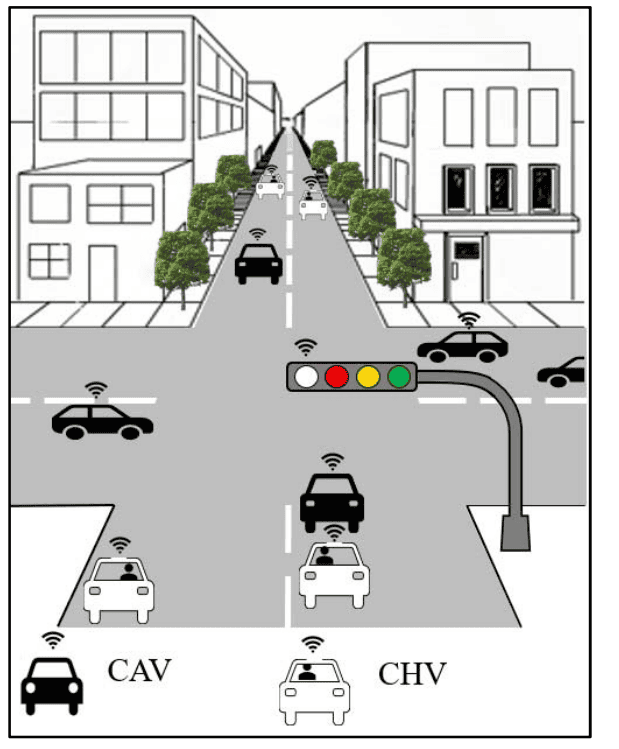
Autonomous vehicles exchange data and jointly decide who passes first. Image source: zmescience.com
How Self-Driving Cars Coordinate Traffic at Intersections
In early versions of the concept, coordination was handled by a central computer installed at the intersection. But what happens if it fails? A traffic jam? An accident? The researchers found a more resilient solution and described it in a paper published in the journal IEEE Transactions on Intelligent Transportation Systems.
Instead of a centralized system, the engineers switched to a distributed computing model. Each autonomous vehicle approaching an intersection acts as a mini-computer. The cars essentially “vote” on the optimal signal switching plan, exchanging data in real time. Imagine a flock of starlings: no single bird is in command, yet the entire flock moves in sync because each one reacts to its nearest neighbors. The distributed “white phase” works in roughly the same way.
“This is both more efficient and less vulnerable to communication failures,” explains Hajbabaie. “If there is a delay or a loss of communication with the traffic light, the distributed approach can still manage the traffic flow.”
The foundation of this “vision” of self-driving cars is lidars, radars, and cameras that capture a picture of the road in real time.
Does the “White Phase” Reduce Traffic Jams and Accidents: Research Results
The researchers tested the concept in complex traffic simulations that accounted for real physics of movement, human reaction times, and decision-making algorithms of autonomous systems. The results were impressive.
The distributed “white phase” reduced intersection delays by 40–99% compared to traditional traffic lights. At the same time, the models recorded not a single near-collision event — neither rear-end nor at trajectory crossings.
Importantly, the effect appears even with a small share of self-driving vehicles in the traffic flow:
- 10% autonomous vehicles — delays decrease by 3%
- 30% autonomous vehicles — delays drop by 10.7%
- The higher the share of self-driving cars, the more noticeable the effect — up to nearly complete elimination of delays
In addition, fuel consumption is reduced: fewer braking and acceleration events mean less pointlessly burned gasoline.
Where Self-Driving Cars Are Already Operating in 2026
It might seem that the discussion about the white traffic light is a matter of the distant future. But the self-driving car industry is developing faster than it appears. Waymo is already expanding its robotaxi service to dozens of cities and completing hundreds of thousands of paid rides weekly. General Motors is testing driverless technology on public roads. According to analyst forecasts, by 2030, there will be more than 125,000 fully autonomous vehicles on the world’s roads.
In Russia, self-driving cars are also actively developing: Yandex is testing its robocars in Moscow and other cities, and commercial autonomous freight transportation is already moving beyond the experimental stage. However, mass adoption of the “white phase” will require not only a sufficient number of autonomous vehicles but also infrastructure modernization — and that is an entirely different scale of challenge.
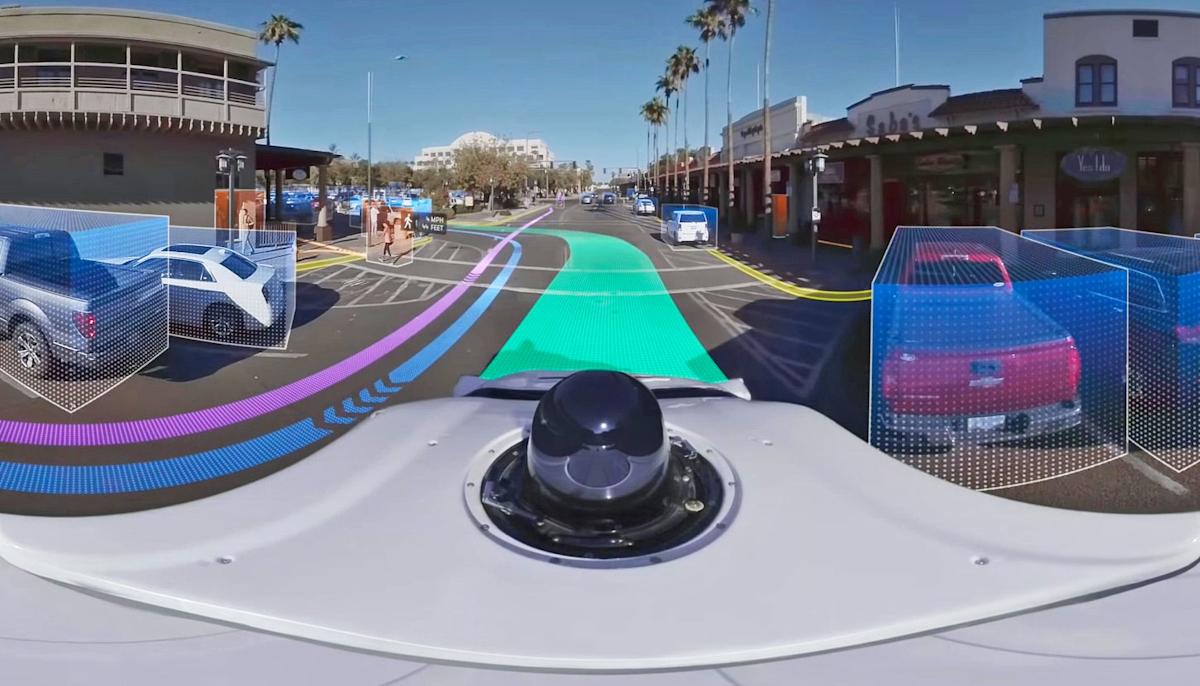
Vision of a self-driving car. Image source: tech.yahoo.com
Where the “White Signal” for Self-Driving Cars Will Be Introduced First
Retrofitting all of a country’s traffic lights simultaneously is unrealistic — the study’s authors themselves understand this. That’s why they propose starting with controlled high-traffic zones where autonomous transport already makes up a significant share of the flow.
The top candidate is seaports and major logistics hubs, where autonomous trucks are already being tested. These locations have a high concentration of commercial transport, and trucks are transitioning to autonomous operation faster than other vehicles. A pilot project at a port would allow testing the concept in real-world conditions without risking the safety of urban traffic.
Hajbabaie notes that certain elements of the “white phase” can be implemented right now — with minimal changes to existing intersections and self-driving software. This is not about an overnight revolution, but about gradual integration.
The fourth traffic light signal is no longer just an engineering fantasy but a well-calculated concept with specific numbers and implementation scenarios. For now, these are simulation results rather than real road tests, and the path from modeling to installing the first white signal at an actual intersection is a long one. But the idea itself shows what road infrastructure could look like in a world where the human behind the wheel is no longer the only participant in traffic, but one of two.