Data can now be stored in ordinary glass. Image: Spiegelau
Imagine that the archives of the entire internet, medical databases, and movie libraries are stored in ordinary glass plates — and remain untouched after ten thousand years. This is exactly what Microsoft has been working on for almost a decade as part of its Project Silica. And recently, the team made an important step forward: the technology is now compatible with borosilicate glass — the very same material used to make kitchen cookware. It sounds like something very unusual, but this is indeed a new way of storing information that is far more reliable than traditional HDDs, SSDs, and even magnetic tapes used for enterprise-grade network storage.
The Best Way to Store Information
This is a fundamental shift. Previously, recording data required expensive fused quartz glass. The transition to an affordable material makes the technology significantly more practical for mass adoption — in medicine, science, the media industry, and storage of datasets for artificial intelligence.
At the core of Project Silica is a femtosecond laser — a tool capable of creating permanent marks directly inside a glass plate. These marks are called voxels: essentially, they are three-dimensional pixels arranged in hundreds of layers throughout the two-millimeter thickness of the glass.
Why Storing Data in Glass Is the Most Reliable
The fundamental advantage of this approach is the physical resilience of the medium. Glass is impervious to water, temperature fluctuations, and magnetic fields, which easily destroy conventional hard drives. The data is literally fused into the material and cannot be accidentally erased or corrupted.

A hard drive seems like a reliable storage method, but after 10-15 years data can be lost irreversibly. Image source: The Verge
The technology’s longevity has been confirmed by accelerated aging tests: samples were “baked” at temperatures up to 290 °C, simulating millennia of storage. The data remained stable. According to the scientists’ calculations, at room temperature, information will be preserved for more than 10,000 years — compared to a maximum of ten years for modern magnetic media.
To read the voxels, the system uses machine learning. Even in the presence of micro-defects, the algorithm recovers data using forward error correction, guaranteeing accurate reproduction of the recorded information.
What Has Changed in Data Storage
The key update, described in an article in the journal Nature, concerns the recording method. The previous approach used birefringent voxels — a two-step process of creating microscopic needle-like structures that alter how the glass interacts with polarized light. The new method — phase voxels — works differently: a single laser pulse slightly changes the physical structure of the glass, affecting the passage of light waves.
This simplifies and reduces the cost of recording and reading equipment. However, neighboring phase voxels have a stronger influence on each other, creating interference during reading. This problem is solved by a machine learning model that accurately decodes data even in the presence of interference.
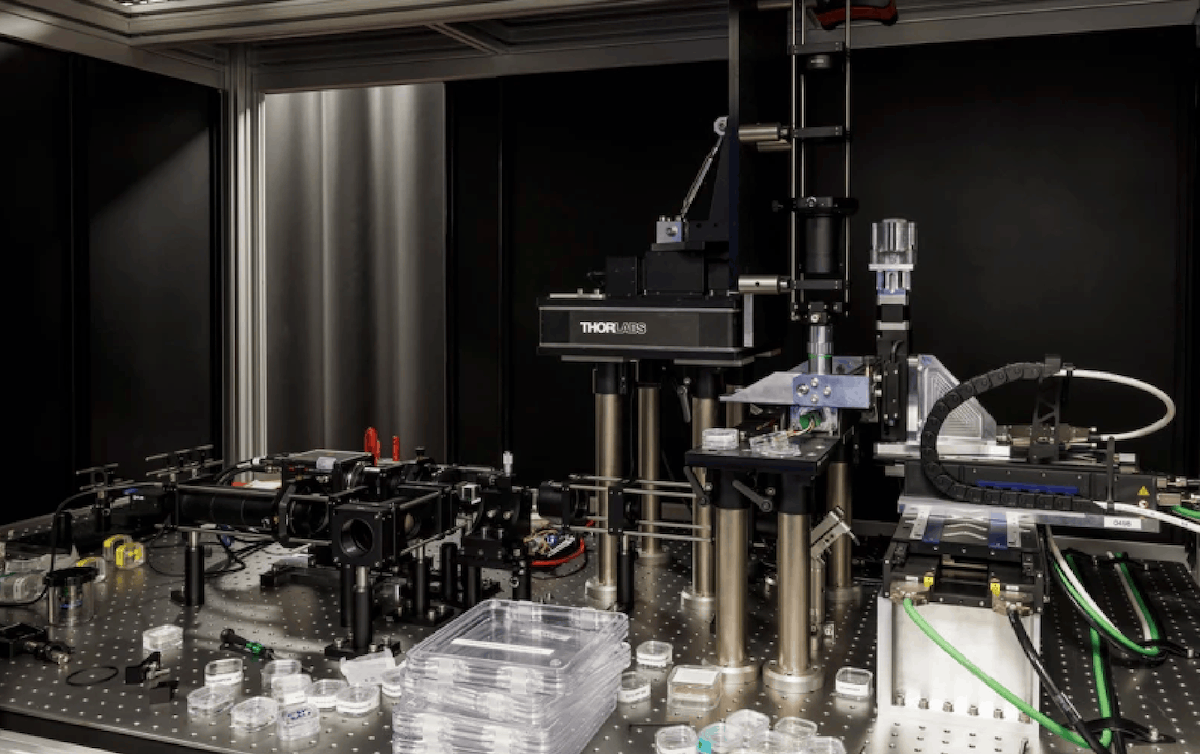
For now, the technology looks quite bulky, but for specialized applications it will be ready quite soon. Image: Microsoft
The capacity of a 120 × 120 mm plate reached just over 2 TB at a writing speed of 18.4 Mbps — somewhat less than the previous version, but at the cost of significantly simplifying the entire system. Additionally, engineers taught the laser to split into multiple beams and write many points simultaneously, while the incidental light flashes during recording are used for automatic real-time calibration of the process.
What Are Glass Data Carriers Needed For
Project Silica looks significantly closer to real-world deployment than many competing long-term data storage concepts. Nevertheless, the path to commercial use has not yet been completed. Issues of recording and data retrieval costs still need to be resolved, as well as developing systems for efficient navigation through zettabytes of data distributed across small glass plates.
Nevertheless, the very idea of storing humanity’s critically important data in a material that will outlast any modern storage medium is no longer the stuff of science fiction. And the availability of borosilicate glass — the same kind used in ordinary kitchen cookware — makes this prospect truly real.