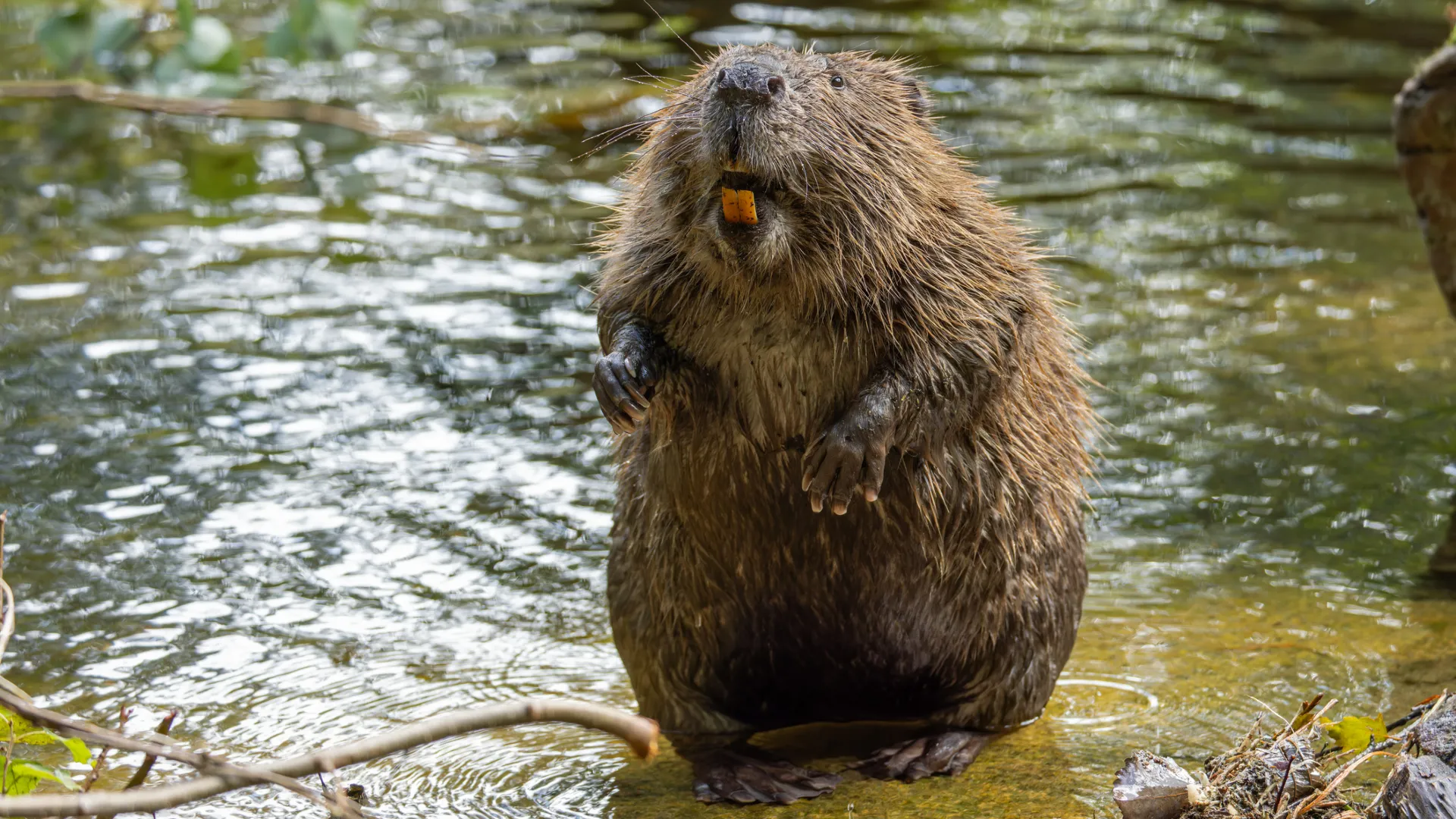
A beaver dam turns a forest stream into a marshy pond — a natural carbon storage
Beavers are among the few animals that deliberately reshape the landscape around them. They fell trees, build dams, and create wetlands. For centuries, people considered this a problem: flooded fields, toppled trunks, eroded banks. But a new study by Swiss scientists shows that beaver dams are also powerful natural carbon traps. And they are so effective that they could become part of a strategy for combating climate change.
How beavers benefit humanity
To understand how this works, you need to picture what a beaver does to a landscape. It blocks a stream with a dam, the water slows down and spreads out, forming a marshy pond. The trees the beaver felled for construction partially remain in the water as dead wood. Instead of a dense forest, an open space with small plants and algae appears around it.
At first glance, it seems like the beaver is destroying an ecosystem. But in reality, it creates a new one — a wetland. And wetlands, as ecologists have long known, are among the most effective carbon stores on the planet. Organic matter — leaves, branches, algae, sediment — accumulates at the bottom in conditions where oxygen is scarce. Without oxygen, decomposition proceeds extremely slowly, and carbon remains “locked” in bottom sediments for decades and centuries.
In essence, the beaver works as an ecological engineer: it slows water, creates conditions for the accumulation of sediments and organic matter, and all of this happens without any human involvement.
How much carbon does one beaver dam absorb
The study, reported by Live Science, was conducted on a stream section just 800 meters long in northern Switzerland. Before 2010, it was an ordinary floodplain with trees. Then Eurasian beavers (Castor fiber) appeared there, built dams, and the area turned into a marshy lowland.
The scientists took a thorough approach to the assessment. They collected samples of bottom sediments and forest soil from the surrounding area, gathered algae samples, measured water flow, salt content, and the amount of transported sediment. They separately calculated the carbon that goes into the atmosphere and the carbon that remains in biomass, dead wood, and bottom sediments.
The result: the beaver wetland turned out to be a net carbon absorber — from 98 to 133 tons per year. For a tiny 800-meter section, this is an impressive figure. According to the U.S. Environmental Protection Agency’s calculator, this is equivalent to burning 830–1,130 barrels of oil. In other words, one small beaver pond offsets emissions from hundreds of thousands of liters of petroleum products annually.
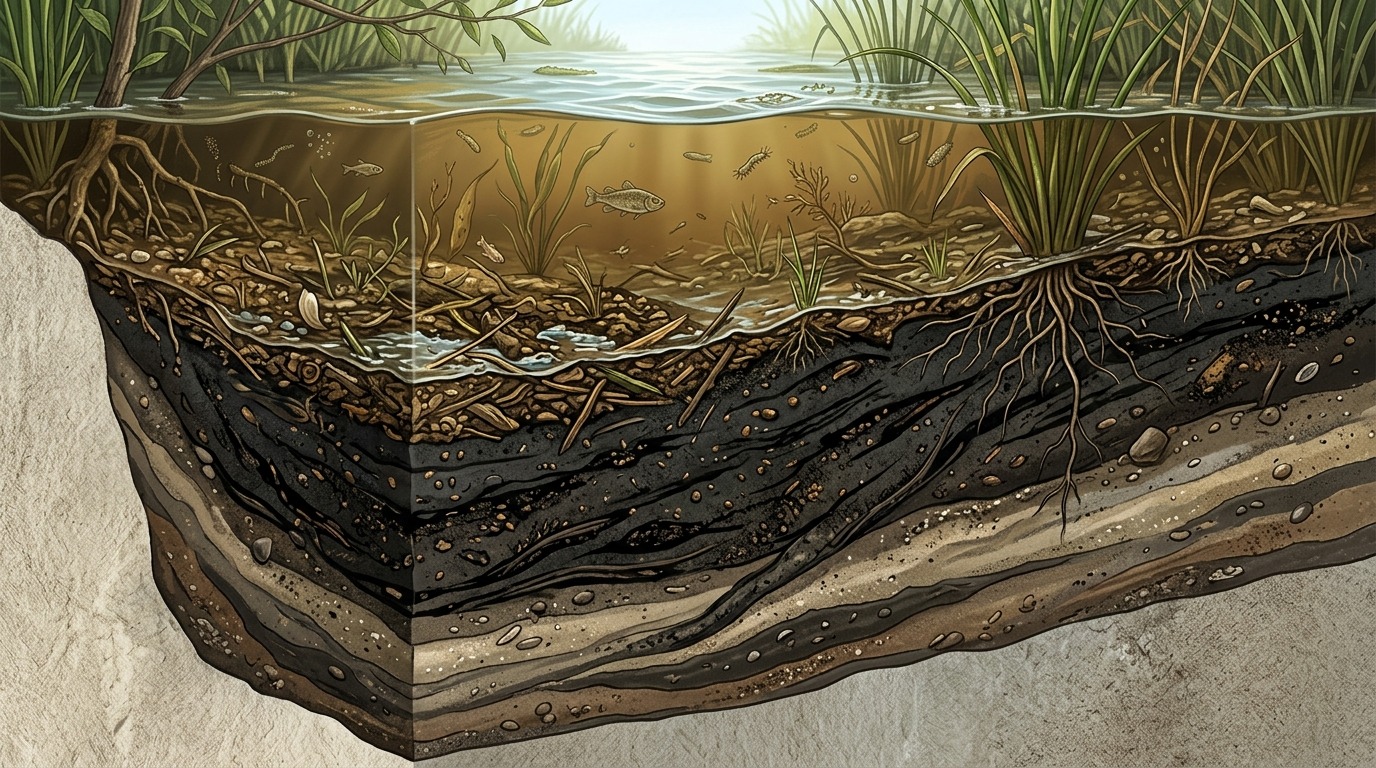
Carbon accumulates in bottom sediments of beaver ponds, where decomposition of organic matter nearly stops
Why beavers were long considered pests
Beavers have a reputation as destructive animals. They fell trees, flood roads, and damage agricultural lands. In Europe and North America, they were hunted for centuries — for fur, meat, and simply to get rid of an “inconvenient” neighbor. By the early 20th century, the Eurasian beaver had been nearly completely exterminated across most of its range.
Along with the beavers, the wetland ecosystems they created also disappeared. And with them, enormous natural carbon reservoirs. Only now, as beaver populations are gradually recovering thanks to reintroduction programs, are scientists getting the opportunity to assess the scale of the losses.
One of the study’s authors references an earlier study in Rocky Mountain National Park in Colorado. There, it was calculated that active beaver territories could account for 23% of all carbon stored in the landscape. Nearly a quarter — from a single animal species. This forces a reconsideration of the conventional view of beavers as “pests.”
How beavers fight global warming
Restoring wetlands and marshlands is one of the recognized strategies for fighting climate change. The problem is that it is expensive and complicated. You need to design a dam system, bring in soil, and control the water regime. Beavers do all the same things for free.
This is truly a powerful tool for supporting wetland restoration. And for reducing skepticism around beavers. People tend to quickly label them as a problem and look for ways to strictly control them. But this study clearly shows: we don’t need to do anything except let beavers be beavers, the researchers note.
Of course, it is too early to scale the results from one Swiss stream to all of Europe or North America. The amount of carbon a beaver ecosystem can absorb depends heavily on local conditions: soil type, vegetation, climate, and the volume of incoming organic matter. The study’s authors directly state that a reliable global estimate is not yet possible.
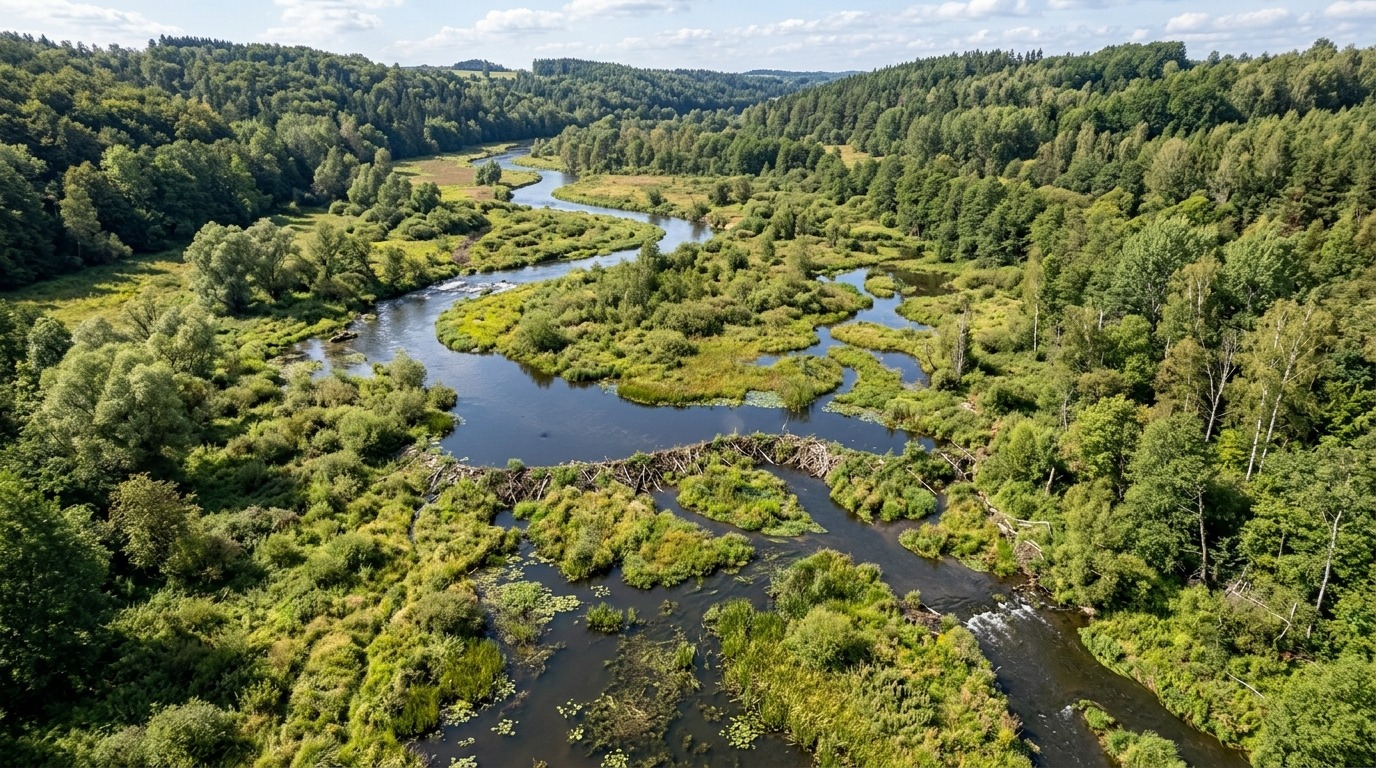
Beaver territories from above — a mosaic of ponds, shallows, and vegetation
The most unexpected way to fight global warming
The study does not claim to be revolutionary. Beaver dams will not solve the problem of global emissions — that requires radically reducing the burning of fossil fuels. But they can become part of a mosaic of nature-based solutions that complement the main measures.
It is also important that this is one of the first studies where the carbon balance of a beaver ecosystem was measured in such detail — accounting for all flows: what is absorbed, what is released, and what remains in sediments. It is precisely this comprehensive approach that allowed the authors to call beaver ponds “sustainable carbon stores” rather than merely theoretical absorbers.
For the average person, the takeaway is simple: sometimes the most effective technologies for combating climate change are not technologies at all, but animals that have been doing what they do best for millions of years. Beavers build dams, create wetlands, and lock carbon in the ground. All we need to do is not interfere — and, perhaps, help them return to the places from which we once drove them away.