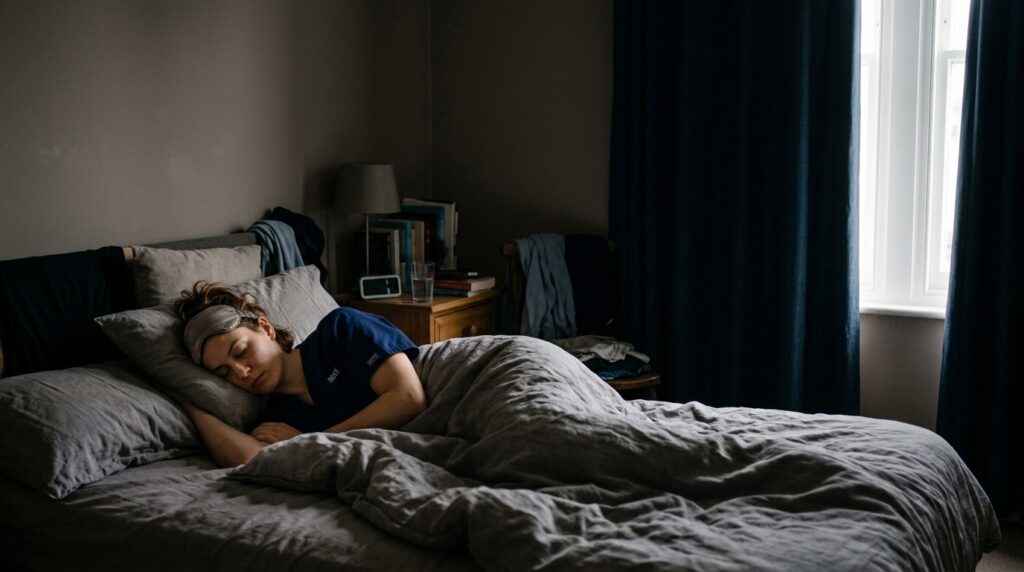
A person sleeping during the day in a darkened bedroom
Night shift workers often get used to their schedule faster than they expect, but their bodies usually do not. Doctors, train drivers, security guards, warehouse staff and round-the-clock retail workers may look and feel normal, yet their internal clocks can stay out of step with their schedules even after years. Research reviewed here links this mismatch with shorter and poorer sleep, weaker attention, higher odds of weight gain, and greater metabolic and cardiovascular risks. Many of these findings are statistical associations rather than proof that night work directly causes disease.
What you need to know
- A 2024 review in the Russian journal Vestnik RAMN found shortened sleep in about 44% of shift workers, compared with 28.8% of day workers.
- The same review cites pooled data showing roughly a 21% higher risk of being overweight and a 16% higher risk of obesity among shift workers.
- The WHO’s International Agency for Research on Cancer classifies night shift work as Group 2A, “probably carcinogenic to humans”, which is not proof that it causes cancer.
- Rotating schedules that jump between day, night and morning shifts are described as harder on the body than steady night work.
The internal clock behaves as if in permanent jet lag
The body runs on a biological clock that, roughly once a day, shifts body temperature, blood pressure, hormone levels, sleepiness, appetite, and gut and immune function. Its main cue is light. During the day, light entering the eyes tells the brain to be active; at night, darkness helps the body produce melatonin, the sleep hormone.
For a night worker, these signals constantly conflict. The schedule says work while the internal clock says sleep. In the morning the reverse happens: the person heads home to rest just as sunlight wakes the brain up. The result is chronic jet lag without any flights. Doctors call this desynchronosis, meaning the body’s processes run out of step with the person’s life.
Daytime sleep tends to be shorter and worse
Eight hours of daytime sleep may seem equivalent to eight hours at night. In practice, sleep after a night shift is usually shorter and of lower quality, even without interruptions. A review by Russian professors published in Vestnik RAMN in 2024 found shortened sleep in about 44% of shift workers and in 28.8% of day workers.
For people working three-shift rotations, the risk of sleep disorders was estimated at about 2.19 times that of people on a permanent day schedule. This explains a frustrating paradox: someone can sleep for a long time during the day and still wake up feeling unrested.
The body may not adapt even after years
The initial discomfort of switching to shifts may ease within about a week. However, Russian sleep specialists note that full physiological adaptation sometimes fails to occur even after many years of shift work.
Days off are one reason. A worker may sleep from 9 a.m. to 4 p.m. all week, then want to spend daytime with family on a day off and go to bed at night. Then the next night shift arrives and the internal clock is pulled back again. This is why irregular schedules that mix day, night and morning shifts are especially hard to tolerate.
Attention, memory and reaction time decline at night
During the deepest hours of the biological night, the body is most strongly geared toward sleep. Attention, reaction time, memory, movement precision, sustained concentration and decision-making all deteriorate. In Russian studies, workers made more mistakes the longer their shift lasted. There is even a specific diagnosis, shift work sleep disorder, which involves insomnia, poor recovery and severe sleepiness precisely when a person needs to be awake.
In 2023, Russia’s National Medical Research Center for Therapy and Preventive Medicine reported on a study in which memory and thinking were most impaired among people with experience of night work: their odds of such impairment were about 1.79 times higher. This is an observational finding, not proof of cause, and it does not mean night shifts will inevitably lead to dementia.
Microsleeps toward morning are dangerous on the road
By the end of a shift, a person is fighting both accumulated fatigue and their own internal clock. This is when microsleeps can occur: lapses lasting a few seconds that the person may not even notice.
The most dangerous scenario is working all night and then driving straight away. A review from a Russian occupational medicine research institute cites studies linking sleep problems in shift workers with higher risks of injuries, wrong decisions and drowsiness-related accidents. After a hard night, a person may drive noticeably worse than they think.
Irritability and anxiety tend to rise
Night work does not turn someone into a different person, but chronic fatigue changes behavior. Patience shrinks, concentration gets harder, the desire to socialize fades and small things become more irritating. The WHO lists working at unsociable hours, long shifts and inflexible schedules among risk factors for mental health.
In a Russian study of 159 students, even irregular shift work was associated with higher anxiety, emotional instability, a shift in morning levels of the stress hormone cortisol, and worse sleep habits. The study is small and does not prove personality change, but it suggests the direction in which such a schedule acts. A feeling that things which never used to bother you now do after a few months of nights is therefore understandable.
Life starts happening without friends and family
Most people live by day: families are awake, children want attention, shops and offices are open, friends meet in the evening. During those hours the night worker wants to sleep and must choose between proper sleep and a normal life. Sleep medicine reviews explicitly list family and social problems among the consequences of shift work.
That choice adds to fatigue. For example, someone finishes work at 7 a.m., sleeps only four hours because of daytime errands, and goes back to work that evening. At that point the problem is not only the internal clock but ordinary chronic sleep deprivation.
Weight gain becomes easier
Several factors combine. Daily hormonal rhythms are disrupted, as is tissue sensitivity to insulin, the hormone that helps the body use sugar. People eat at hours when the body expects almost no food, control appetite less well after poor sleep, and find high-calorie food more appealing than salad when tired.
The Vestnik RAMN review cites a pooled analysis of many studies: shift workers have about a 21% higher risk of being overweight and a 16% higher risk of obesity. Rospotrebnadzor, Russia’s public health and consumer protection agency, also describes night work combined with night-time eating as a factor contributing to obesity and type 2 diabetes. Hence the typical night-shift menu: coffee, sweets, energy drinks and a sandwich at 3 a.m.

A worker eating a sandwich in a break room under fluorescent lighting
The body handles sugar less well
Internal clocks are not limited to the brain. The liver, pancreas, fat tissue and other organs have their own daily rhythms. When food, light and activity keep arriving at the “wrong” time, these organs coordinate with one another less effectively.
Russian medical literature links night and shift schedules with a higher risk of type 2 diabetes: when rhythms are disrupted, the body produces insulin less effectively and tissues respond to it more weakly. This is an increased probability, not a verdict; working nights does not mean a person will necessarily get sick.
Blood pressure and the heart run off schedule
In a healthy person, blood pressure usually dips slightly at night. If that person is working under bright lights in a factory, hospital or train cab, the rhythm is disrupted. According to a review of 45 studies involving more than 117,000 people, permanent night work is associated with an average rise in systolic pressure of about 2.5 mmHg and in diastolic pressure of about 1.8 mmHg. For an individual this is small, but over many years and across a whole population such figures matter.
Large observational studies find more cases of coronary heart disease, in which the heart muscle does not get enough blood, among people with long histories of night work. The link is especially noticeable after 10 or more years. However, night shifts act alongside smoking, excess weight, heredity and hypertension, so no specific heart attack can be attributed to night work.
Digestion falls off its timetable
Digestive enzyme production, gut activity and hunger all change over the course of the day. If “lunch” happens at 3 a.m. and “breakfast” at 8 a.m. right before bed, food arrives when the body is not ready for it.
Shift workers more often report heaviness, indigestion, appetite disturbances and bowel problems. Russian sleep specialists note that stomach and intestinal diseases can appear or worsen in this group. The problem is not just instant noodles at night: even a healthy meal in the middle of the night reaches the body at an unusual time.
Menstrual cycles may be disrupted
Many studies have been conducted among women, including medical workers, for whom night shifts are routine. A review by Russian specialists describes a link between night work and irregular cycles, as well as elevated risks of certain reproductive disorders.
This is a statistical association, not a guaranteed outcome. Age, occupation, stress, physical workload and other working conditions all affect the results. Claiming that night work will make a woman infertile would be a clear exaggeration; it is more accurate to describe it as a possible additional risk factor.
Night shifts and cancer: a probable link, not a proven cause
The WHO’s International Agency for Research on Cancer classifies night shift work as Group 2A, meaning probably carcinogenic to humans. This does not mean night shifts cause cancer; the category indicates serious grounds to consider a link possible. Human data remain limited, while experimental evidence and understanding of a possible mechanism are stronger. Breast, prostate and colorectal cancers are the most frequently studied.
The hypothesis is that night-time light disrupts the melatonin rhythm and desynchronizes internal clocks, which may affect gene activity, immunity, inflammation and DNA repair. But these data cannot be used to calculate a personal risk such as “20 years of shifts adds a certain percentage”: the studies differ too much in occupations, schedules and numbers of nights worked.
Erratic schedules are worse than steady nights
If someone works only nights and keeps roughly the same routine on days off, the body at least receives a predictable signal. A pattern of “two days, two nights, days off, then mornings again” forces the internal clock to readjust constantly. The WHO advises that if rotating shifts cannot be avoided, they should move forward in order: day, evening, night. Going to bed a little later than usual is easier for the body than falling asleep much earlier. Risks also grow when many night shifts are worked in a row, rest between them is short, and the work continues for years.
Night owls do find night work easier than early risers, but humans remain daytime creatures. Enjoying going to bed at 2 a.m. is not the same as regularly working from midnight to 8 a.m. under bright light. The authors of the Vestnik RAMN review observed that relatively few extreme owls or larks remain in shift work long term. This may reflect a kind of selection: those who cannot tolerate the schedule leave early. So a story of “twenty years of nights and I’m fine” may be true, but not everyone can repeat it.
How to make night work less harmful
If there is no alternative, the goal is not a miracle pill but minimizing disruption to the internal clock. The main principles are protecting sleep and keeping the schedule as predictable as possible:
- sleep after a shift in a dark, quiet and cool room; blackout curtains, a sleep mask and muted notifications can help;
- avoid completely flipping your routine on every day off;
- if shifts rotate, move them in the order day, evening, night;
- avoid having your heaviest meals at night;
- drink coffee in the first half of the shift so it does not interfere with sleep in the morning;
- press your employer for reasonable shift lengths, breaks and sufficient rest between shifts, an issue the WHO also highlights.
Catching up on sleep at weekends helps, since some accumulated sleepiness does go away. But one long Saturday sleep will not turn a five-hours-a-night routine into a healthy one. According to Rospotrebnadzor, adults generally need 7–9 hours of regular sleep, and the key word is “regular”. Melatonin and other remedies are not straightforward either: a Cochrane systematic review rated the evidence for many popular interventions against sleepiness in night workers as low or very low quality. Feeling that a remedy helped does not prove it works, as the placebo effect shows.
People adapt to nights faster than their bodies do
The harm of night shifts is not just about late bedtimes. The body is made to eat, think, move and handle stress during hours when dozens of internal systems expect sleep, and then to sleep when light and the biological clock have already switched to daytime mode. Over time, a person may sleep worse, tire faster, become more irritable, concentrate less well and gain weight more easily. With long experience, metabolic and cardiovascular risks rise statistically, while links to cancer and reproductive disorders are still being studied and cannot be called an inevitable cause.
The paradox is that after a few years a person may feel everything is fine even though their internal clock never became nocturnal. Feeling well after a shift does not mean the schedule has no effect on health. For anyone working nights long term, it is worth building protected sleep and a predictable schedule around the job.