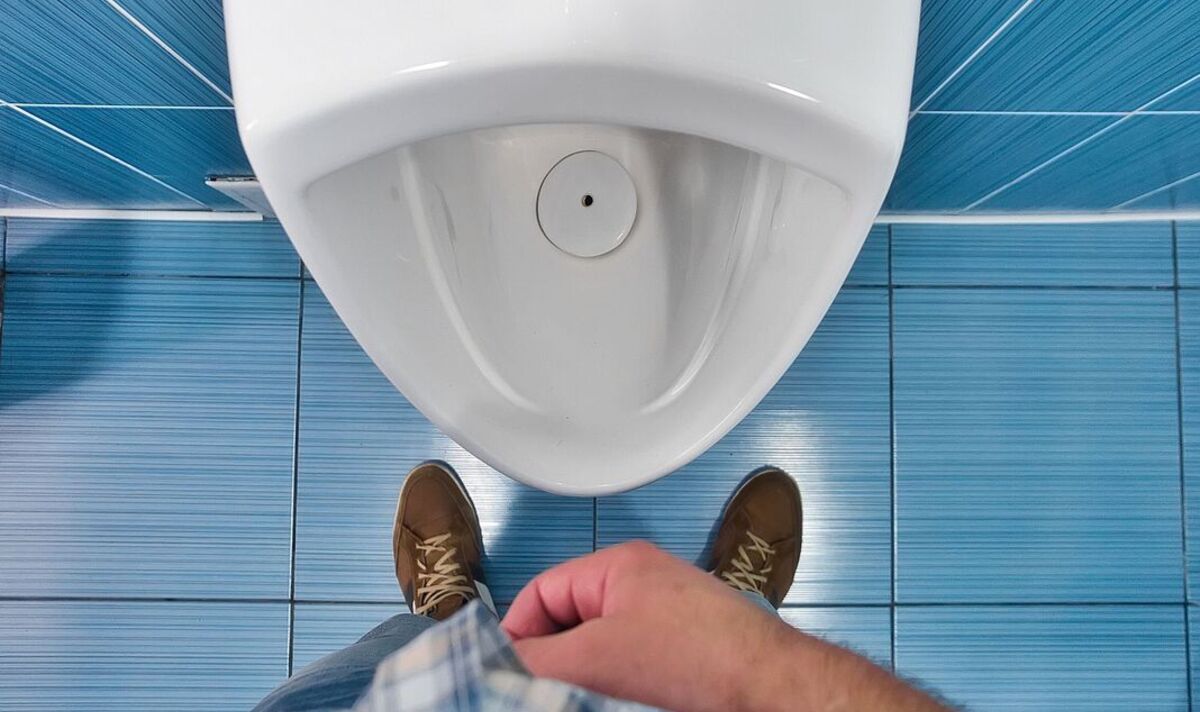
You might be urinating incorrectly and not even know it.
Scientists from different countries — from physicists to urologists — have seriously studied how men should use the toilet: standing or sitting. It sounds like a trivial everyday matter, but behind this topic lies real data about bladder health, the prostate gland, and even the physics of splashing. You might be urinating incorrectly and not even know it. So let’s look at what science says and who really should reconsider their habits.
Standing or Sitting: How Posture Affects Urination
The key study on this topic is a 2014 meta-analysis published in the journal PLOS One. Its authors from Leiden University (the Netherlands) analyzed 11 scientific papers and data from about 800 participants from different countries. The scientists compared three key urination parameters — maximum flow rate, bladder emptying time, and residual urine volume in the bladder — in the standing and sitting positions.
The result was unexpected: in men with lower urinary tract symptoms (LUTS), the sitting position was associated with a more favorable urodynamic profile: higher flow rate, lower residual volume, and shorter urination time compared to standing. However, in healthy men, the meta-analysis results showed no differences in any of the measured urodynamic parameters.
Simply put: if you're young and healthy — there's no real difference. But with age, the situation changes, and sitting can become a serious advantage.
Why It’s Better to Urinate Sitting Down with Prostate Enlargement
In men over 50, benign prostatic hyperplasia (prostate adenoma) often develops — a condition in which the prostate gland enlarges and begins to compress the urethra. This leads to a weakened stream, frequent urges, and the sensation that the bladder hasn’t fully emptied.
In these patients, residual urine volume in the sitting position was significantly lower — 25 ml less than when standing. You might think 25 ml is nothing. But it’s clinically important because urine retention can lead to complications — cystitis and bladder stones.
When a man stands, the pelvic floor muscles are in a different state and require more effort. In the sitting position, these muscles relax, making urination more efficient. A simple analogy: imagine you’re trying to squeeze a sponge by clenching it in your fist — that’s urination standing up with tense muscles. But if you simply place the sponge down and press from above — the liquid flows out more freely. That’s roughly how pelvic floor relaxation works in the sitting position.
Men over 50 should pay particular attention to their urination posture
The meta-analysis authors emphasize that the effect of posture on urodynamic parameters in patients with LUTS is comparable in magnitude to the effect of medications. In other words, a simple change in position can produce an effect analogous to taking alpha-blockers — drugs prescribed for problems with urine flow.
Why Splashing Occurs When Urinating Standing Up
Beyond urology, physicists have also tackled this topic. A team from the Splash Lab at Brigham Young University (BYU) studied the physics of urine splashing. They found that urinating while sitting produces minimal splashing because the distance to the water is significantly shorter.
The key phenomenon that makes standing urination so “messy” is the so-called Plateau-Rayleigh instability. Because of it, the urine stream breaks up into individual droplets approximately 15 centimeters from the urethra. Each such droplet, upon hitting a surface, creates its own little fountain of splashes.
When a man stands, he is approximately five times farther from the water than when sitting — and avoiding splashing in that case is virtually impossible. In public restrooms, the problem is further compounded by flushing, which launches microdroplets containing bacteria into the air. The researchers filmed the entire urination process with high-speed cameras and came to an unequivocal conclusion: sitting is the “cleanest” option from the standpoint of physics.
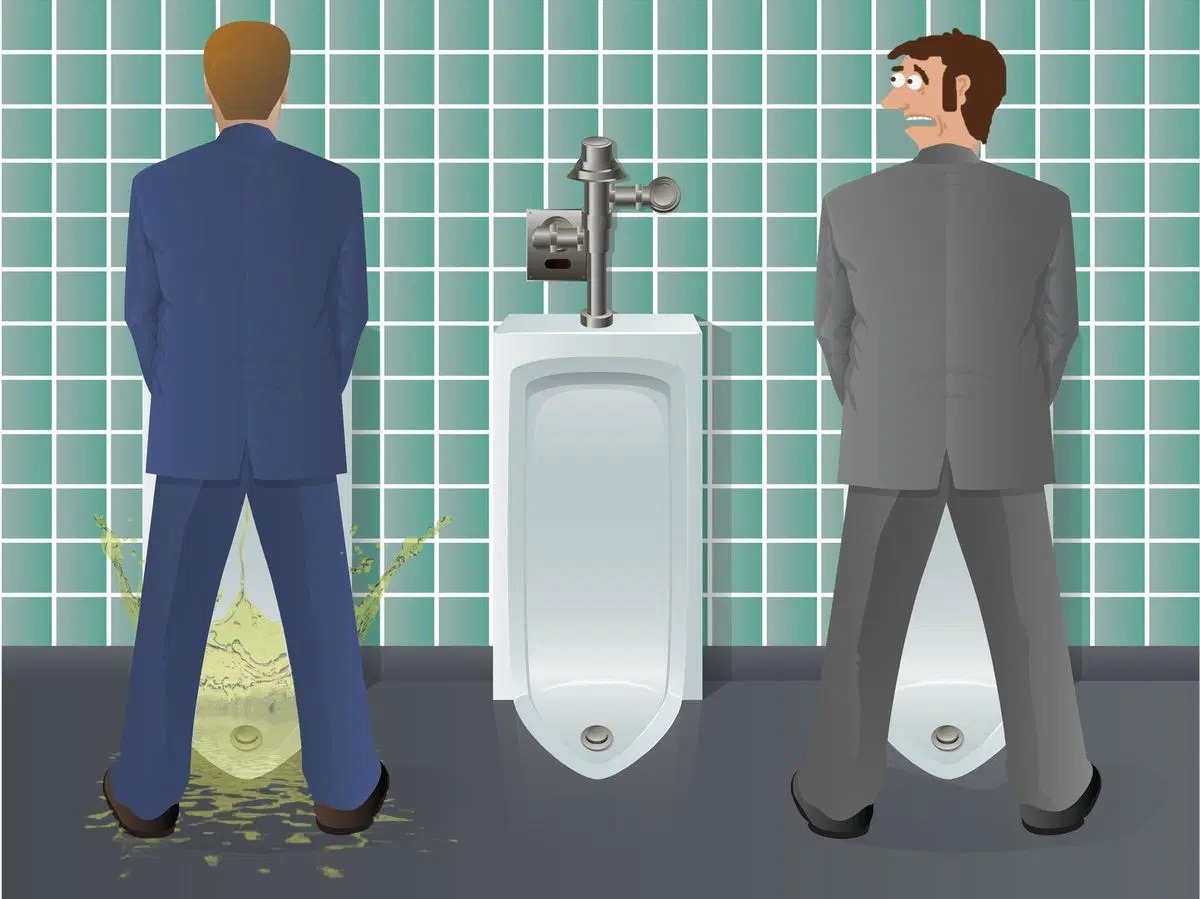
Have you ever noticed there’s less splashing if you lower a hose into a bucket rather than swinging it like a lasso from a significant height? Image source: wishescards.ru
If standing is still more comfortable for you, the BYU scientists offer several tips:
- stand as close to the toilet or urinal as possible;
- aim the stream at the back wall at a shallow angle;
- aim at the porcelain, not the water — this makes the process less chaotic.
Why Urinating Standing Up Is Considered Normal for Men
In many Western cultures, urinating while standing is perceived as something self-evident for men. However, habits vary geographically: in most Western countries, the standing position is common, while in Eastern and Asian countries, men more often urinate sitting or squatting.
According to 2023 data, in the US 23% of men always or almost always urinate sitting down, in the UK — 24%, and the highest percentage is in Germany — 62%. Interestingly, in the German language there exists the derogatory word Sitzpinkler — “one who sits down to urinate” — which is used as a taunt.
In male “toilet culture,” the stereotype persists: urinating standing up is manly. Many men don’t sit down even when it’s uncomfortable or painful, simply because “that’s how it’s done.” Paradoxically, this stereotype can harm health — especially for those who would genuinely benefit from the sitting position.
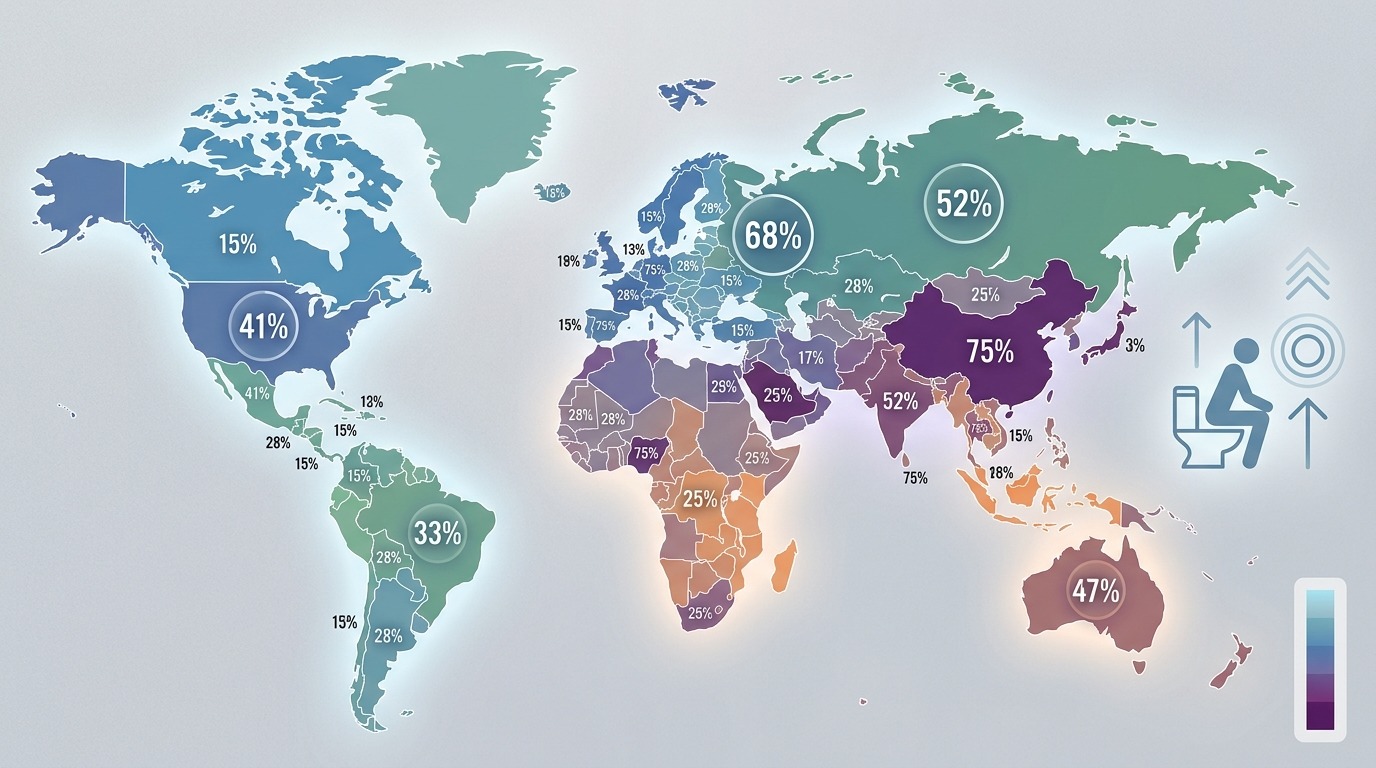
The percentage of men who prefer to urinate sitting down varies greatly across different countries
Standing or Sitting: What Is Actually Healthier According to Science
It’s important to honestly outline the limits of what science currently knows. The 2014 meta-analysis concluded that the sitting position is the better option for men with urination problems (for example, due to an enlarged prostate), while no difference was found for healthy men.
The authors explicitly state: for healthy men, the debate about posture cannot be resolved based solely on urodynamic arguments. This means that for young and healthy men, the choice of posture is a matter of comfort and hygiene, not medical necessity.
However, there’s a nuance. In men over 50, after urinating while sitting, nearly 30 ml less urine remained compared to standing — regardless of whether they had lower urinary tract symptoms. At the same time, older men urinated longer while sitting, yet the authors still concluded that for people over 50, urinating while sitting is a better option.
From a hygiene perspective, the physics is clear: the sitting position reduces splashing to a minimum. And the most common reason men start urinating while sitting is the desire to maintain cleanliness in the bathroom (54.5% of respondents).
So, the answer to the main question depends on who is asking it. For young and healthy men, any position will do — it’s a matter of personal comfort and respect for bathroom cleanliness. But for men with age-related prostate problems, weak flow, or a sensation of incomplete emptying, the sitting position is not a compromise but a medically backed recommendation supported by research. And there is certainly nothing “unmanly” about it.