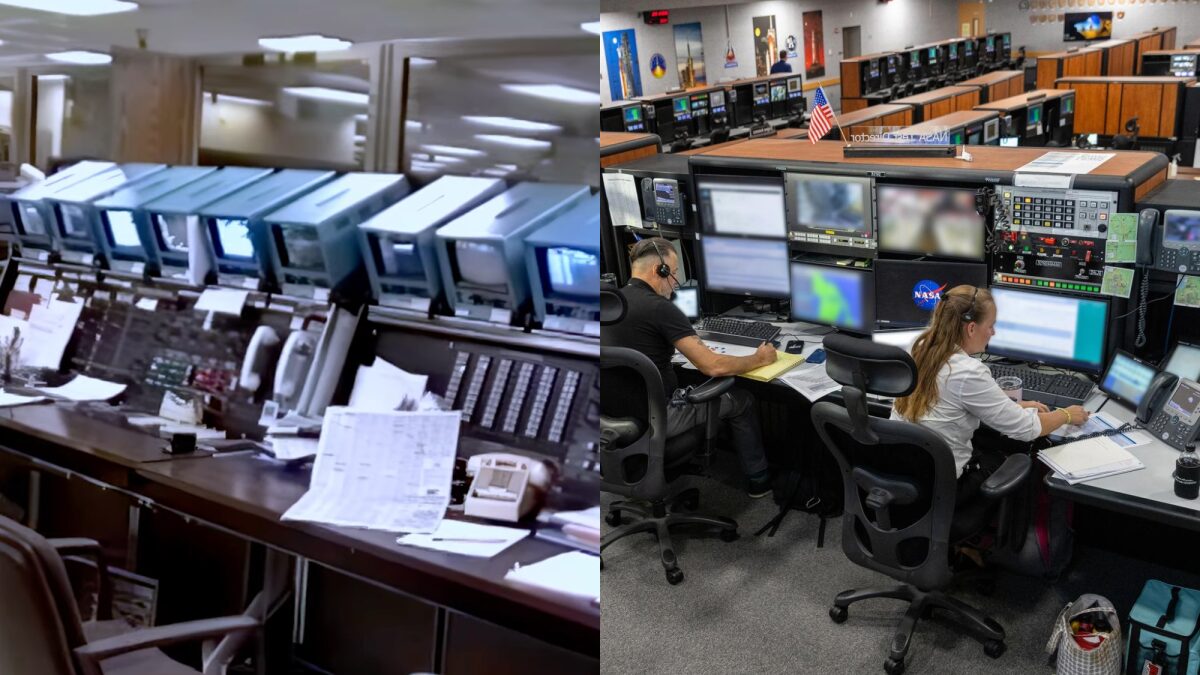
Voyager Mission Control Center in the 1980s (left) and Artemis Mission Control Center in 2026 (right). Image source: popsci.com
The Voyager probes, launched by NASA in 1977, run on onboard computers with a total memory of 69 kilobytes. That’s less than a single JPEG image on your smartphone! These spacecraft have already crossed the boundary of the Solar System, traveled 25 billion kilometers from Earth, and continue to transmit scientific data. While the whole world was watching the launch of the Artemis 2 mission in early April 2026, we suddenly remembered that modern space exploration stands on the shoulders of technology that looks like a museum exhibit.
What Computers Are Installed in the Voyager Probes
According to Popular Science, each of the two spacecraft, which are at a record distance from Earth, carries three onboard computer systems: the Computer Command System (CCS), the Flight Data Subsystem (FDS), and the Attitude and Articulation Control System (AACS). The computers worked together to ensure the probes’ journey to Jupiter, Saturn, and beyond. Each system has a backup copy, meaning there are six computers per probe in total.
The total memory of all onboard computers is just 69.63 kilobytes — less than a standard JPEG file. The Voyager computers process about 8,000 instructions per second, while a modern smartphone handles over 14 billion. The memory is stored using magnetic wire technology, a predecessor to magnetic disks, which records bits as magnetic domains on wire coated with an iron-nickel alloy.
Scientific data is recorded on a digital 8-track tape recorder and then transmitted to Earth. The transmission speed is 160 bits per second. To put that in perspective, even a slow dial-up modem transmitted at least 20,000 bits per second. There is so little memory that the probes constantly overwrite old data with new data as soon as the old data has been sent to Earth.
How the Voyager Probes Survive in Space
Both Voyagers have long outlived their five-year design mission. Voyager 1 reached the boundary of the heliosphere and entered interstellar space in 2012. Voyager 2 crossed this boundary in 2018. No other human-made spacecraft has ever operated in interstellar space!
The secret to their longevity lies in the engineering philosophy of redundancy. All onboard systems were originally duplicated, and the designers deliberately chose proven, radiation-resistant components over the fastest ones. JPL engineers directly powered the CMOS memory of the Flight Data Subsystem from the radioisotope generators, bypassing the main power bus, so that even a brief glitch wouldn’t erase the memory contents.
Both spacecraft are powered by Radioisotope Thermoelectric Generators (RTGs) — devices that convert heat from the decay of plutonium-238 into electricity. At launch, the generators produced about 470 watts, and now they operate at roughly two-thirds of their original capacity, losing about 4 watts per year. To stretch the remaining energy, NASA has been sequentially shutting down onboard instruments.
Where Are the Voyagers in 2026
As of March 2026, Voyager 1 is at a distance of 172.59 astronomical units (25.8 billion kilometers) from Earth — it is the most distant human-made object. Voyager 2 is approximately 21.3 billion kilometers away, in the constellation Pavo. A signal to Voyager 1 takes about 23.5 hours one way. And around November 15, 2026, Voyager 1 will become the first spacecraft from which light takes exactly one day to reach — one light-day.
In early 2025, NASA had to make serious decisions about energy conservation. JPL engineers shut down the cosmic ray instrument on Voyager 1 on February 25, and the low-energy charged particle detector on Voyager 2 on March 24. Three scientific instruments continue to operate on each probe.
Under the current energy-saving plan, engineers believe both probes can continue operating with at least one scientific instrument into the 2030s. This means that technology designed before the advent of personal computers could operate for more than half a century in the harshest conditions imaginable.
How Orion’s Computers Differ from the Voyager Systems
The contrast between the Voyagers and the Orion spacecraft, which launched on April 1, 2026, from Kennedy Space Center for a ten-day flight around the Moon, is almost absurd. According to Lockheed Martin, Orion’s computing power is 20,000 times greater than that of the Apollo computers and 25 times greater than the systems on the International Space Station. Its onboard computers communicate with the avionics via Gigabit Ethernet — a technology familiar to any home router.
All systems aboard Orion have triple redundancy, whereas on the Voyagers, many backup components have long since failed or been shut down to conserve energy. But the very fact that 1977 technology still works speaks to the quality of that era’s engineering solutions no less than the newest systems speak to progress.
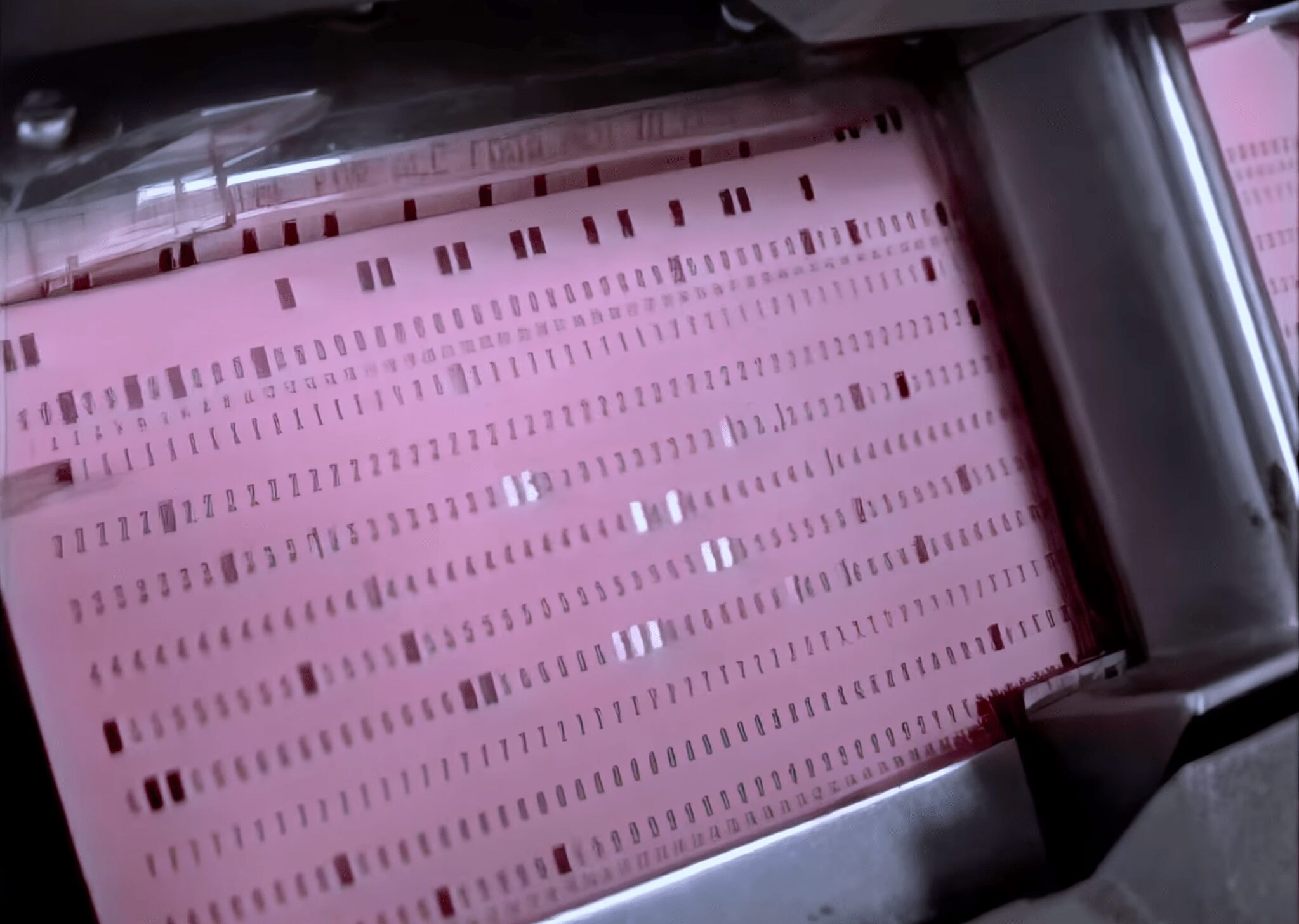
To “communicate” with the Voyager’s onboard computer systems, engineers had to use a punch card system. Image source: Popular Science
Why the Voyager Spacecraft Are Important for Science
The Voyagers continue to collect data that cannot be obtained any other way. The remaining instruments allow both probes to function as a kind of weather station in interstellar space, measuring the environment through which they fly. Scientists are particularly interested in how the Sun’s magnetic field interacts with the interstellar medium at the boundary of the heliosphere.
The probes have measured stronger-than-expected interstellar magnetic fields, a hot plasma boundary at the heliopause with temperatures of 30,000–50,000 K, and increasing intensity of galactic cosmic rays — data that no other instrument can provide.
When the Voyagers finally go silent, they will continue to fly. Aboard each one is the famous Golden Record containing recordings of Earth’s sounds, music, and images — a message for any civilization that might someday find them. On their current trajectories, each probe will be approximately 1.7 light-years from another star in about 40,000 years.
But as long as they are alive, those 69 kilobytes of memory and 160 bits per second are humanity’s only window into the space between stars. And the fact that this window remains open is perhaps one of the most impressive achievements of engineering thought in history.