
For reproduction to succeed, flowers must bloom exactly when pollinators wake up
Daffodils bloom in early spring, hydrangeas in summer, and chrysanthemums wait for autumn’s chill. It turns out that plants use a complex system of molecular sensors for light, temperature, and internal clocks to bloom at the most favorable moment for their offspring’s survival. All these numerous signals ultimately converge on a single protein that travels to the shoots and gives the command to begin forming buds. So, are you ready to learn something new about flowers?
Why Do Plants Need Flowers
According to Science ABC, flowering is not just an aesthetic process but a crucial stage of reproduction. Plants spend an enormous amount of energy and internal resources on it. Their main goal is to mix their genes with those of other members of the same species, form fruits, and disperse seeds.
Since plants cannot move in search of a partner or shelter from bad weather, they are entirely dependent on their environment. For the reproduction process to succeed, two main factors must align:
- When buds open, pollinating insects must be present in nature;
- By the time fruits ripen, weather conditions must be suitable for their survival and seed germination.
This is precisely why the first step — flower initiation — must occur at a strictly defined time. Plants do not rely on chance but constantly read a whole complex of external and internal signals.
For example, a few warm days in the middle of winter won’t fool a rose or an apple tree. They won’t decide that spring has suddenly arrived because their internal systems will register that daylight hours are still too short.
How Day Length Affects Plant Flowering
One of the main indicators of seasonal change for most species is the photoperiod, or day length. Although botanists historically divide species into “short-day” and “long-day” plants, the actual mechanism works slightly differently. In reality, plants don’t measure the length of the day but rather the duration of uninterrupted darkness.
For example, chrysanthemums bloom in early spring or autumn — they respond to long nights. Strawberry varieties harvested in summer, on the other hand, produce buds in response to short summer nights and long days.
Beyond the duration of light exposure, its composition is also extremely important. Plants assess light quality using a special pigment called phytochrome. It exists in two forms and works like a biological switch:
- The inactive form absorbs red light (which predominates in direct sunlight) and converts into the active form. This stimulates flowering in some species.
- The active form absorbs far-red light. In nature, plants often receive this spectrum when growing in the shade beneath tree canopies (neighboring leaves absorb regular red light). In response, the plant begins actively stretching upward to escape the shade, postponing flowering for later.
Chemical Signals in Plants
Light is not the only factor that the bud development mechanism relies on. Internal chemical signals — phytohormones — play an important role. For example, gibberellins promote the onset of flowering in long-day plants. Farmers actively use this property in practice. When growing lettuce in California, producers deliberately spray crops with gibberellins to stimulate bud formation and obtain more seeds. Interestingly, in some species such as citrus trees, these same hormones have the exact opposite effect — they suppress flowering.
Another important mechanism is the response to cold, known in botany as vernalization. Some species must endure harsh winter temperatures to prepare for spring flowering. The plant must spend a strictly defined minimum amount of time in the cold. Only after this, when temperatures rise again in spring, will it produce flowers. A typical example of this mechanism is sugar beet.
But what happens if a plant is waiting for ideal conditions that never arrive due to climate anomalies? For this scenario, there is an “autonomous pathway.” If external signals are absent for too long, the plant will bloom anyway to fulfill its evolutionary duty and leave offspring, even in a less-than-ideal environment.
The use of plant hormones helps farmers control the flowering time of agricultural crops
How Genes Participate in Plant Flowering
Although different species use different pathways to trigger flowering (evaluating light, temperature, or hormone levels), all these processes ultimately converge on two genes — FT and SOC1. These are the ones that control a plant’s transition from a state of regular growth to a state of flowering.
Back in 1937, Soviet biologist Mikhail Chailakhyan proposed the hypothesis of florigen — a special mobile flowering signal. He suggested that this signal carries a chemical message from the leaves to the shoot tips where buds form. In 2007, scientists finally confirmed this hypothesis, discovering that florigen is the FT protein produced by the gene of the same name.
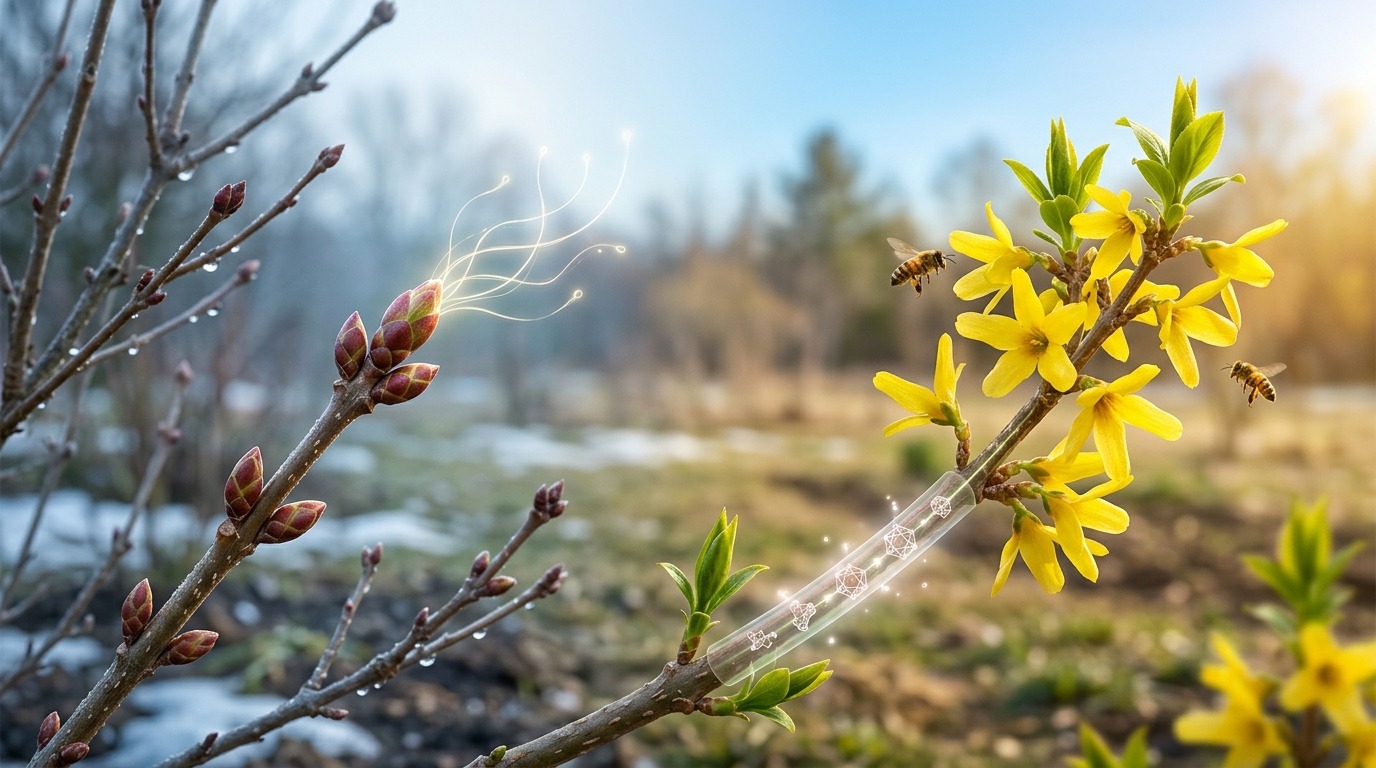
Here’s how it works: all signaling pathways (data about day length, light quality, completed vernalization) send information to the FT protein in the leaves. When the protein receives confirmation that the time has come, it physically moves to the shoot tip. There, a flower bud forms, and the plant prepares to bloom.
Since plants are immobile, they must cope with whatever environmental conditions exist where they have taken root. This is precisely why nature has created such a complex genetic system of checks and balances. Thanks to fine molecular tuning, buds open only when the plant has the maximum chance of successful pollination and safe continuation of its lineage.