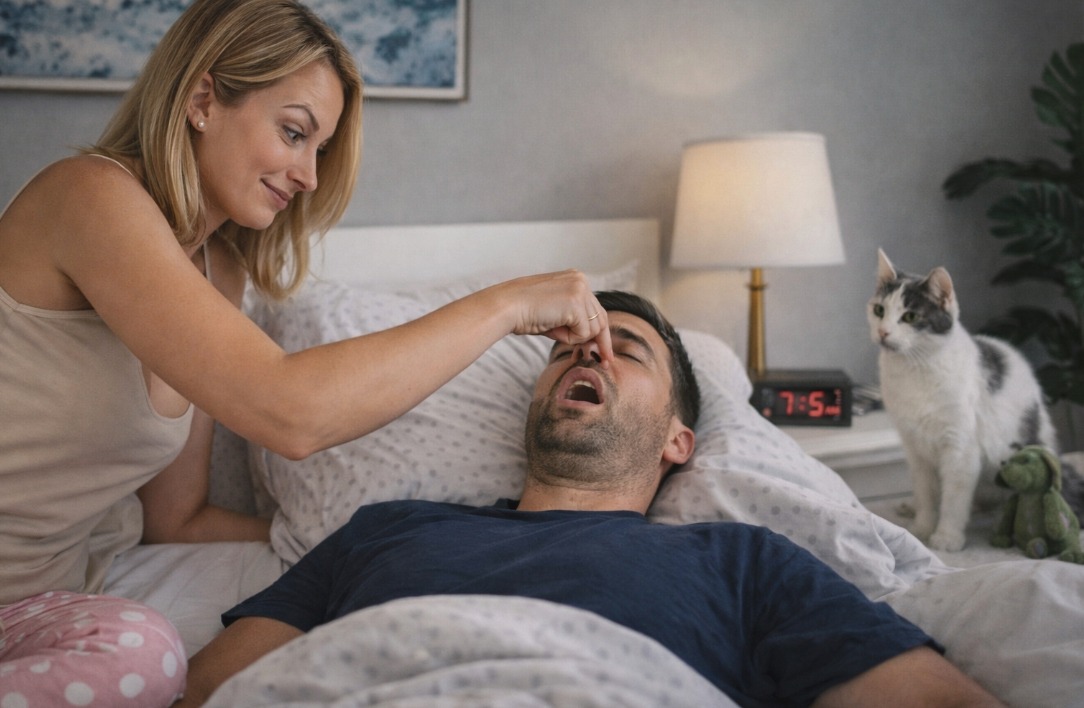
People suffocate in their sleep and don’t even know it
You’ve probably heard someone close to you snoring at night — and dismissed it as just an annoying habit. But behind seemingly harmless snoring, something serious may be hiding: 48% of Russians experience brief episodes of breathing cessation during sleep. According to research, obstructive sleep apnea syndrome has become a real epidemic, and among young people the number of cases is rapidly growing. And people don’t know about it because for a number of reasons we don’t wake up from our own snoring.
Why People Snore and Suffocate in Their Sleep
Obstructive sleep apnea syndrome is a condition in which the upper airways are periodically blocked during sleep. A person literally stops breathing for several seconds, and sometimes longer. The brain “wakes up” at that moment to resume breathing, but the body doesn’t get proper rest. And this can repeat hundreds of times per night.
The main reasons the disease has reached such a scale are the sharp rise in the number of overweight people and smoking. Obesity remains the key risk factor: fat deposits, especially around the neck and chest, narrow the trachea and make breathing difficult. According to Ministry of Health data, in 2025 about a quarter of all Russians were overweight. Doctors confirm: every third resident of Russia has already faced this problem.
But obesity is not the only cause. Among other factors are bite disorders and jaw deformities, which can also provoke apnea.
At What Age Do People Start Snoring
It was previously believed that snoring was a disease of older people. Indeed, this condition most often affects people under the age of 40–50. But over the past year, the situation has changed dramatically: the number of young patients from age 18 complaining of heart problems, including heart attacks and strokes, has doubled.
Simply put, apnea strikes the cardiovascular system, and the blow falls on people who just yesterday considered themselves perfectly healthy. The fact is that each breathing cessation is stress for the body: oxygen levels drop, blood pressure rises, and the heart works at its limit. Night after night.
But that’s not all. It’s extremely difficult to establish exact mortality statistics from apnea because death during sleep is most often registered as a regular cardiac arrest. In other words, the real scale of the problem may be far more serious than statistics show.

Breathing cessation during sleep can last from several seconds to a minute and repeat hundreds of times per night. And in the morning you won’t even remember it
Is It Dangerous If a Child Snores
A particularly alarming situation is developing with children. It turns out that symptoms of apnea in minors are often mistaken for attention deficit hyperactivity disorder. A child sleeps poorly, doesn’t get enough rest, can’t concentrate during the day, becomes hyperactive — and receives a diagnosis that has nothing to do with the real problem.
What does this lead to? A misdiagnosis and placing healthy children in remedial classes. Instead of solving the breathing problem, the child is prescribed completely unnecessary treatment. And the real cause of their behavioral issues — lack of oxygen at night — remains unaddressed.
It's pure chemistry: when the brain is deprived of oxygen every night, it cannot recover properly. This leads to problems with concentration, irritability, and academic difficulties. In fact, if a child snores — it's not cute or funny. It's a reason to see a doctor.
How to Get Rid of Snoring During Sleep
The good news is that apnea is treatable. To combat the condition, specialists recommend several strategies, and the first one is obvious: lose 10–15% of excess weight. Even such moderate weight loss can significantly widen the airways and ease nighttime breathing.
If excess weight is not the only problem, doctors suggest using special breathing support devices. Another option is nighttime nasal guards that hold the jaw in the correct position during sleep.
In severe cases, surgical intervention is used — uvuloplasty. This is an operation in which the soft palate and uvula are corrected, removing tissues that obstruct free airflow. The procedure is performed on an outpatient basis, often under local anesthesia, and takes about 30 minutes.
But there’s a catch: surgery doesn’t help everyone. If the main cause is obesity, the effect of the operation may be temporary without weight loss. It’s also very important to quit smoking.