Apple’s upcoming OLED MacBook Pro will be significantly lighter than today’s models, according to Bloomberg’s Mark Gurman. He reports that Apple achieved this by fully reworking the laptop’s internal design. For people who carry a MacBook Pro every day, this could matter more than the new touchscreen. Gurman’s report gives no exact weight figures, so the size of the reduction is still unknown. The report adds to earlier signs of an OLED MacBook, which reportedly surfaced in a beta version of macOS 27.
What you need to know
- In his October 4 Power On newsletter, Mark Gurman reported that the OLED MacBook Pro will be significantly lighter than current models. He did not give exact figures.
- According to Gurman, Apple shrank some components and rearranged them inside the chassis.
- Gurman says the laptops are being tested with macOS 27.2, now in beta, and are expected in October or November.
- The new models are expected to sit above the current MacBook Pro lineup as more expensive versions, not replace it.
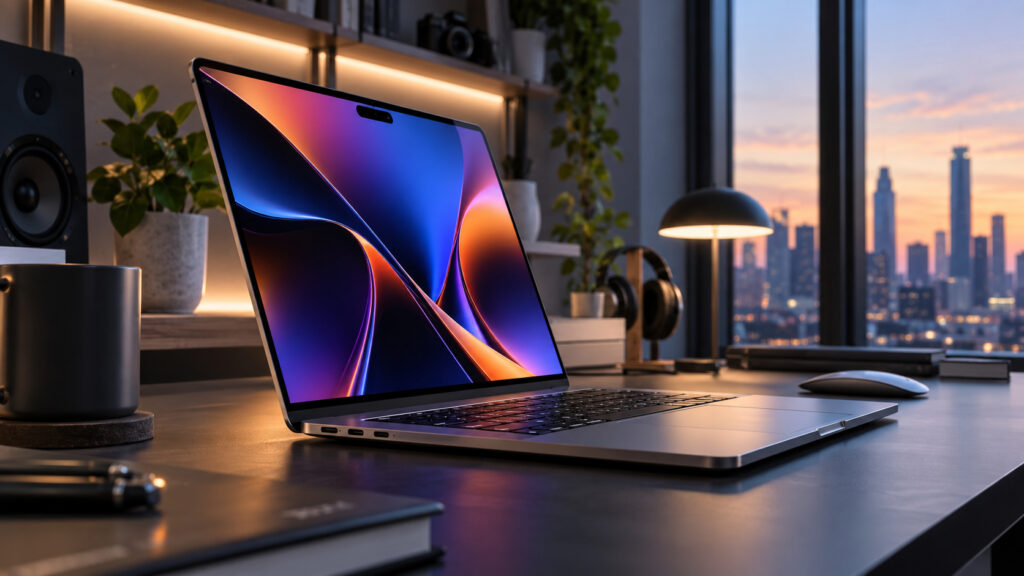
Concept of a MacBook Pro with an OLED display and Dynamic Island, side view
What Gurman reported about the new MacBook Pro
The new details appeared in Gurman’s Sunday Power On newsletter on October 4. He reports that the new MacBook Pro models with OLED displays will be significantly lighter than current ones. As the source describes it, this is a noticeable difference in weight, not a case of shaving off a couple of millimeters of thickness.
A thin MacBook Pro with an OLED display
According to Gurman, the weight loss does not come from a single change. Apple reportedly redesigned the computer’s internal layout, making some components smaller and arranging them differently inside the case. The goal is to make the laptop noticeably easier to carry.
There is an important caveat. The report contains no exact figures, so it is not yet known how many grams the new model will lose. The source author notes that Gurman’s phrase “significantly lighter” usually points to more than a cosmetic change. However, the author cautions against guessing at specific weights.
How much current MacBooks weigh
The current lineup shows how much room there is to cut weight. The source lists the following figures:
| Model | Weight |
|---|---|
| MacBook Pro | up to 2.1 kg |
| MacBook Air | up to 1.5 kg |
| MacBook Neo | 1.2 kg |
By these figures, the heaviest MacBook Pro configuration weighs up to 2.1 kg and the MacBook Neo weighs 1.2 kg. The gap between the top MacBook Pro and the larger MacBook Air is about 600 grams. The source argues that this difference is easy to feel when the laptop goes to the office, to class or on business trips, especially alongside a charger, power bank and cables. On a desk, it hardly matters.
MacBook Pro, partially open
For people who work on the move, the source suggests the weight reduction may matter even more than the OLED display.
Where Apple could save weight
Gurman points to smaller components and a new internal layout. The source author adds a personal view that the display itself could also play a significant role. Current MacBook Pro models use mini-LED screens, with thousands of backlight LEDs behind the panel. OLED panels do not need a backlight, because each pixel emits its own light. That makes the whole display stack thinner and lighter.
The source cites a precedent from Apple’s own lineup. When the iPad Pro moved from mini-LED to tandem OLED, the 13-inch model became roughly 100 grams lighter. It was also Apple’s thinnest device at the time. The MacBook Pro is rumored to use tandem OLED as well, so the source sees a similar logic at work.
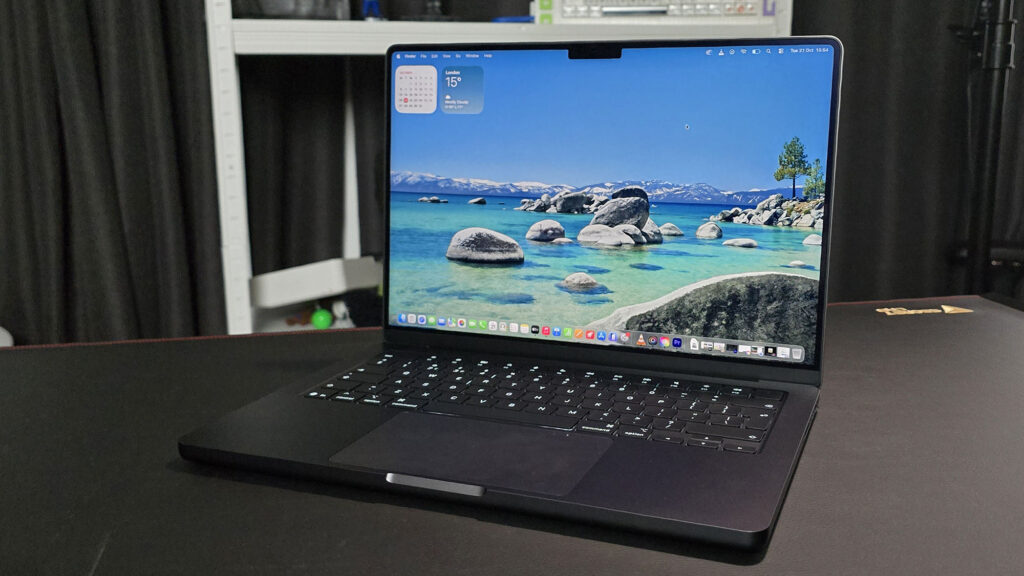
Current MacBook Pro with a mini-LED display
Changes that add weight
Not every change helps reduce weight. A touchscreen needs a reinforced hinge, or the lid would bounce with every tap. Gurman reported this earlier. The source concludes that Apple’s engineers had to find grams elsewhere and, judging by the report, managed to do so.
The open question of the battery
The battery takes up most of the space inside a MacBook Pro and provides the battery life the line is known for. The source author speculates that Apple is unlikely to shrink the battery to save weight. The author stresses that this is only a guess, because Gurman’s report says nothing about the battery.
What else is expected to change
Weight is not the only change. Taken together, the rumors point to the biggest MacBook Pro redesign in years.
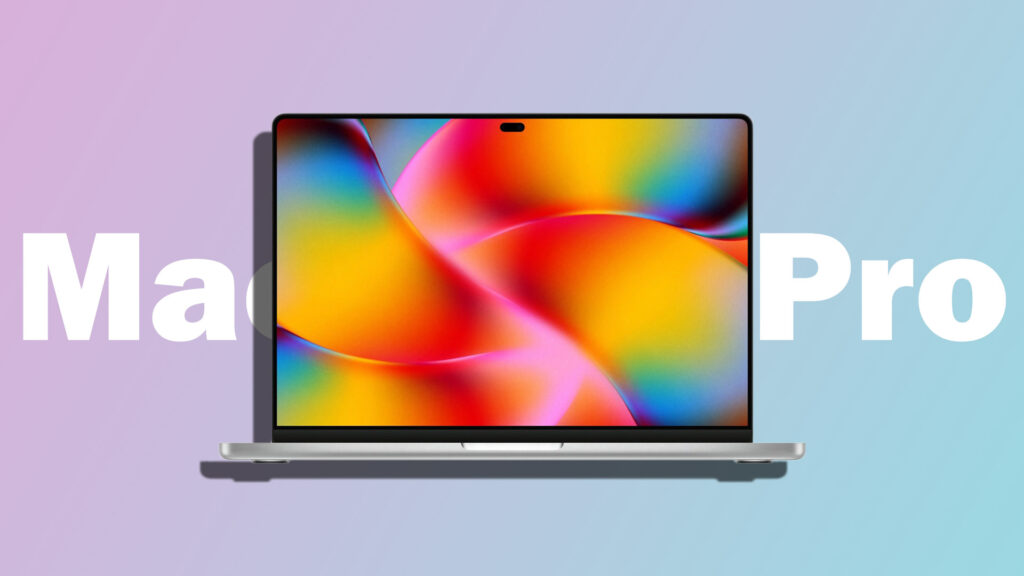
Possible design of the OLED MacBook Pro
Here is what the new model is expected to bring, according to the reports summarized by the source:
- an OLED display instead of mini-LED, as on the iPad Pro;
- touch support, a first for any MacBook;
- Dynamic Island instead of the notch at the top of the screen;
- M5 Pro and M5 Max chips;
- a thinner chassis;
- noticeably lower weight.
The touchscreen is the headline change. For years, Apple argued that reaching up to touch a laptop screen is uncomfortable, and now it appears to be adopting the idea itself. The software is also being prepared: according to Gurman, the laptops are currently being tested with macOS 27.2, which is in beta.
A puzzle over the chips
The chips are an odd detail. The current MacBook Pro already uses the M5 Pro and M5 Max, and the new model is rumored to use the same chips. 9to5Mac suggests Apple is skipping the higher-end M6 variants to move to M7 sooner. That explanation is plausible, but it has not been officially confirmed.
When it could launch and whether it is worth waiting for
According to Gurman, the OLED MacBook Pro models will be released in October or November. Because testing is happening on macOS 27.2, the source author guesses that Apple could announce them by press release rather than at a dedicated event. This is the author’s own speculation.

Touchscreen on a MacBook Pro
Pricing is a key consideration. The new models are not expected to replace the current MacBook Pro. Instead, they are expected to sit above it as more expensive versions. Prices have not been reported. The source expects the OLED panel, touchscreen and new chassis to carry a significant premium.
The source author offers the following advice:
- If you often carry your laptop and are willing to pay more for lighter weight and the new display, it may be worth waiting a couple of months.
- If you need a Mac for video editing or coding right now and weight is not an issue, the current MacBook Pro with the same M5 Pro and M5 Max chips will stay on sale and will likely be noticeably cheaper.
- If low weight matters most and you do not need MacBook Pro performance, the MacBook Air or MacBook Neo may be a better fit.
For now, the exact weight is still unknown until Apple announces official figures. In the source author’s view, if the new MacBook Pro really comes close to the MacBook Air in weight, it would be the first MacBook Pro people would not want to leave at home.